



General Secretary To Lam emphasizes Hanoi's role as a central development hub
WVR - According to General Secretary To Lam, Hanoi must not develop with the mindset of a large locality but should be positioned and operated as a national development hub, playing a leading role.
Latest
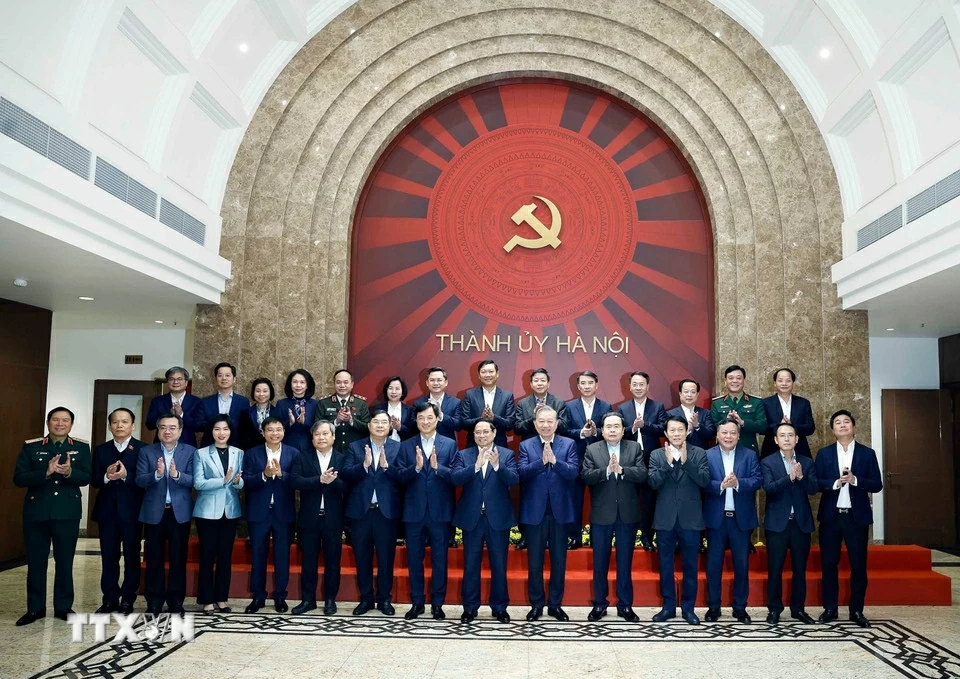 |
| General Secretary To Lam, Prime Minister Pham Minh Chinh, National Assembly Chairman Tran Thanh Man, and other delegates. (Source: VNA) |
On the morning of January 10, in Hanoi, General Secretary To Lam met with the Standing Committee of the Hanoi Party Committee to propose the development of a 100-year Capital Planning associated with institutional completion to meet development requirements; projecting socio-economic development models and achieving double-digit growth targets.
Attending the meeting were Politburo members: Phạm Minh Chính, Prime Minister; Tran Thanh Man, National Assembly Chairman; General Luong Tam Quang, Minister of Public Security; Nguyen Duy Ngoc, Secretary of the Hanoi Party Committee; Central Committee members, leaders of central committees, ministries, and agencies, and representatives of the Standing Committee of centrally-run cities.
Creating a foundation for Hanoi's double-digit growth
According to the report at the meeting, the comprehensive Capital Planning will expand interactive space with the Red River Delta, Northern midland and mountainous areas, and the Hanoi metropolitan area. Besides regional content, the planning focuses on addressing the city's bottlenecks related to transportation infrastructure, urban infrastructure, urban management, and the environment.
To combat flooding, Hanoi plans to build underground structures and synchronized underground transportation systems with ring roads, radial and cross-city routes, combined with underground water collection systems, underground reservoirs to prevent flooding, and pumping stations.
To solve traffic congestion, the city will add inter-regional road and rail connections with surrounding provinces; plan to enhance inter-regional transportation systems linking new and old urban areas; plan to add large bridges over the Red River to expand urban development space... The ring road systems 1, 2, 5, 4... and radial axes are being urgently constructed in a synchronized manner.
Regarding environmental pollution, the city will review solid waste treatment planning; propose increasing or decreasing locations, scale, and technology requirements for treatment; study waste and wastewater treatment chain planning; classify waste; add locations and scale for wastewater treatment areas in sync with urban development planning under a new structure.
The city will restructure urban areas to create a revolution in urban architectural landscapes, housing, heritage, and conservation (shifting from "preservation-renovation" thinking to "value reconstruction" thinking); create a new planning structure, release land resources, and create new value; simultaneously address root infrastructure bottlenecks, aiming for a developed, green, smart, and sustainable city.
Alongside addressing bottlenecks, the city focuses on cultural development planning; planning both sides of the Red River into the largest public cultural-artistic space in the capital, symbolizing a new era's rise.
Planning education and training-university urban areas; thoroughly solving the overload of inner-city schools; relocating major training institutions to the periphery to form world-class university urban areas.
Planning healthcare and health care, making Hanoi a leading high-tech medical center in the region; reducing overload at central hospitals; developing wellness tourism. Planning science and technology; Hòa Lạc Hi-Tech Park as a national innovation nucleus; expanding planning to attract technology corporations...
Regarding the socio-economic development model and double-digit growth, the city identifies synchronized deployment across three pillars: economy, environment, society. For the 2026-2030 period, the city identifies the economic growth model and growth drivers as science and technology, innovation, and the digital economy as the main drivers.
Technological innovation creates new productivity for the economy through four pillars: institutions, digital infrastructure and smart platforms; effective governance and digital government; digital economy and new growth drivers; digital society and social welfare.
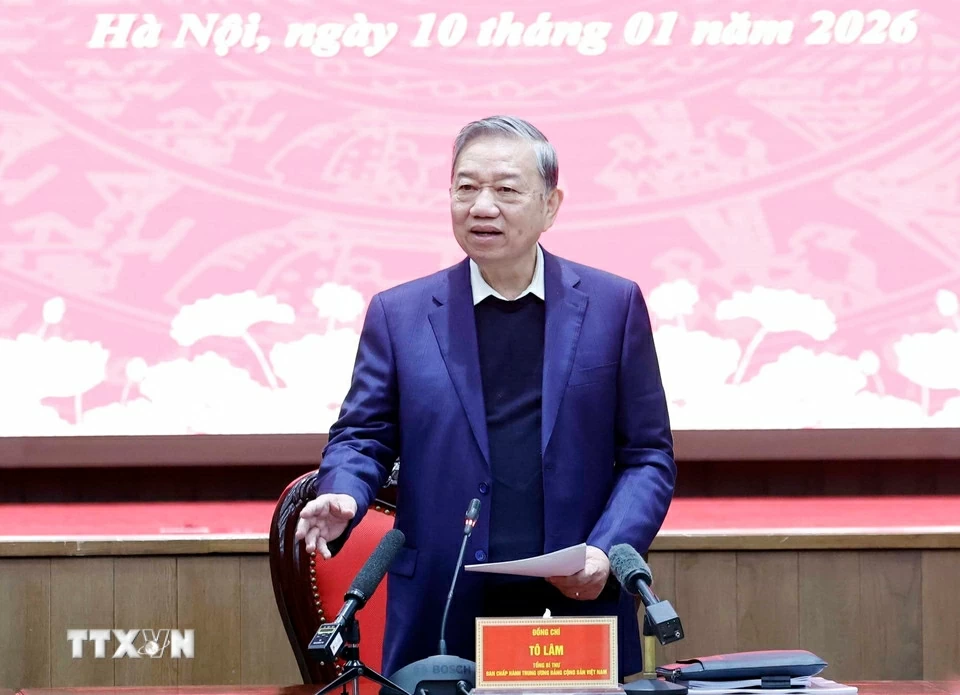 |
| General Secretary To Lam speaking at the meeting with the Standing Committee of the Hanoi Party Committee. (Source: VNA) |
Development is based on a synchronized connection between culture-economic space-people; exploiting and effectively promoting cultural, heritage, and landscape values... Tourism affirms its role as a key economic sector, especially cultural tourism.
Improving the investment and business environment, attracting investment; using public investment to lead and activate private and FDI investment; developing the private economy, enhancing state economic efficiency, and promoting production and business.
The city identifies creating new growth drivers from the two-tier local government; each commune and ward develops an economic development plan to leverage local potential and comparative advantages, participating in supply chains, linking production and business development.
After hearing opinions from government, National Assembly leaders, central committee, ministry, and agency leaders, and Hanoi leaders, General Secretary To Lam concluded the meeting by praising the comprehensive development results Hanoi achieved in 2025.
The Hanoi Party Committee focuses on directly addressing pressing, prolonged issues of the capital such as traffic congestion, environmental pollution, flooding, urban order, and food safety; treating them as tasks requiring measurable, accountable changes monthly and quarterly, linked to specific responsibilities of each sector and level.
Particularly, the rapid and urgent progress in land clearance and implementation of urban infrastructure projects that have been stalled for many years. These changes indicate that Hanoi is forming a leadership and management method based on discipline and real effectiveness.
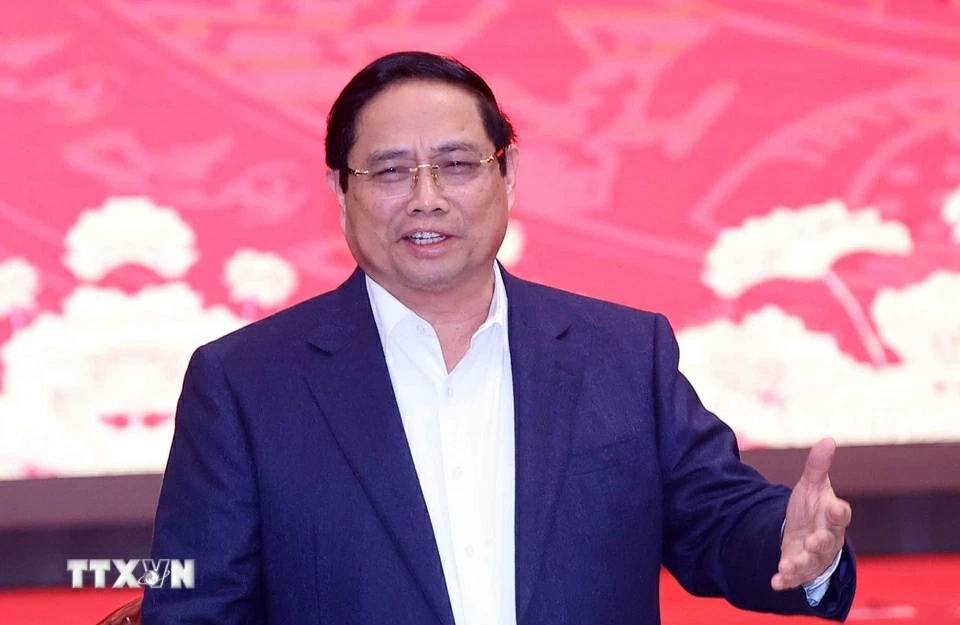 |
| Prime Minister Pham Minh Chinh speaking. (Source: VNA) |
The General Secretary pointed out that the capital still has untapped potential; issues of transportation, environment, resource efficiency, and governance quality are direct tests of urban management and execution capabilities.
Therefore, the changes that have shown progress need to be further promoted, elevated, and transformed into specific, verifiable results, meeting the capital's development requirements in the new phase and contributing positively to the implementation of Resolution of the 14th National Party Congress.
Hanoi must be positioned within the National Development Strategy
At the meeting, General Secretary To Lam emphasized that we are at a historical development turning point. In this context, Hanoi's role is particularly important.
Therefore, Hanoi cannot develop with the mindset of a large locality but must be positioned and operated as a national development hub, playing a leading role in shaping new development models and thinking.
Every issue Hanoi successfully and effectively addresses, from urban management, development space organization, congestion, pollution, flooding to public investment discipline, administrative reform, and digital transformation, will significantly impact the thinking and actions of other localities and the entire nation. If Hanoi is slow, the whole country will be slow.
Emphasizing that the 100-year Capital Planning must be a work of intelligence, responsibility, and development aspiration; today's planning will determine Hanoi in 50 years, 100 years, the General Secretary basically agreed with the major orientations in the comprehensive 100-year Capital Planning, including new proposal ideas, shifting from "5 urban regions, 5 spatial axes, 5 urban areas, satellite cities" to a "Multi-core-multi-center, Multi-layer-multi-tier" model.
The General Secretary proposed adhering to seven requirements: Capital Planning must position Hanoi within the national development strategy; Capital Planning must put people at the center, with quality of life as the highest measure; Hanoi's development must harmonize modernity and tradition, expansion and preservation; Capital Planning must be ahead, with a long-term vision, open development space, planning not just for today but with enough room for future generations; Hanoi must be planned as a national center of creativity, knowledge, and innovation; ensuring national defense, security, and social safety is a consistent requirement in Capital Planning; planning must be organized scientifically, democratically, openly, transparently, listening to the opinions of scientists, intellectuals, experts at home and abroad, and the people, while being consistent and not allowing planning to be distorted by local interests, group interests, or term thinking.
Regarding the Capital's development institution, the General Secretary praised Hanoi's proactiveness in summarizing, evaluating, and proposing a new Politburo Resolution on building and developing Hanoi, replacing Resolution No. 15-NQ/TW dated May 5, 2022, of the Politburo on the development direction and tasks of the Capital until 2030, with a vision to 2045, to complete the political foundation for the city; praised the proposed amendments to the Capital Law with four major content groups and 31 policy mechanisms.
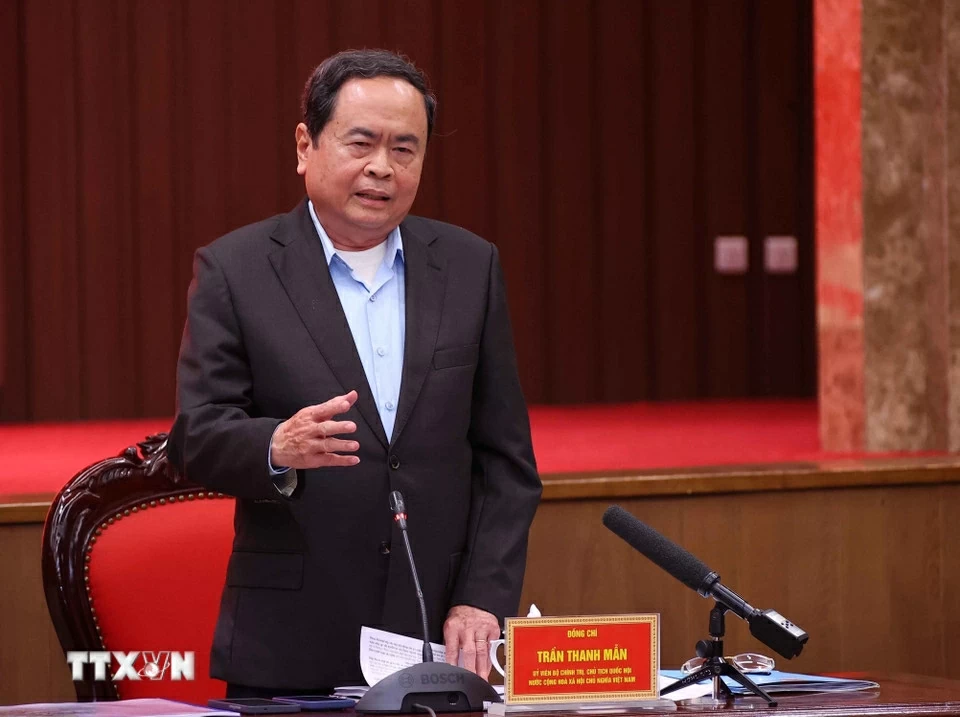 |
| National Assembly Chairman Tran Thanh Man speaking. (Source: VNA) |
The General Secretary demanded that building and completing the Capital's development institution is a crucial breakthrough, decisive for the long-term quality and speed of the Capital's development.
Without appropriate institutions, there can be no good planning; without superior institutions, there can be no superior development space.
This amendment to the Capital Law must be approached with innovative thinking, a long-term vision, creating a superior legal basis strong enough for Hanoi to maximize its potential, unique advantages, boldly piloting new models and methods, while ensuring discipline, transparency, and serving the common interest.
The overarching spirit is "Empower more - more comprehensive decentralization and delegation - clearer accountability," in line with the requirement "Hanoi decides - Hanoi acts - Hanoi takes responsibility".
Amending the Capital Law is not just Hanoi's matter, but the common responsibility of the National Assembly, Government, and central ministries and agencies in removing legal barriers, ensuring the unity and consistency of the legal system.
Central agencies must accompany, share, and create conditions for Hanoi to have enough legal space, tools, and necessary authority, thereby promoting the Capital's role as a leading, spreading development center of the Capital region and the whole country.
The Hanoi Party Committee and central agencies must closely coordinate to complete these important documents; submit to the Politburo to issue a new Resolution on Capital development; submit three contents to the National Assembly: a new Resolution 15, the amended Capital Law, and the comprehensive Capital Planning.
Regarding establishing a new growth model and double-digit growth targets, the General Secretary suggested that Hanoi needs to unlock new drivers, determined to maintain continuous double-digit growth, with an immediate goal of achieving at least 11% growth in 2026.
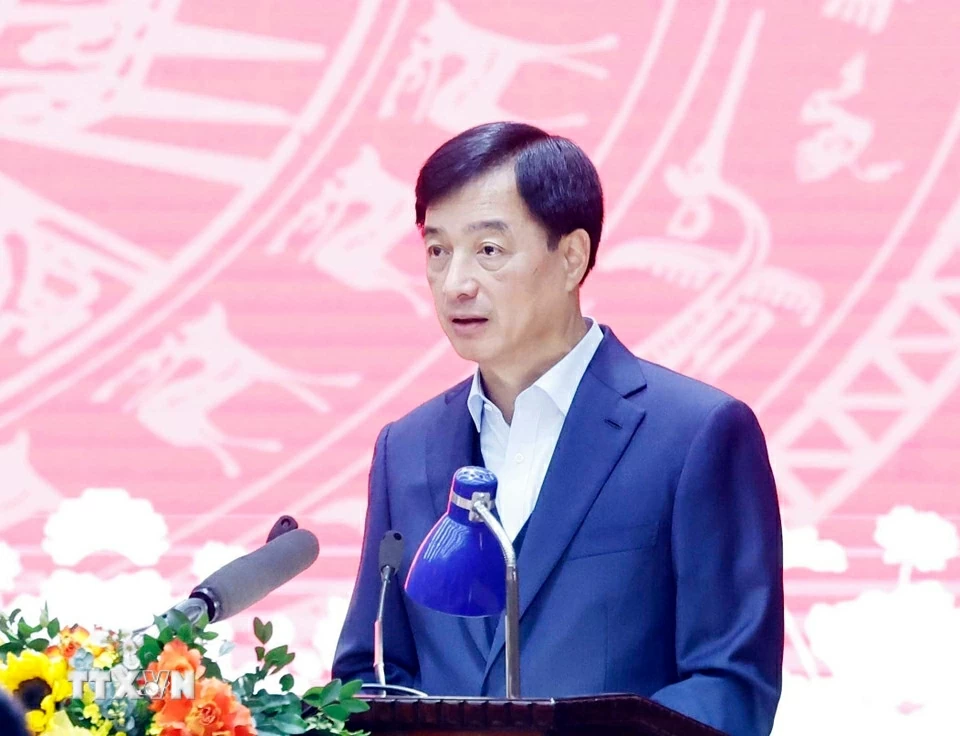 |
| Hanoi Party Secretary Nguyen Duy Ngoc speaking. (Source: VNA) |
To achieve this goal, the core lies not in expanding scale at any cost, but in establishing a new growth model, primarily based on increasing labor productivity through knowledge, science-technology, innovation, digital transformation, and quality human resources.
The Capital's new growth model must be closely linked with institutional reform, significantly improving the investment and business environment, attracting and utilizing talent, forming growth poles, creative spaces, and innovation ecosystems, thereby creating sustainable development momentum, capable of leading the Capital region and making a worthy contribution to the country's growth.
Supporting Hanoi's solutions to promote decentralization and address five bottlenecks (flooding, traffic congestion, urban order, environmental pollution, food safety), the General Secretary emphasized the need to study granting maximum authority to Hanoi to self-resolve, instead of waiting for multi-layered approvals; addressing seven groups of bottlenecks in science, technology, innovation, and difficulties to resolve the five bottlenecks.
Hanoi must act immediately, quickly, correctly, effectively, and thoroughly, with the spirit "Once said, it must be done; once done, it must be completed; once done, it must be effective".
With a thousand-year tradition of culture, a determined and brave cadre team, and the people's unity, the General Secretary believes that the Party, government, and people of the Capital will overcome all challenges, achieving greater achievements, worthy of the position "Heroic Capital", "City for Peace", "Creative City".
(Source: WVR/VNA)