




ASEAN Future Forum 2026: Solving the energy puzzle with 21st-century thinking
WVR - ASEAN faces numerous energy-related challenges; however, in line with global trends, ASEAN is promoting energy transition towards green and clean solutions, collaborating to address any fluctuations in energy security.
Latest
 |
| On June 10, the thematic discussion session "Energy Security in a New Context" was held within the framework of the ASEAN Future Forum. (Photo: Thanh Long) |
Energy security in a new context is a "puzzle" that concerns everyone today, and it has become an engaging topic for lively discussion at the ASEAN Future Forum 2026.
On June 10, during the thematic discussion session "Energy Security in a New Context", speakers including UK Parliamentary Under-Secretary of State in the Foreign, Commonwealth and Development Office Seema Malhotra, Deputy Minister of Industry and Trade Nguyen Hoang Long, GIZ Energy Support Program Director Christiana Hageneder, Dr. Venkatachalam Anbumozhi, Senior Research Fellow at the Economic Research Institute for ASEAN and East Asia (ERIA), and Dr. Nguyen Anh Tuan, Vice President of the Vietnam Energy Association, analyzed this complex issue and contributed ideas for ASEAN's approach. The session was moderated by Frederick Kliem, Director of Southeast Asia and The Economist.
Foundation for long-term growth
In her opening remarks, Seema Malhotra, UK Parliamentary Under-Secretary of State, stressed that recent geopolitical fluctuations have brought energy security back to the forefront of the global agenda.
According to her, risks to maritime operations through the Strait of Hormuz have directly impacted oil and gas prices and the energy supply chain, placing significant cost pressures on power generation and transportation in many Southeast Asian countries.
In this context, the UK Minister emphasized that ensuring freedom of navigation, maintaining a rules-based international order, and enhancing international cooperation are crucial conditions for safeguarding economic stability and regional energy security.
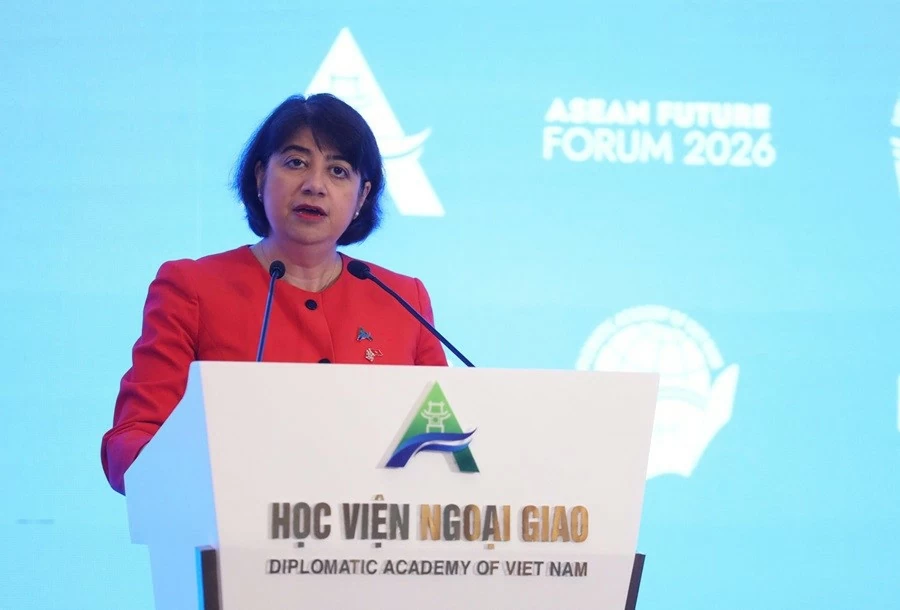 |
| Seema Malhotra, UK Parliamentary Under-Secretary of State in the Foreign, Commonwealth and Development Office, delivering the opening remarks at the discussion session. (Photo: Thanh Long) |
Drawing from recent crisis lessons, Under-Secretary of State Seema Malhotra suggested that ASEAN and its partners should accelerate the transition to cleaner and more resilient energy systems against external shocks.
She stated that the UK is ready to share its experience in market risk management, supply diversification, and renewable energy development while continuing to promote cooperative initiatives such as the Just Energy Transition Partnership (JETP) in Vietnam and Indonesia, as well as supporting the realization of the ASEAN Power Grid.
According to the British diplomat, a connected, sustainable energy system that ensures benefits for all citizens will be the foundation for long-term growth and the region's future resilience.
Following the UK Minister's remarks, Deputy Minister of Industry and Trade Nguyen Hoang Long suggested that the concept of energy security today needs to be viewed more comprehensively in the rapidly changing international environment. According to Deputy Minister Nguyen Hoang Long, geopolitical tensions, regional conflicts, disruptions of key maritime routes, the impact of climate change, and the global energy transition are creating unprecedented pressures on national and regional energy systems.
For ASEAN, one of the world's most dynamic growth centers, ensuring a stable, reliable, and affordable energy supply is not only related to economic growth but also directly affects production, supply chains, food security, the operations of small and medium-sized enterprises, and the lives of citizens.
 |
| Deputy Minister of Industry and Trade Nguyen Hoang Long speaking at the discussion session. (Photo: Thanh Long) |
From a regional cooperation perspective, Deputy Minister Nguyen Hoang Long emphasized that ASEAN needs to maintain a balance between three key objectives: ensuring energy security, promoting energy transition, and maintaining affordability for citizens and businesses.
The Deputy Minister suggested that the region should continue to effectively utilize existing cooperation mechanisms such as the ASEAN Plan of Action for Energy Cooperation (APAEC), the ASEAN Petroleum Security Agreement (APSA), while accelerating infrastructure connectivity through the ASEAN Power Grid, expanding cross-border electricity trade, and enhancing linkages within the ASEAN Gas Pipeline framework.
According to the Deputy Minister of Industry and Trade, ASEAN should also focus on five priority directions, including enhancing the resilience of the energy supply chain, diversifying supply sources and transportation routes, promoting a just energy transition, increasing energy efficiency, and mobilizing stronger financial, technological, and knowledge resources from international partners for the region's green transition.
 |
| Christiana Hageneder, Director of the GIZ Energy Support Program, providing an in-depth analysis of energy security characteristics in the 21st century. (Photo: Thanh Long) |
Crises bring more than just risks
Christiana Hageneder, Director of the GIZ Energy Support Program, stated that when discussing energy, we are referring to oil, coal, gas, and liquefied natural gas. "If we look at how these energy sources are distributed globally, we will see that this is also the root cause of many subsequent price crises," she noted.
According to her, throughout the 21st century, the economic growth of many countries has largely relied on energy imports and interdependence in the global supply chain. Numerous energy shocks over the past decades, from oil price crises, the Chernobyl and Fukushima nuclear disasters, to the gas crisis in Europe or recent instability in the Strait of Hormuz, have highlighted the vulnerability of this development model.
Using Germany's experience as an example, Hageneder added that energy crises have become a driving force for major green transition decisions, including the roadmap to end nuclear power by 2023 and gradually phase out coal between 2030 and 2038. Thus, each crisis presents an opportunity to accelerate the transition to a more sustainable energy system.
Assessing ASEAN's prospects, she noted that the region is following a similar path with priorities such as energy market integration, power system connectivity, and promoting electrification in sectors from industry and transportation to civilian life. This is seen as the foundation for countries to more effectively harness domestic renewable energy sources.
She also emphasized that economic growth does not necessarily have to come with increasing energy consumption. Thanks to technological advancements and improved energy efficiency, countries can reduce energy intensity while maintaining economic growth.
According to the Director of the GIZ Energy Support Program, ASEAN has significant potential for renewable energy, particularly wind and solar power. To realize this potential, investing in grid infrastructure, energy storage systems, and smart grid solutions will play a crucial role.
GIZ is currently supporting the Vietnamese Government in developing smart grid systems to facilitate the integration of renewable energy and electricity storage. Additionally, the energy transition process must be linked with social transformation, as it will be a driving force for creating new jobs and opening up sustainable development opportunities for citizens in the future.
Continuing, Dr. Venkatachalam Anbumozhi, Senior Research Fellow at the Economic Research Institute for ASEAN and East Asia (ERIA), stated that ASEAN's energy demand will continue to rise alongside the region's rapid economic growth. With an economy size of approximately $3.7 trillion and a primary energy demand of up to 550 million tons, ASEAN still significantly depends on fossil fuel sources to maintain its development momentum, while facing increasing carbon emissions.
According to him, ASEAN's current challenge is not only to decouple economic growth from energy consumption but also to ensure that the energy transition occurs inclusively. Although the region has over 600 million people, a large portion of the population still lacks full access to clean energy. Therefore, energy policies need to simultaneously address both growth and social equity goals.
Anbumozhi emphasized that energy security is becoming one of ASEAN's strategic issues as the region increasingly relies on imported energy sources, particularly coal, gas, LPG, and LNG. The strategic oil reserve capacity of many ASEAN countries remains limited compared to international standards. As ASEAN gradually becomes a net importer of gas and LNG, strengthening mechanisms to ensure energy supply should be given higher priority.
In the long term, Anbumozhi proposed that ASEAN should focus on three important pillars: enhancing strategic oil reserves, accelerating the deployment of the ASEAN Power Grid (APG), and developing the ASEAN Gas Pipeline System. Additionally, ASEAN should maximize domestic energy sources, promote supply chain digitization, and adopt a people-centered approach in energy policy planning.
 |
| Dr. Nguyen Anh Tuan, Vice President of the Vietnam Energy Association, emphasized that Vietnam does not choose a sudden transition but follows a roadmap. (Photo: Thanh Long) |
Finally, Dr. Nguyen Anh Tuan, Vice President of the Vietnam Energy Association, noted that Vietnam is facing the challenge of balancing the goals of rapid economic growth, green transition, and ensuring national energy security in a volatile world.
According to him, although renewable energy has made significant progress, Vietnam's energy structure still heavily relies on coal and oil, while dependence on imported energy is increasing. In 2024 alone, Vietnam imported nearly 26 million tons of oil equivalent, making the economy vulnerable to shocks from global markets and supply chains.
To mitigate this risk, Vietnam is implementing Power Development Plan VIII (PDP8), requiring an investment of approximately $136 billion by 2030, focusing on reducing coal power, developing offshore wind power, renewable energy, and energy storage systems. However, the transition process also poses significant financial pressures and the need to ensure a stable energy supply for the economy.
According to Dr. Nguyen Anh Tuan, Vietnam does not choose a sudden transition but follows a roadmap based on three pillars: optimizing domestic resources, ensuring the physical security of the energy system, and maintaining a stable power supply. This reflects a shift from the "sufficient electricity" mindset to a "comprehensive energy security" model, balancing economic, environmental, and national security goals simultaneously.
He affirmed that Vietnam is committed to pursuing this balance, but achieving energy security will require substantial capital, long-term perseverance, and especially international cooperation, "as this is not a task Vietnam can accomplish alone".