



ASEAN Future Forum 2026: Dialogue for peacebuilding and resilience
Acting ASEAN SOM Leader of New Zealand, Alana Hudson, believes that the strength of ASEAN's future, as well as our shared future, will depend on continuing to place people at the center of all cooperative efforts.
Latest
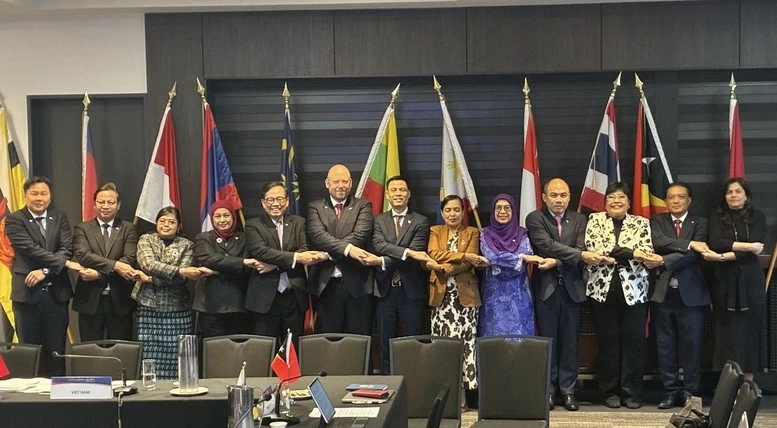 |
| The 33rd ASEAN-New Zealand Dialogue took place from May 14-15 in Christchurch, New Zealand, with the participation of Deputy Foreign Ministers, Senior Officials from ASEAN countries, and New Zealand. (Source: VGP) |
What are your expectations for this year’s ASEAN Future Forum (AFF) in fostering a regional platform for dialogue to promote peace and stability amid the current volatile international landscape?
New Zealand warmly welcomes the opportunity to participate in the 2026 AFF. Its theme – Shaping our future together: peace, prosperity, people-centred – has never been more relevant.
We are living in a world of intensifying great-power competition and strategic rivalry, where multilateral norms and the rules-based system are under strain. Concurrently, climate change impacts and rapid technological transformations are reshaping economies and societies. In this dynamic environment, the resilience we derive through ASEAN is vital to helping us navigate shared challenges and seize new opportunities.
The ASEAN Future Forum brings together governments, business leaders, experts, and communities, providing a valuable space for constructive engagement and the open exchange of ideas. I welcome the scope and ambition of this year’s Forum. I look forward to discussions that not only deepen our collective understanding of these complex challenges but also generate practical, inclusive, and forward-looking solutions.
For New Zealand, our priorities include strengthening resilient and diversified supply chains, addressing energy security, advancing climate adaptation and mitigation, and harnessing emerging technologies responsibly to deliver prosperity and peace. At a global level, we look to continue our mutual support for international law and the rules-based system. At a regional level, we are particularly interested in discussions on the Mekong Subregion - especially on climate and economic resilience, smart agriculture, and renewable energy - where cooperation can deliver tangible benefits for communities. To that end, we look forward to co-hosting the ASEAN-New Zealand Forum on Sub-regional Cooperation, where our longstanding partners from the Mekong Institute and New Zealand’s Bioeconomy Science Institute will share their expertise.
As we address today’s challenges, the AFF 2026 provides a platform that calls for focus on the legacy we leave for future generations - a legacy where peace and prosperity endure.
How would you assess ASEAN’s central role and ASEAN-led mechanisms in fostering peace and regional stability?
 |
| Acting ASEAN SOM of New Zealand Alana Hudson. (New Zealand Diplomatic Mission to ASEAN) |
New Zealand regards ASEAN and its broader architecture as indispensable to securing peace and stability in the Indo-Pacific. Over decades, the value of ASEAN Centrality has been demonstrated time and again. ASEAN provides a neutral, trusted, and respected platform where countries—both large and small—can engage on equal footing, fostering habits of dialogue and de-escalation even during periods of heightened strategic tension.
New Zealand particularly values ASEAN’s unique convening power. Through mechanisms such as the East Asia Summit (EAS) and ASEAN Regional Forum (ARF), ASEAN successfully brings together actors from inside and outside the region. Its inclusive, consensus-based approach to problem-solving remains a cornerstone of peace and security in a highly diverse region.
As an ASEAN Dialogue Partner since 1975, New Zealand’s ties to the region are deep and enduring. We acceded to the Treaty of Amity and Cooperation in Southeast Asia on 28 July 2005, and we continue to participate fully across a range of ASEAN security architecture, recognising the close linkages between ASEAN’s stability and New Zealand’s own peace and security.
New Zealand is profoundly grateful to Viet Nam for its leadership as our ASEAN Country Coordinator for the 2024-2027 term. Viet Nam’s tireless efforts and steadfast support were instrumental in guiding the successful negotiations that led to the elevation of New Zealand’s relationship with ASEAN to a Comprehensive Strategic Partnership (CSP) at the 50th Anniversary Commemorative Summit in October 2025.
The ASEAN-New Zealand Comprehensive Strategic Partnership and accompanying Plan of Action provide a framework for high-level dialogue and practical cooperation that supports our shared pillars of peace, planet, prosperity, and people. It guides New Zealand’s investments across the ASEAN region to promote peace and stability.
Under the “peace” pillar of the Plan of Action, we focus on the shared priorities of good governance and leadership, social cohesion, preventing violent extremism, and mine-action, through a range of bilateral, sub-regional, and regional initiatives. One tangible example of this is our support for the AMPLIFY initiative (NZ$16.5m over 5 years), empowering women across ASEAN to lead in peace and security, addressing the unequal impacts of conflict, strengthening communities and regional resilience, and helping to deliver on the ASEAN Regional Plan of Action on Women, Peace and Security.
What are your comments on ASEAN-New Zealand cooperation in promoting regional peace and stability, multilateralism, and a rules-based order grounded in international law, including the United Nations Charter and the 1982 UNCLOS?
ASEAN–New Zealand cooperation is firmly anchored in a shared commitment to multilateralism and the rules-based international order. This includes core frameworks such as the United Nations Charter, the World Trade Organization (WTO), and the 1982 United Nations Convention on the Law of the Sea (UNCLOS). We highly value opportunities to work alongside our ASEAN partners in the multilateral sphere to sustain and enhance these foundational systems.
For New Zealand and ASEAN countries, UNCLOS is fundamental. It establishes the legal framework for all activities in the oceans, including freedom of navigation and overflight, and provides for the peaceful resolution of disputes. As maritime trading nations, we share a reliance on open and secure sea lines of communication. Freedom of navigation is essential to the movement of goods, energy, and services, and to the integrity of regional and global supply chains.
We also continue to cooperate through ASEAN’s regional agencies. A recent, excellent example of this is New Zealand’s support of the upcoming AICHR-Viet Nam’s workshop on Human Rights at Sea, which aims to promote and protect the rights of seafarers and fishing crews.
We recognise the important contribution of Viet Nam to ASEAN architecture and appreciate its constructive approach to complex regional dynamics. By consistently championing open dialogue, Viet Nam and ASEAN play an invaluable role in bolstering the region amid geopolitical volatility.
Could you share your expectations for future cooperation between the two sides in economic fields like digital and green economy, energy, as well as Viet Nam’s contributions to this process?
Our economic cooperation with ASEAN members is driven significantly through the ASEAN-Australia-New Zealand Free Trade Area (AANZFTA) and the Regional Comprehensive Economic Partnership (RCEP). We welcomed the recent upgrade of AANZFTA and look forward to its full ratification. These agreements support open, transparent, and predictable trade while fostering deeper economic integration and more resilient supply chains. New Zealand will continue to work with Viet Nam and other regional partners to ensure these trade agreements remain fit for purpose and reflective of our modern, evolving economies.
ASEAN–New Zealand development cooperation is driving prosperity and economic transformation. As technology advances, we are combining innovation with existing expertise to build greener, innovative, and resilient economies. A cornerstone of this effort is our deep bilateral cooperation with Viet Nam on Climate Smart Agriculture, supported by New Zealand technical expertise, including from our Ministry of Primary Industries.
We are also working alongside the Mekong Institute, Mekong River Commission, the Global Research Alliance, the ASEAN Mega Deltas Initiative, and the EmPower programme to enhance agricultural productivity and drive greener investments across the Mekong sub-region. We are supporting ASEAN countries to develop agricultural greenhouse gas emissions inventories that meet international standards, enabling them to measure and manage agricultural emissions and meet their international climate obligations.
ASEAN scholars studying at New Zealand’s highly regarded tertiary institutions are building the next generation of experts and innovators. We are also exploring how artificial intelligence and other digital applications can expand these productivity gains safely and equitably.
Energy transition is another defining challenge sitting at the intersection of economic growth, sustainability, and climate resilience. As ASEAN’s energy demand rises, New Zealand is supporting efforts through our NZ$43.5m contribution to the ADB’s Energy Transition Mechanism in Viet Nam, Indonesia, and the Philippines, to accelerate coal phase-out and clean energy adoption. With over 85% renewable electricity at home, we see strong opportunities to support the region’s energy transition.
Ultimately, the strength of ASEAN’s future - and our shared future - will depend on keeping people at the centre of our efforts. By working together, grounded in peace and driven by sustainable prosperity, we can build a more resilient, inclusive, and secure Indo-Pacific for generations to come.