




2026 Military Service: Nearsightedness of 1.5 Diopters Still Eligible
WVR - This is the content of Circular 68/2025/TT-BQP, issued on July 3, 2025, by the Ministry of National Defense, amending and supplementing several provisions of Circular 148/2018/TT-BQP on the selection and conscription of citizens into military service.
Latest
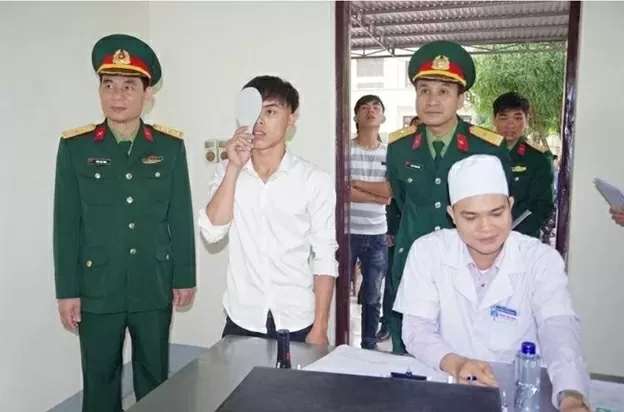 |
| 2026 Military Service: Nearsightedness of 1.5 Diopters Still Eligible. (Photo: WVR) |
Accordingly, Point (c), Clause 3, Article 4 of Circular 148/2018/TT-BQP on health standards for military recruitment is amended as follows:
(c) Citizens with refractive errors — nearsightedness greater than 1.5 diopters, any degree of farsightedness; or a BMI less than 18.0 or greater than 29.9 — will not be conscripted into the military.
Previously, Point (c), Clause 3, Article 4 of Circular 148/2018/TT-BQP stated:
(c) Citizens classified as Health Category 3 due to refractive eye defects (nearsightedness of 1.5 diopters or more, any degree of farsightedness); drug addiction; or HIV/AIDS will not be conscripted into the military.
Thus, under the old regulation, individuals with 1.5 diopters of nearsightedness were temporarily exempted from military service. However, under the new regulation, individuals with exactly 1.5 diopters must still serve; only those with more than 1.5 diopters will be temporarily exempt.
Cases of Temporary Postponement of Military Service in 2026
Specifically, Clause 1, Article 41 of the 2015 Law on Military Service, supplemented by Point (c), Clause 1, Article 49 of the 2019 Law on the Militia and Self-Defense Forces, stipulates the cases eligible for temporary postponement of conscription:
- Those deemed unfit for service according to the Health Examination Council’s conclusion;
- Sole breadwinners directly responsible for supporting dependents who are incapable of working or under working age; households suffering severe human or property losses due to accidents, natural disasters, or dangerous epidemics, certified by the commune-level People’s Committee;
- Children of war invalids or Agent Orange victims with labor capacity reduction of 61% to 80%;
- Individuals with siblings (brothers or sisters) currently serving as non-commissioned officers or soldiers in the armed forces;
- Individuals subject to resettlement or population redistribution within the first three years of relocation to especially difficult communes under state socio-economic development projects approved by provincial-level authorities or higher;
- Officials, public employees, or youth volunteers assigned to work in areas with extremely difficult socio-economic conditions as prescribed by law;
- Students currently enrolled in general education institutions; students undergoing full-time training at universities or colleges for the duration of one degree program;
- Standing militia members.
Additionally, Clause 2, Article 41 of the 2015 Law on Military Service provides exemptions from conscription for the following individuals:
- Children of martyrs and Class 1 war invalids;
- One brother or one sister of a martyr;
- Children of Class 2 war invalids; children of war invalids with labor capacity reduction of 81% or more; children of Agent Orange victims with labor capacity reduction of 81% or more;
- Individuals working in cryptography (cipher) not belonging to the military or police forces;
- Officials, public employees, or youth volunteers assigned to work in areas with extremely difficult socio-economic conditions for 24 months or more.
Note: Citizens eligible for temporary postponement of conscription, once the reasons for postponement are no longer valid, may still be conscripted.
Citizens eligible for postponement or exemption may voluntarily apply to serve and will be considered for recruitment and enlistment.
Translated by Ngoc Tram