






Zhou Xun Honoured at Busan: Stories that define the allure of Asian cinema
The Best Actor Award at the 31st Busan International Film Festival brings Zhou Xun back into the spotlight of Asian cinema.
Latest
 |
| Actress Zhou Xun. (Source: Weibo) |
For Vietnamese audiences, the actress has become familiar through works such as Legend of the Condor Heroes, Painted Skin, and Ruyi's Royal Love in the Palace. But beyond the allure of a Chinese star, this award opens up a broader narrative about Asian films centred on family, identity, and human trauma.
The 31st Busan International Film Festival concluded on October 15 in the Republic of Korea. According to the official announcement by the Organising Committee on October 16, Zhou Xun was awarded Best Actor for her role in The First Taste of Loneliness, directed by Gu You. Also receiving an award in this category was Japanese actor Himeno Kashun for the film Satoko Always. The Best Film award went to Midday Meal by Iranian director Majid Majidi, while IBUKU, a collaboration between Indonesia and Japan directed by Eddie Cahyono, received the Special Jury Prize.
The three films, originating from different cinematic backgrounds, with unique settings and storytelling approaches, all focus on ordinary people facing life's challenges. From loneliness in a Chinese family, the struggle to keep a school running in Iran, to an Indonesian mother's journey to reunite with her daughter abroad, these works pose questions about kinship, responsibility, and human dignity. These specific stories help cinema transcend language barriers, fostering empathy among audiences from diverse cultures.
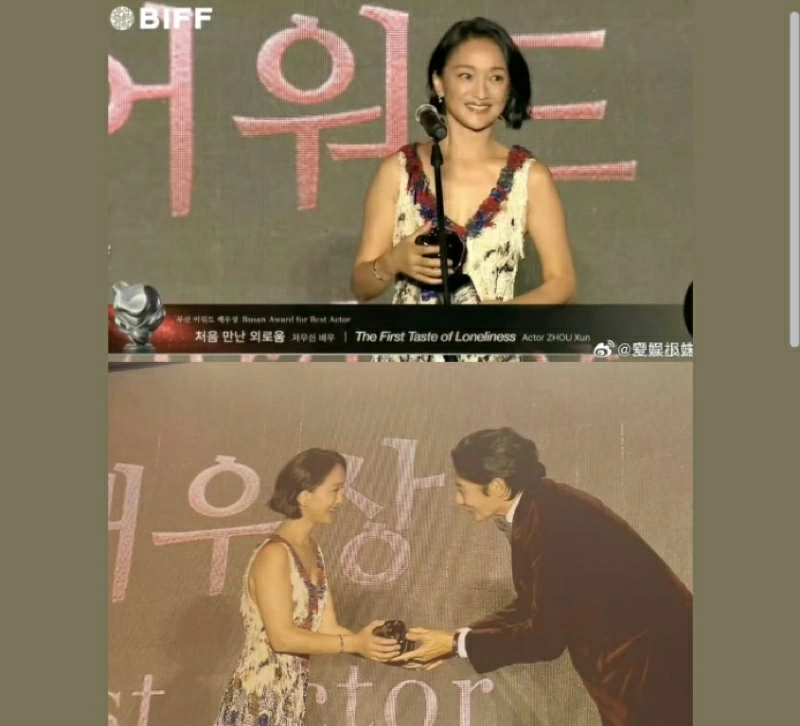 |
| At the 31st Busan International Film Festival, which concluded on October 15 in the Republic of Korea, Zhou Xun was awarded Best Actor for her role in The First Taste of Loneliness, directed by Gu You. |
Zhou Xun: From Familiar Roles to a New Milestone at Busan
In The First Taste of Loneliness, Zhou Xun plays Jiang Yue, a middle-aged woman confronting her father's passing and the ensuing changes in her family life. After this loss, she, her mother, and her daughter strive to fill the void left by their loved one. Three generations of women, spanning three ages and three ways of dealing with grief, form the film's emotional structure.
Director Gu, you refrain from dramatising the loss. Instead, he uses familiar living spaces, objects bearing the deceased's marks, and long takes to depict how memories linger in everyday life. According to the official introduction of the Busan Film Festival, the work is the third instalment in the director's trilogy on landscapes and family life, following Dwelling in the Fuchun Mountains (2019) and Dwelling by the West Lake (2023).
In this context, Zhou Xun's role demands restraint. Jiang Yue is not only mourning her father's death but also adjusting her relationship with her mother, who seeks a new beginning, and her daughter, who is preparing to leave the family. Loneliness thus stems not only from loss but also from the realisation that the lives of loved ones will continue to change.
Notably, Zhou Xun portrays a mature woman without reducing the character to a mere symbol of endurance. Her nuanced expressions, attitudes, and interactions with family members reveal the character's struggle between clinging to the past and the need to move forward. According to Screen International at Busan, the actress's performance adds depth to the film, particularly in how the character gradually accepts change and seeks her own path.
For Vietnamese audiences, Zhou Xun is not a new face. Over the years, the actress has appeared in films widely shown on Vietnamese television and in the media, ranging from martial arts and historical dramas to psychological and romantic cinema.
With Legend of the Condor Heroes, she became well-known for her role as Huang Rong, a smart, agile, and charismatic character in the martial arts world of writer Jin Yong. In Painted Skin, the fox spirit Xiaowei brought her into a different role, where external allure contrasts with internal conflicts. In The Banquet and Perhaps Love, Zhou Xun continued to demonstrate her ability to portray characters with complex emotional lives, rather than confining them to a single archetype.
Another notable milestone is Ruyi's Royal Love in the Palace, a series aired on HTV7 in Vietnam since 2018, sparking much debate in the media. Zhou Xun played Ruyi, a woman undergoing profound changes in love and palace life. Upon airing, her performance received mixed reviews on her suitability for the character's youthful phase, alongside praise for her ability to convey emotions in psychological scenes. VnExpress noted positive comments from Vietnamese audiences about how the actress conveyed Ruyi's pain, anger, and helplessness without resorting to exaggerated expressions.
These responses indicate that the relationship between an actor and the public is not solely built on initial admiration. A role may spark debate, but it also offers viewers an opportunity to reassess an artist's capabilities as the story progresses. For Zhou Xun, the diversity of roles offers audiences multiple points of contact with her career, from colourful entertainment characters to women facing difficult choices and enduring long-term trauma.
This is why the award at Busan holds significance beyond mere celebrity news. For Vietnamese audiences who have followed Zhou Xun through various stages, The First Taste of Loneliness offers a chance to see a different side of the actress: a mature woman, no longer facing palace intrigues or mythical choices, but finding a way to live on after loss in an ordinary family.
Of course, Zhou Xun's familiarity with Vietnamese audiences does not, without survey data, imply that she is among the most beloved actresses. What can be observed from the long-standing presence of her works in Vietnamese media is that her name and roles have created a connection with audiences. The new award in Busan adds a new chapter to that connection, while also sparking interest in Asian art films, which are less well known than popular commercial works.
From Family Stories to Social Issues
While The First Taste of Loneliness focuses on loss and generational shifts, Majid Majidi's Midday Meal places its character in a struggle between community responsibility and personal survival needs.
The film follows Solan, a teacher in the arid countryside of Iran. When the financial sponsor of the school meal program passes away, the school can no longer sustain its operations. Children gradually drop out, while educational authorities fail to provide practical solutions. To keep the class open, Solan and his mother move into the school, using their savings from renting out their home to provide meals for the students.
Initially driven by compassion, the teacher's efforts gradually place him in a more challenging situation. As responsibilities expand, he must choose between protecting his livelihood and maintaining educational opportunities for the children. The film thus not only speaks of a dedicated teacher but also raises questions about the limits of personal sacrifice when social issues are not addressed with appropriate support mechanisms.
Director Majid Majidi, known for works focusing on the lives of children and vulnerable communities, continues to use simple stories to explore broader issues. The Best Film award at Busan for Midday Meal draws attention to a work in which conflict lies not in large-scale confrontations but in everyday decisions that can change the future of an entire community.
Meanwhile, IBUKU by Indonesian director Eddie Cahyono delves into the mother-daughter relationship amid poverty, domestic violence, and labour migration.
The character Sumiati, portrayed by actress Christine Hakim, was once a beloved Jatilan dancer in her youth. After her husband's death, leaving behind debts, she is forced to marry off her daughter, Sri, to resolve financial difficulties. Unable to protect her daughter from an abusive husband, Sumiati witnesses Sri leaving Indonesia to work abroad. In Saudi Arabia, Sri is mistreated by her employer and later sentenced to death for murder. Upon hearing the news, the mother decides to find a way to meet her daughter despite the obstacles posed by distance and procedures.
The story transcends a family's tragedy to address issues of migrant labour, inequality, and women's ability to protect themselves. Sumiati and Sri's choices do not occur in a vacuum but are influenced by economic circumstances, patriarchal constraints, and the lack of protective mechanisms for workers.
The interwoven storytelling between past and present helps IBUKU depict accumulated traumas over the years. The Special Jury Prize at Busan acknowledges a work that situates social issues within a specific family relationship, making questions of responsibility, sacrifice, and the right to live safely more relatable to viewers.
Placed side by side, the three films showcase the diversity in how Asian cinema approaches humanity. One work observes loneliness within a family, another explores responsibility towards children and education, while the other delves into the consequences of labour migration. Despite differences in setting and style, the stories do not portray characters as simple archetypes. They can love and err, wish to protect others while struggling to survive. These contradictions create depth and provoke thought long after the film ends.
What Makes Asian Cinema Captivating
The commonality among the works honoured at Busan does not lie in a unified storytelling formula but in their ability to blend local contexts with universal issues. The loneliness of a Chinese woman, the struggle of an Iranian teacher, or an Indonesian mother's journey all stem from specific social conditions. However, kinship, responsibility, loss, and the desire for a better life are themes not confined by national borders.
For Vietnamese audiences, this is also a noteworthy approach when following regional cinema. Familiarity with Chinese films may be a starting point, but works from Iran, Indonesia, or other cinematic backgrounds offer new experiences of life and culture. Instead of only following famous faces or heavily promoted works, viewers can explore lesser-known stories rich in artistic and social value.
This does not mean every award-winning film at a festival is easily accessible or guaranteed to be a commercial success. Art cinema may employ slow pacing, non-linear structures, and symbolic details requiring viewer patience. The ability to be widely released also depends on distribution strategies, subtitles, marketing, and market-specific tastes.
Nevertheless, international film festivals play a crucial role in providing opportunities for works from different cinematic backgrounds to be introduced, evaluated, and gain new audiences. Busan is not only a place to announce awards but also a space where stories from various countries and cultures are juxtaposed, broadening perspectives on Asian cinema.
For Zhou Xun, this award not only adds a milestone to her career but also brings her back to audiences with a role distinct from her familiar portrayals. For Vietnamese viewers, it is an opportunity to revisit an actress who has graced the screen through various stages, while also discovering works that do not necessarily rely on star power to make an impact.
The vitality of Asian cinema lies not only in its ability to produce box office hits but also in the diversity of stories told and the people portrayed. From a family learning to overcome loss to a teacher striving to keep a classroom open or a mother travelling far to find her child, these stories remind viewers that cultural differences do not hinder empathy. Sometimes, it is the ordinary fates and the most challenging choices that help cinema address common human issues.

| Vietnamese cinema expands presence at Busan International Film Festival WVR - Vietnamese cinema features five works selected in four categories at the 31st Busan International Film Festival (BIFF), taking place in Busan, Republic of ... |

| Enhancing cooperation in digital copyright protection and development of cinema WVR - The Ministry of Public Security of Vietnam seeks to enhance cooperation with the Motion Picture Association in protecting intellectual property rights, combating copyright ... |