


Opening of the Expanded BRICS Foreign Ministers' Meeting
WVR - Deputy Minister of Foreign Affairs Nguyen Minh Hang leads the Vietnamese delegation attending the Expanded BRICS Foreign Ministers' Meeting held in India.
Latest
On May 14, the Expanded BRICS Meeting commenced in New Delhi, India, under the chairmanship of the Indian Minister of Foreign Affairs, the BRICS Chair for 2026.
The meeting was attended by Ministers and Deputy Ministers of Foreign Affairs from BRICS member countries and partner nations. Within the framework of the meeting, the heads of delegations from BRICS member countries and partner nations paid a courtesy call to Indian Prime Minister Narendra Modi.
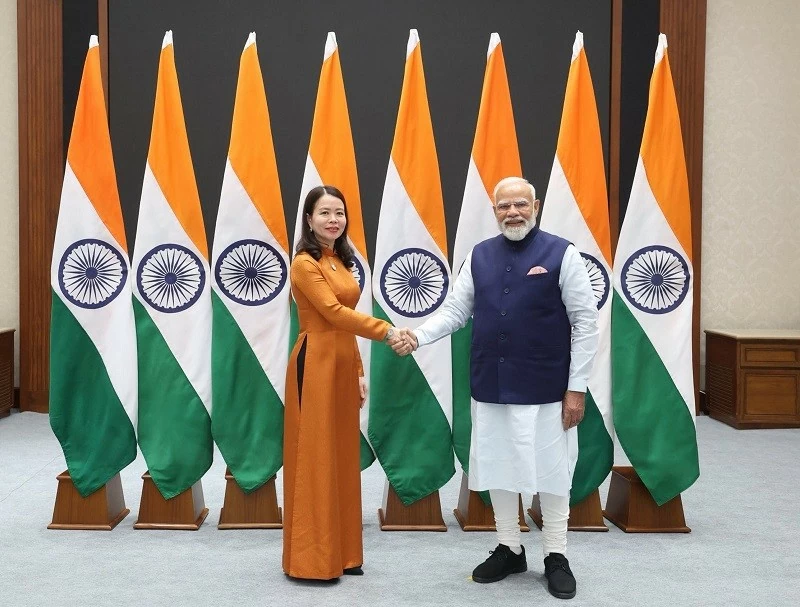 |
| Deputy Minister of Foreign Affairs Nguyen Minh Hang pays a courtesy call to Indian Prime Minister Narendra Modi. |
With the theme "Building Resilience, Innovation, Cooperation, and Sustainable Development", the Expanded BRICS Foreign Ministers' Meeting 2026 focused on exchanging and agreeing on major directions to build resilient, innovative, cooperative, and sustainable development platforms; reforming the multilateral system and global governance; addressing global challenges and shaping the development space for Southern Hemisphere countries.
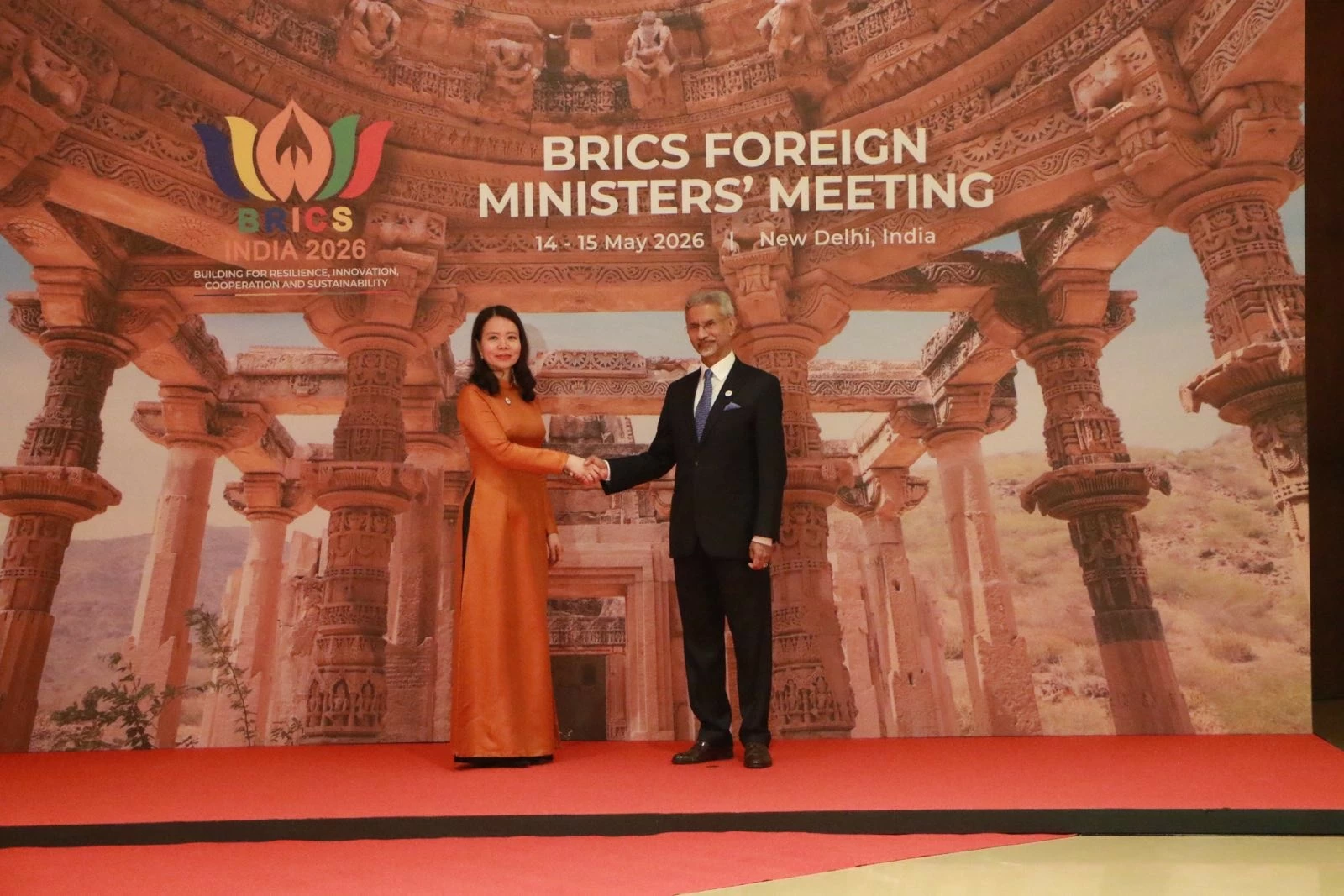 |
| Deputy Minister of Foreign Affairs Nguyen Minh Hang and Indian Minister of Foreign Affairs S. Jaishankar. |
Indian Minister of Foreign Affairs S. Jaishankar delivered the opening speech, emphasizing that the meeting took place amidst increasing global uncertainty, requiring deeper cooperation among emerging economies. As the BRICS Chair, India has promoted discussions on enhancing cooperation across various fields and driving further progress to build a more inclusive BRICS framework, with development issues remaining central, particularly BRICS's role in supporting countries in addressing challenges related to energy, food security, supply chain security, and market diversification; highlighting the growing importance of technology, stating that technology should be used to enhance governance efficiency and ensure inclusive growth.
Speeches at the meeting highlighted the global context with numerous intertwined challenges – from geopolitical conflicts, supply chain disruptions, energy supply issues to inequality in access to climate finance and fragmentation in science and technology. Many expressed concerns about the complex situation in the Middle East, which not only affects regional security but also threatens global economic growth and development, limiting the development space of nations.
In this context, the heads of delegations emphasized the need to strengthen economic and social resilience, enhance policy coordination to ensure macroeconomic stability and maintain sustainable growth momentum. Members and partner countries praised the development achievements of BRICS over the past 20 years; appreciated BRICS's role in supporting countries to build sustainable trade policies, attract responsible investment, and transfer technology, while calling on BRICS to actively participate in the process of establishing international standards for science and technology, especially in artificial intelligence, to better reflect the needs and voices of developing countries.
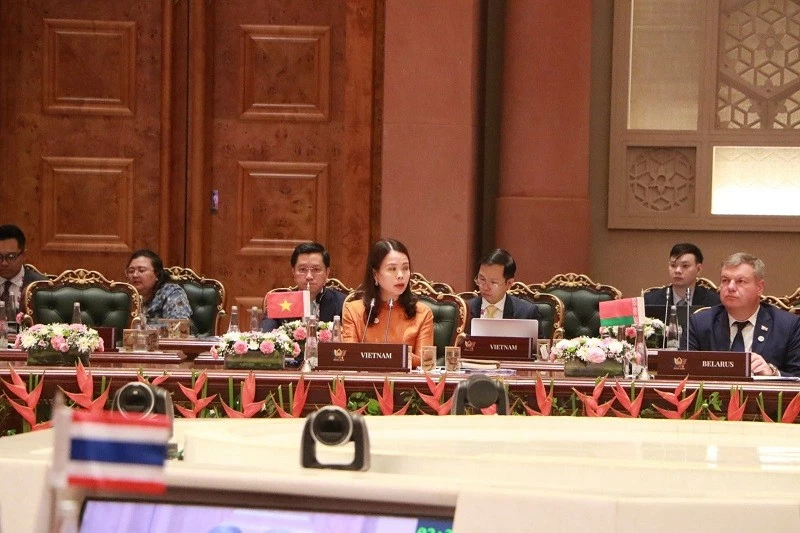 |
| Deputy Minister of Foreign Affairs Nguyen Minh Hang speaks at the discussion session on "Building Resilient, Innovative, Cooperative, and Sustainable Development Platforms". |
The Vietnamese delegation, led by Deputy Minister of Foreign Affairs Nguyen Minh Hang, engaged in various activities at the meeting. Speaking at the discussion session on "Building Resilient, Innovative, Cooperative, and Sustainable Development Platforms", Deputy Minister Nguyen Minh Hang emphasized that no nation can withstand external shocks without a truly robust resilient foundation and international cooperation.
Deputy Minister Nguyen Minh Hang shared directions on building an independent, self-reliant economy linked to Vietnam's deep international integration, while proposing several cooperation directions between BRICS and partner countries. Notable proposals included: (i) enhancing cooperation to ensure energy security, strengthening the resilience of essential product supply chains, with a focus on mutual support in energy supply, expanding cooperation in renewable energy and energy transition, and establishing mechanisms for mutual support against external shocks; (ii) developing logistics infrastructure and intercontinental connectivity, ensuring freedom and safety in maritime and air navigation, prioritizing strategic infrastructure projects connecting economic centers, promoting freedom, security, and safety in maritime and air navigation in accordance with international law; (iii) cooperating to ensure the smooth flow of trade, investment, and enhancing cooperation in science and technology, digital transformation, emphasizing the need to promote a rule-based, fair, and inclusive multilateral trading system, encouraging cooperation mechanisms, technology transfer, research, development, and application of new technologies such as artificial intelligence, semiconductors, biotechnology, and green technology; (iv) creating a new development ecosystem through breakthroughs in institutions and governance, with people as the main subject and driving force; encouraging the sharing of experiences and development models, enhancing cooperation in specific fields such as ensuring food security, water resources, pharmaceuticals, and healthcare, thereby strengthening resilience and improving the quality of life for people.
On the morning of May 15, the meeting will continue its activities with a discussion session on "Reforming the Multilateral System and Global Governance".