








National Assembly and People's Councils Election 2026: The competence of people's representatives in the digital era
WVR - The digital transformation process is placing National Assembly and People's Council representatives at all levels under urgent requirements to enhance their capabilities in a digitized environment.
Latest
 |
| Dr. Nguyen Van Dang. |
The digital era and transformation
With the integration of personal computers, the internet, and smartphones, humanity is living in a new developmental phase known as the digital era, characterized by the ability to store vast amounts of information in digital form without the need for large physical spaces.
Entering the second decade of the 21st century, groundbreaking innovations in technology and engineering have shaped the Fourth Industrial Revolution, with the emergence of smart factories, smart products, and smart supply chains. Consequently, digital transformation has become an inevitable trend for all entities, both in the public and private sectors, across all nations worldwide.
In our country, digital transformation has been vigorously implemented in recent years, identified as a process of "comprehensive digitization, creating a digital environment and interacting with the real environment to change the way activities are organized, services are provided, and new values are created".
Advancements in science and technology have altered organizational thinking, policy planning and execution processes, the nature of relationships, and communication methods between the government and the people. This reality is reflected in the development of "e-government", characterized by the use of information and communication technology devices connected to the internet to manage and conduct activities within the public authority system, as well as provide online public services to citizens, businesses, and social organizations; "digital government", characterized by transitioning government activities to the digital environment and using data.
For the National Assembly, on January 14, 2026, the Conference on Summarizing Digital Transformation Work in 2025 highlighted significant achievements. Most notably, the completion of the institutional framework and long-term strategic direction of the National Assembly on digital transformation. The Standing Committee of the National Assembly issued a Resolution approving the National Assembly Digital Transformation Project for the period 2025–2030.
The National Assembly Office issued a comprehensive plan to implement the Project and the Digital National Assembly Architecture version 1.0. The year 2025 also saw the trial and effective operation of nearly 20 important systems such as: the electronic document and management system, National Assembly App 2.0, audio transcription system, paperless meeting room (Q-Cabinet), and the "Digital Literacy – Digital National Assembly" platform.
In 2025, digital data continued to be identified as a core asset, with the shared data repository of the National Assembly (Q-Data) being built and put into operation, integrating hundreds of thousands of legislative, supervisory documents, legal documents, voter opinions, and election data. The digitization of records and documents at the Ethnic Council, the Committees of the National Assembly, and the Party Committee of the National Assembly was implemented synchronously, forming a centralized data source capable of sharing and reuse, directly serving the activities of National Assembly representatives.
According to the 2026 plan, the National Assembly will focus on completing and operating the Digital National Assembly, issuing Digital National Assembly Architecture 2.0; building a Digital Data Center, deploying a secure network and shared management system, ensuring information security and safety, and developing digital human resources.
Globally, the digital transformation process and the development of digital government are inevitable trends creating new opportunities for improving the quality of public governance. The most visible advantages include reducing the size of the government apparatus and personnel; lowering costs; increasing convenience for citizens and businesses; improving transparency in government activities; reducing risks and preventing corruption; enhancing management effectiveness and efficiency; encouraging innovation for the economy; promoting social equality and citizen participation in public governance activities.
For each country, building a digital government will contribute to enhancing the ability to comprehensively update data and information. As a result, governments, businesses, and citizens can be more proactive in assessing the overall economic-political-social situation to make appropriate policy directions and action plans.
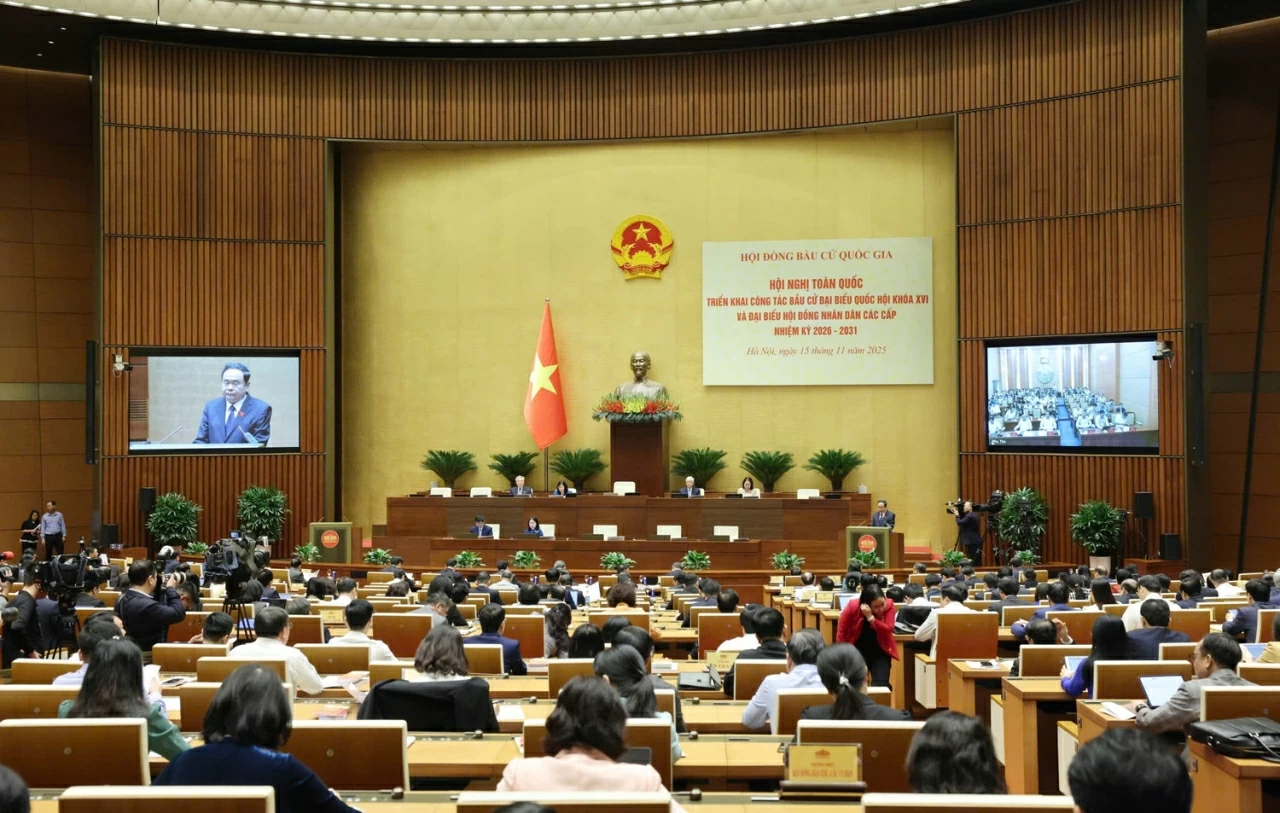 |
| National conference to implement the Politburo's Directive, organize the election of National Assembly deputies for the 16th term and People's Council deputies for the 2026-2031 term, held on the morning of November 15, at the National Assembly House. (Source: National Assembly) |
Representatives of the people
According to the 2013 Constitution, the National Assembly is the highest representative body of the people, the highest state power body of the Socialist Republic of Vietnam. The National Assembly exercises constitutional and legislative powers, decides on important national issues, and exercises supreme oversight over state activities.
Meanwhile, the People's Council, according to the 2025 Law on Local Government Organization, is the state power body at the local level, representing the will, aspirations, and mastery of the people, deciding on important local issues, overseeing the observance of the Constitution and laws, and supervising the activities of state agencies at the local level.
When participating in the election of the National Assembly and People's Councils at all levels, each voter chooses their "political representatives" in the state power body. On an individual level, the ballot represents the voter's trust and support for the representatives.
On a political and legal level, the voter's ballot affirms the authorization for the representatives to "represent" them in expressing views or acting as a representative. Therefore, becoming a National Assembly or People's Council representative at any level is always a special honor for each individual as they can proudly declare: "I am trusted to be a representative of the people".
However, such great honor also places each representative under heavy political responsibilities and duties. After the election, each voter expects the National Assembly and People's Council representatives at all levels to become a bridge between the interests and views of citizen groups and the policy actions of government levels.
The principle of political representation is a way to implement democracy, minimize the gap between the people and the government, and ensure the connection between government policy actions and the needs, aspirations, and expectations of various population groups.
Through the representatives, people express their thoughts, aspirations, and policy expectations. The responsibility of the representatives is to record, analyze, and synthesize these expectations to convey them to the National Assembly and People's Councils at all levels. Each decision issued by the National Assembly or People's Councils becomes institutional frameworks and policies that affect the lives of classes, strata, social groups, and even all citizens.
In the context of vigorous digital transformation being promoted and implemented decisively in our country today, it can be envisioned that a complete "digital government" model will become a reality in the not-too-distant future. The combination of digital transformation and the modernization process of national governance will place public sector entities in our country before three new characteristics: First, they must respect the position and role of non-state entities; Second, they must reduce the habit of working within a hierarchical (high-low, unequal) system to gradually transition to working within more equal multi-entity cooperative networks; Third, they must strictly adhere to common principles of information access and data exploitation, openness and transparency, and accountability.
Therefore, the technological and digital era not only provides public governance entities with new, more effective and efficient policy mechanisms and tools, but also demands that each elected representative quickly adapt to the new context, enhance digital capabilities, adjust their mindset, and work methods to keep pace with technological and social advancements. Through this, they can meet the increasingly high expectations of modern voters.
 |
| The election of National Assembly deputies for the 16th term and People's Council deputies for the 2026 - 2031 term is a particularly important political event for the country. (Source: VNA) |
New competency requirements
In daily life, the competence of an individual or organization is often understood as the ability to utilize all available resources to successfully complete a task or goal. Thus, we can envision the competence of each elected representative as the ability to perform their functions, duties, and political responsibilities as prescribed by law, as well as the expectations of voters.
The three components that make up the competence of representatives include: Knowledge, which is general understanding, especially of specialized issues; Perspectives and attitudes, which are the interest in certain issues and the support for policy options to address those issues; Skills, which are the work operations, interactions within the organization, and interactions with voters.
It is evident that the current technological context is creating a demand for improving the competence of people's representatives in our country in three key aspects:
First, each representative needs to regularly update and supplement their knowledge and understanding of digital transformation, the digital world, and the impacts of this trend. This requirement is based on numerous real-world evidences that the working capacity of representatives can be severely affected if they fall behind in contextual knowledge, lack basic technological competencies, leading to conservatism, reluctance to change, and reluctance to act.
Currently, the continuous emergence of groundbreaking technological innovations and the rapid movement and change of technological trends further highlight the special importance of updating knowledge about the context in general, including the technological context.
Second, each representative needs to develop a "digital governance perspective and mindset", which is the ability to perceive, think, analyze, and form ideas and approaches to issues arising in daily social life. Digital governance thinking is characterized by "openness, transparency", "objectivity", "openness and encouragement of participation", "encouragement of multi-entity cooperation", "management and decision-making based on data".
This means that every representative needs to be aware that digital transformation and building a digital government is not simply about applying modern technological means in public governance activities, providing public goods and services, or using data in government decision-making and execution.
More importantly, it is a comprehensive change process with many aspects of government (perspectives and perceptions, organizational apparatus, personnel, finance, working mechanisms…), requiring comprehensive change from all entities in the public sector.
Third, each representative needs to adjust, supplement, and perfect their working skills in an environment that applies many modern technologies, forming appropriate habits to handle work in a digitized environment. A representative skilled in skills means being able to perform certain actions with dexterity and proficiency, characterized by repeated practice over a long period.
The key skills that each elected representative needs to quickly perfect include: Searching, synthesizing, exploiting, and verifying the accuracy of information and data in a digitized environment. Simultaneously, using technological devices to maintain connections, influence with voters; monitoring, maintaining commitments to perform duties. Additionally, maintaining and strengthening relationships between individuals and organizations in the context of minimizing direct interaction…