



Government’s April Press Conference highlights administrative reform, tackles institutional ‘bottlenecks’
WVR - The regular Government press conference in April 2026 clarified many important issues, from administrative procedure reforms to the progress of key projects.
Latest
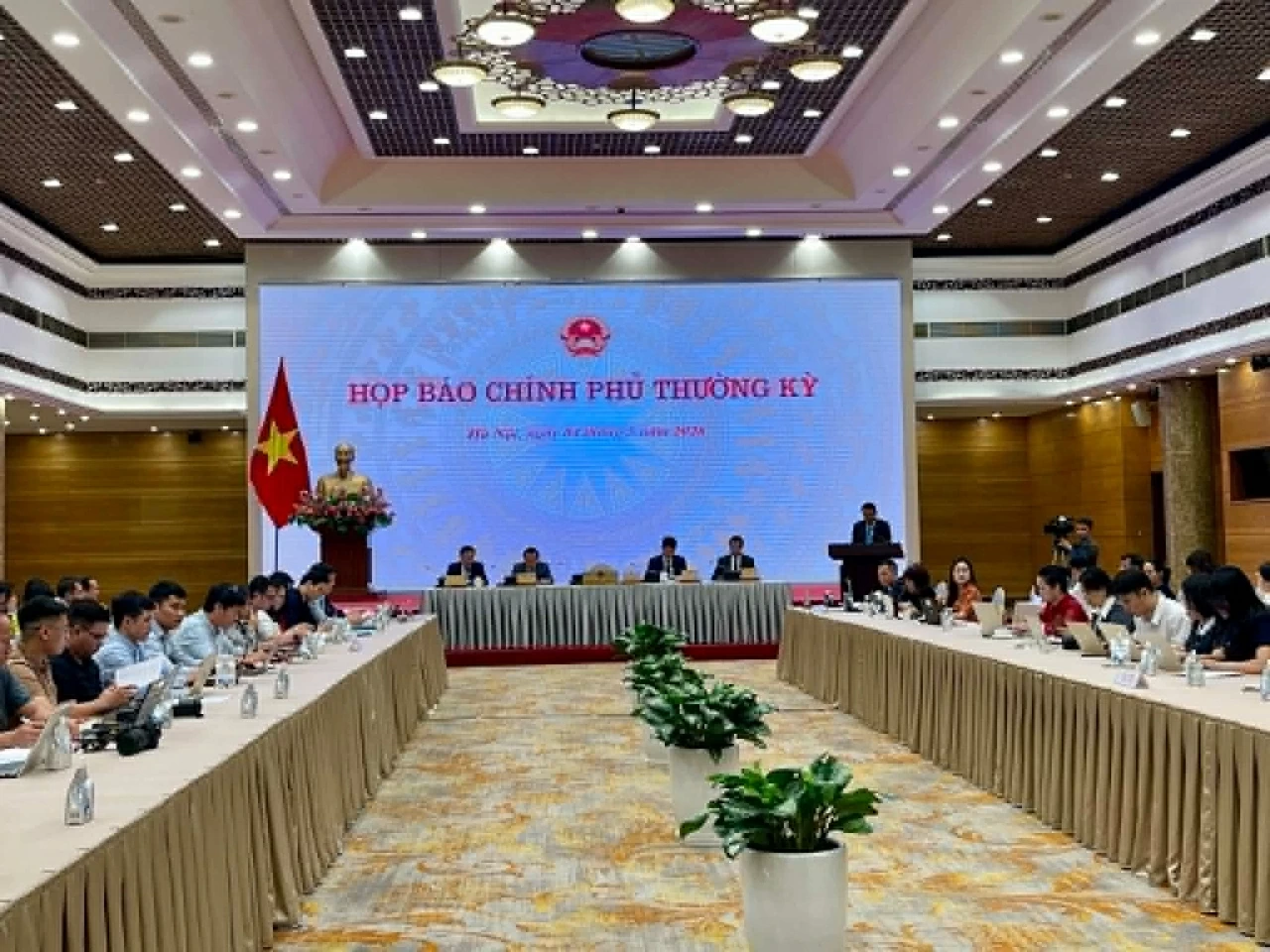 |
| Overview of the regular Government press conference in April 2026. (Photo: Minh Trang) |
On the afternoon of May 4, presiding over the regular Government press conference for April 2026, the first press conference of the Government for the 2026-2031 term, Minister and Head of the Government Office Dang Xuan Phong stated that immediately after being elected and approved by the National Assembly, the Government quickly got to work, directing and completing many important and urgent tasks in a very short time.
Minister Dang Xuan Phong noted that on the afternoon of May 4, the Government held the regular meeting for April 2026, the first regular Government meeting of the 16th Government term, chaired by Prime Minister Le Minh Hung to assess the socio-economic situation in the early months of 2026 and to set out tasks and solutions for May and the upcoming period.
Striving to reduce at least 30% of conditional business sectors
At the press conference, issues of administrative procedure reforms, resolving institutional "bottlenecks", solutions to ensure macroeconomic stability, and the unified implementation of a set of textbooks were clarified by representatives of ministries and sectors.
Deputy Minister of Justice Nguyen Thanh Tinh stated that at the Government meeting on April 3, 2026, the Prime Minister concluded, requiring ministries, sectors, and localities to have a decisive and urgent plan to implement no more than 30 administrative procedures at the ministerial level, with the rest decentralized to localities.
Reducing 50% of implementation time, 50% of compliance costs compared to 2024. Striving to reduce at least 30% of conditional business sectors; eliminating 100% of unnecessary business conditions. The basic requirement is to complete this by April 2026.
In carrying out this task, the Ministry of Justice has developed a plan and, together with other ministries and sectors, implemented it very urgently and decisively according to the Prime Minister's and the Standing Government's directives.
Regarding the results, by April 26, 2026, the Ministry of Justice had compiled reports from ministries and sectors and found that they had proposed basic plans to achieve the targets set by the Prime Minister. In other words, they have met the targets according to Resolution No. 18 of the Central Committee. These are fundamental solutions and measures for us to achieve socio-economic development goals, specifically improving the investment and business environment.
For the implementation plan that requires adjusting Decrees, the provisions of Clause 2, Article 14 of the Law on Promulgation of Legal Documents will be applied for the Government to issue resolutions under a simplified procedure for immediate implementation.
For plans that require amending the law, a special mechanism will be applied to resolve difficulties and obstacles according to Resolution 206 of the National Assembly to issue legal documents and resolutions.
By April 29, the Government had issued 8 Resolutions on reduction, decentralization, and simplification of administrative procedures. By this time, the Ministry of Justice had appraised 3 normative resolutions according to Resolution 206, drafted by the Ministry of Justice, Ministry of Finance, Ministry of Agriculture and Environment, in accordance with the requirements, to be submitted to the Government for consideration and approval on May 5.
“This is a very significant effort, which can be described as a '15-day and night rapid campaign' to develop plans and advise on the issuance of legal documents to implement the reduction and simplification of administrative procedures as required by Resolution 18 of the Central Committee,” emphasized Deputy Minister of Justice Nguyen Thanh Tinh.
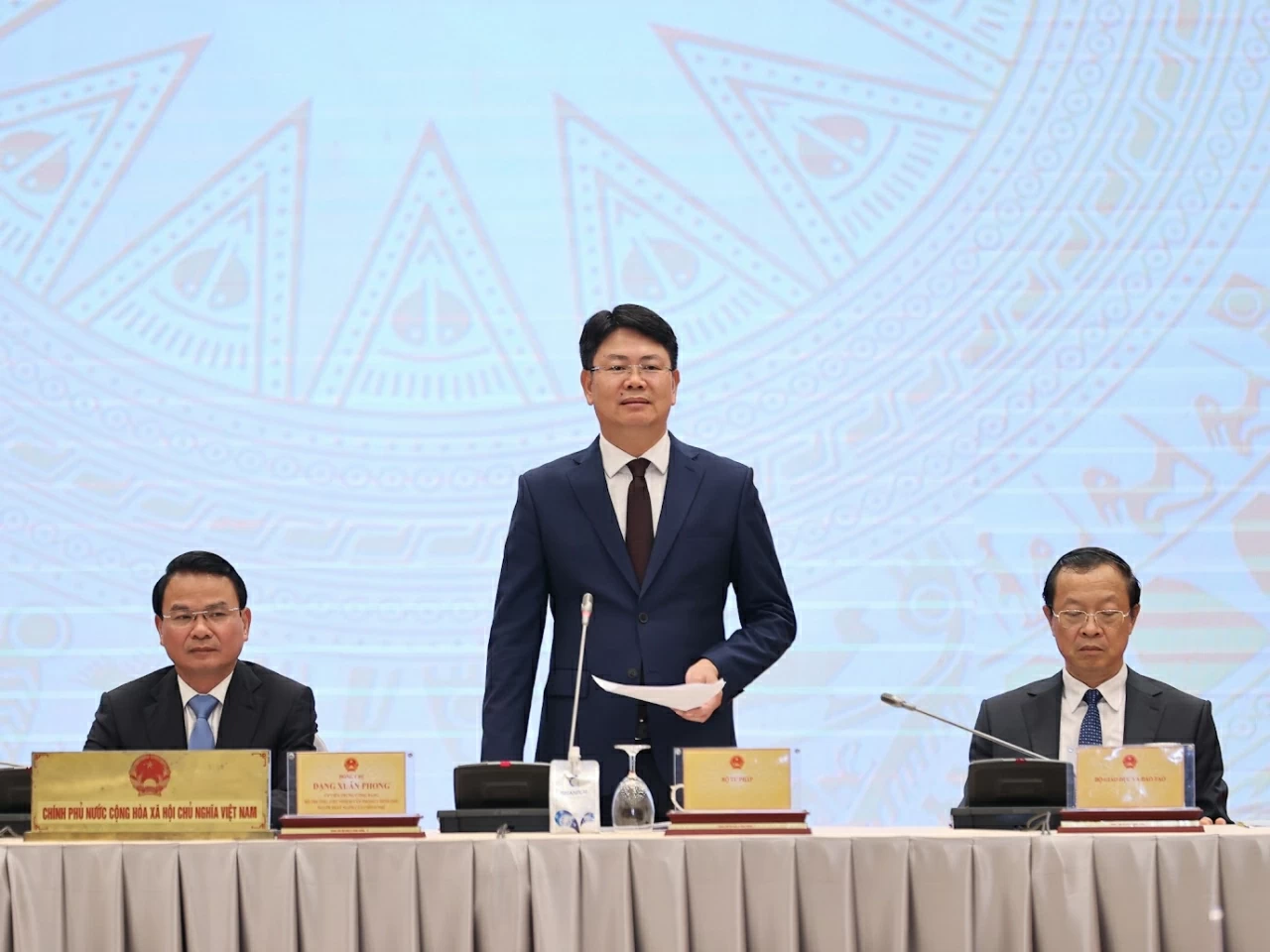 |
| Deputy Minister of Justice Nguyen Thanh Tinh answers reporters' questions about resolving institutional "bottlenecks". (Source: VGP) |
Costly administrative procedures for businesses set to be eliminated
Regarding detailed figures on the reduction and simplification of administrative procedures, Deputy Minister of Justice Nguyen Thanh Tinh stated:
Firstly, regarding decentralization and delegation: The Central level now only implements 1,570 administrative procedures, accounting for 32.1%, exceeding the target set by Resolution 18 of the Central Committee.
Secondly, concerning conditional investment and business sectors: Currently, there are 198 sectors, and ministries have proposed plans to reduce 60 sectors, achieving 30.3%, meeting the requirements set by Resolution 18 of the Central Committee.
Thirdly, regarding reduction (according to the 8 Resolutions issued): 1,732 unnecessary business conditions have been eliminated. 680 administrative procedures have been abolished. 521 administrative procedures have been simplified. An additional 18,097 days of administrative procedure processing time have been reduced, bringing the total reduced processing time to 51,419 days out of 97,020 days, achieving 52.9%, exceeding the set target.
Fourthly, continuing to propose reducing administrative procedure costs with an estimated savings of over 23,000 billion VND per year.
Fifthly, the dossiers submitted by 3 ministries to the Government for issuing Resolutions according to Resolution 206 will adjust nearly 50 laws to reduce nearly 60 conditional business sectors and abolish 158 administrative procedures, along with many other simplification contents.
According to the Deputy Minister of Justice, this is a very extensive reform. “Thus, in less than a month, we have achieved the goal of reducing and simplifying administrative procedures and conditional business sectors as directed by the Prime Minister,” affirmed Deputy Minister of Justice Nguyen Thanh Tinh.
Regarding the question "Is the reduction substantial? Will new business conditions and procedures 'emerge'?", the Deputy Minister of Justice stated that this is an issue that the Standing Government has directed very specifically and clearly.
Based on the spirit of Resolution 18 of the Central Committee, which is to thoroughly shift from "pre-check" to "post-check", the current mindset of reducing and simplifying administrative procedure conditions is different. When appraising normative resolutions, the Ministry of Justice requires ministries and sectors, along with reducing, abolishing, and simplifying administrative procedures and "pre-check" procedures, to have alternative solutions to ensure that the reduction and simplification are feasible, not just on paper.
Specifically, with the 8 Resolutions already issued and the 3 upcoming Resolutions to be built in the direction of shifting the mindset from "pre-check" to "post-check", along with the legal provisions implementing administrative procedure reform plans, ministries and sectors will have to specify standards and criteria for investment and business services. When citizens and businesses meet these standards and criteria, they can decide on investment and business without having to go through licensing procedures.
"When conducting business in this manner, citizens and businesses will notify the state management agency. Based on this notification, the state management agency will conduct 'post-check'. We also propose that with decentralization and delegation, the management function of ministries and sectors at the provincial level must be linked to the commune level. This is a requirement to enhance management capacity at the grassroots level, local government level," emphasized Deputy Minister of Justice Nguyen Thanh Tinh.
Regarding solutions, ministries and sectors have also proposed very specific measures. For example, the Ministry of Agriculture and Environment proposes implementing "post-check" by requiring entities conducting production and business investments to fill in information on the Ministry's or provincial, communal electronic portal. Once the information is complete, they can carry out production, investment, and business service activities.
At that point, state management agencies will exercise their management responsibilities. Simultaneously, to implement this new mechanism, individuals, businesses, and citizens participating in production and business must enhance their responsibility for implementation, which means upholding the law.
According to the Deputy Minister of Justice, to effectively implement and enhance implementation responsibility, the law must also have sanctions. For example, for entities registering and notifying activities according to their plans, they must be honest, and the legal provisions must ensure they meet the conditions for investing in business sectors. If they do not meet the conditions, when "post-check", the state agency discovers it, they will revoke the business licenses and permanently ban individuals and organizations from engaging in that business sector and impose heavy administrative penalties.
State agencies must enhance information technology transformation and digital transformation for management. The Ministry of Justice has reported to the Government to soon implement the construction of an information system for administrative procedure control, digital transformation in the field of administrative procedure control to meet that requirement.
"With this spirit, the emergence of business conditions and administrative procedures that increase costs for businesses will not recur," affirmed Deputy Minister Nguyen Thanh Tinh.
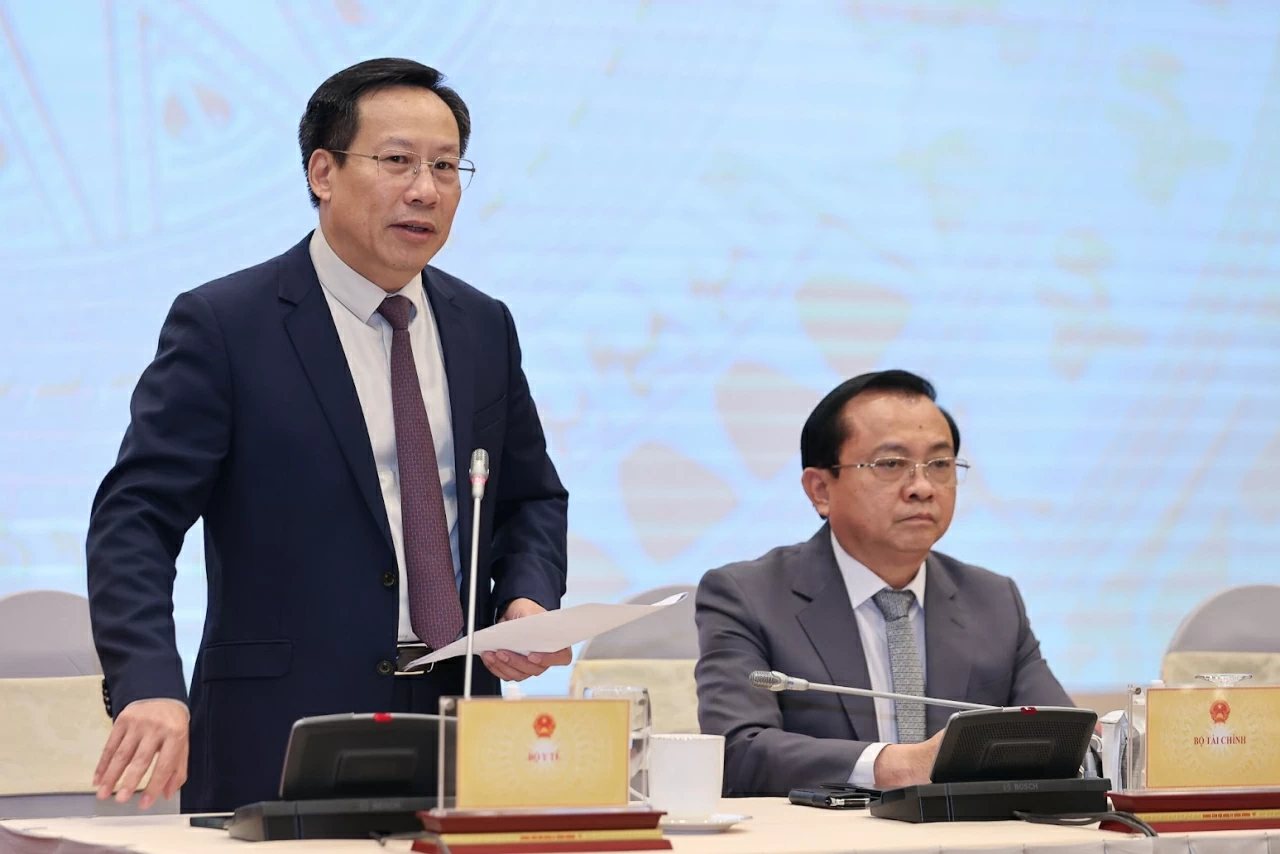 |
| Deputy Minister of Health Le Duc Luan provides information on the progress of two projects to build the second facilities of Bach Mai Hospital and Viet Duc Hospital. |
Bringing Bach Mai Hospital Facility 2 and Viet Duc Hospital Facility 2 into use in Q2/2026
At the press conference, Deputy Minister of Health Le Duc Luan stated that the basic obstacles of the Bach Mai Hospital Facility 2 and Viet Duc Hospital Facility 2 projects have been resolved, aiming to bring them into use in the second quarter of 2026.
According to Deputy Minister Le Duc Luan, the Bach Mai Hospital Facility 2 project in Ha Nam Province and the Viet Duc Hospital Facility 2 project in Ninh Binh Province are large-scale and very modern projects. The Government has issued Resolution No. 34 on mechanisms to address issues related to these projects.
During implementation, many obstacles arose in construction and completion that needed to be addressed. For example, verifying and approving estimates for work done from 2018 and 2019 was very challenging. Changes in the design of the project led to many alterations in items, including fire prevention and fighting, water supply and drainage, and policies related to the environment.
Purchasing medical equipment was also problematic as it was not possible to buy equipment as initially approved in 2014-2015, requiring a complete adjustment to purchase modern medical equipment. Additionally, financial issues arose when contractors' loans were not approved by banks. Besides these major obstacles, there were many other specific issues.
Mr. Luan noted that in recent times, the Government, the Ministry of Health, and related ministries and units have made great efforts to resolve these issues, aiming to bring these two hospitals into use in the second quarter of 2026.
Specifically, the Ministry of Health coordinated with the Ministry of Construction to address obstacles related to verifying and approving estimates of bidding packages; coordinated with the Ministry of Construction and the Ministry of Public Security to direct contractors to urgently focus manpower to complete unfinished items such as fire prevention and fighting, wastewater treatment, and waste management. These are the bases for issuing fire prevention and environmental permits.
The Ministry of Health also directed the project management board to implement the most favorable mechanisms for contractors in payment, such as allowing temporary payment up to 90% of the completed volume; being more flexible with new arising items, requiring amendments, supplements, and contract appendix adjustments.
"Currently, the basic obstacles have been resolved. The project is focusing on constructing fire prevention, wastewater treatment, and environmental management systems," said Deputy Minister of Health Le Duc Luan.