







Korea's 7,000-year-old petroglyphs gain UNESCO World Heritage status
The 7,000-year-old prehistoric petroglyphs carved into rocks at the southeastern tip of Korea have been inscribed as a UNESCO World Heritage site, recognized for their vivid depictions of marine life and what is believed to be the world’s oldest portrayal of whale hunting.
Latest
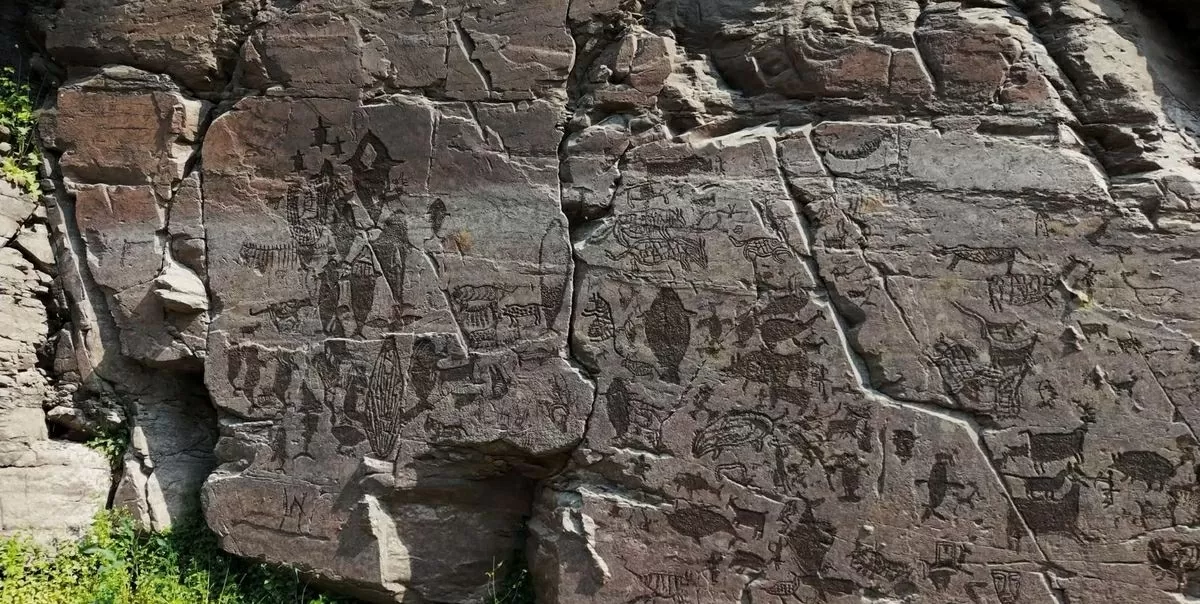 |
| The rock engravings of Bangudae Terrace hold 312 distinct images, from humans and animals to ships and tools. (Source: Korea Heritage Service) |
The decision to inscribe the Neolithic rock carvings, found along Ulsan’s Bangucheon Stream, was made Saturday (local time) during the 47th session of UNESCO’s World Heritage Committee in Paris.
The newly listed site encompasses the petroglyphs of Bangudae Terrace and nearby Cheonjeon-ri, both of which are state-designated national treasures.
First discovered in 1971, the Bangudae engravings are etched into the lower portion of a cliff in the upper reaches of Bangucheon Stream.
Spanning 3 meters in height and 10 meters across, the rock face holds 312 distinct imprints: humans, land and sea animals, ships and tools - each one an image of ancient life along the Korean coast.
Among the sea creatures portrayed, whales appear most frequently. Rendered with striking finesse, they have made the site famous as the world’s oldest-known visual account of whale hunting.
The rock art of Cheonjeon-ri, located just 2 kilometers from Bangudae, came to light in 1970.
What sets it apart is the remarkable layering of imagery etched across different time periods: animal and human figures from the late Neolithic Age, abstract geometric patterns from the Bronze Age, fine-line engravings from the Iron Age and inscriptions from the Three Kingdoms Period through the Unified Silla era (18 BCE-935 CE). Together, they form a rare visual genealogy of Korea’s prehistoric culture.
However, these ancient engravings have long faced threats from rising waters.
The petroglyphs are frequently submerged due to fluctuating stream levels caused by the Sayeon Dam, built in 1965. Since then, they have endured a repeated cycle of flooding and exposure, particularly during the summer monsoon season. Swollen waters also carry debris swept down by the rains, endangering the site further.
On average, the carvings have been underwater for 42 days each year, though in some years, submersion has lasted as long as five to six months.
To mitigate the damage, plans are underway to install additional floodgates at the Sayeon Dam’s spillway. The goal is to drastically reduce the number of days the rock art spends submerged, ideally just one day a year. Construction could begin as early as next year, with completion targeted around 2030.
“It has been over 50 years since the petroglyphs first came to the world’s attention, but the road to UNESCO recognition has not been easy,” said Choi Eung-chon, head of the Korea Heritage Service, the state agency overseeing national heritage. “Going forward, we will do our best to preserve and share the value of these ancient engravings along Bangucheon Stream as a legacy for all humankind.”
With this latest inscription, Korea now holds a total of 17 UNESCO World Heritage properties, including Haein Temple, which is home to the Goryeo-era “Tripitaka Koreana” woodblocks, Jongmyo Shrine, Hwaseong Fortress and the volcanic landscapes and lava tubes of Jeju Island.
(Source: Korea Times)