




Kinh Thien Palace and the layers of memories of Thang Long
The excavation of the Kinh Thien Palace area in 2026 continues to clarify the exceptional value of the Thang Long Imperial Citadel's underground, which preserves a cultural stratigraphy approximately 6 meters thick with layers of relics spanning from the Dai La period to the Nguyen period.
Latest
The new discoveries contribute to a clearer identification of the scale and structure of Kinh Thien Hall, while also providing additional evidence of the continuity of the power space at the center of Thang Long over many centuries.
1,300-Year Stratigraphy and Successive Relics
In 2026, the Thang Long - Hanoi Heritage Conservation Center, in collaboration with the Institute of Archaeology, conducted the fourth excavation at the Kinh Thien foundation area, the Artillery House area, covering an area of 910m².
The results reveal a cultural stratigraphy approximately 6 meters thick, comprising layers from the Dai La, Dinh - Tien Le, Ly, Tran, Le So, Le Trung Hung to the Nguyen periods. This is the thickest and most complete cultural stratigraphy of Thang Long–Hanoi discovered to date
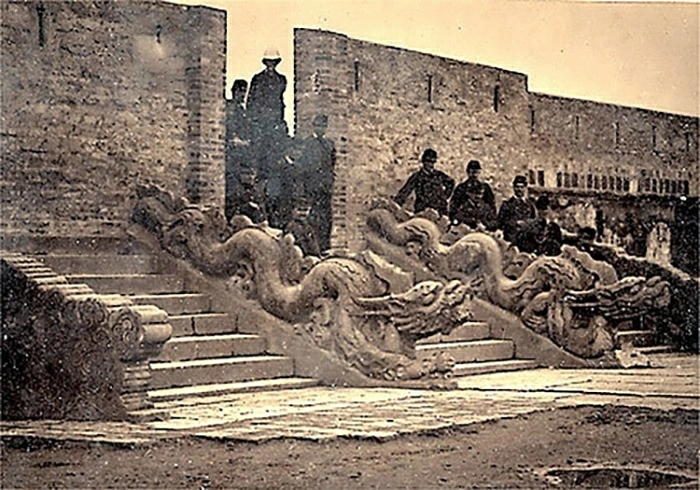 |
| French soldiers photographed on the steps of Kinh Thien Palace during their garrison period here. (Archival photo by Dr. Charles – Edouard Hocquard taken during 1884-1885). |
Notably, the relics of Long Thien Palace from the Nguyen period are located above the architectural layers of Main Hall of Kinh Thien from the Le So and Le Trung Hung periods.
The foundation system, drainage system discovered through excavations, further clarifies the structure of the building, while also showing the continuity and adjustments of the central space through different periods.
In the deeper layers, the foundation system of Kinh Thien Palace reveals a large scale and complex construction techniques. Archaeologists initially identified the structure as having 9 compartments in the East-West direction with 10 rows of columns and 5 compartments in the North-South direction with 6 rows of columns. The single, double foundation system and the core column foundation part show meticulous calculations in structural organization.
These discoveries not only help visualize the layout of an important palace structure of the Le period but also demonstrate how the power space was maintained in the same area through various dynasties.
Before Kinh Thien Palace, historical documents recorded the presence of structures such as Can Nguyen Palace, Thien An Palace from the Ly period, and Thien An Palace from the Tran period. The continuous stratigraphy of approximately 1,300 years opens up new research directions on the succession of power centers at the Thang Long Imperial Citadel.
After more than 15 years of research, the combination of archaeology, historical documents, and interdisciplinary sources increasingly helps to clearly identify the position, scale, and role of Kinh Thien Palace in the central Forbidden City area. This was once the central space of power and court rituals of Dai Viet for many centuries.
Reconstruction Needs More Pieces
The new archaeological results also raise questions about the reconstruction of Kinh Thien Palace. The foundation relics have provided much evidence about the layout, size, and structure of the building, but the complete appearance of the palace still depends on documents about architecture, art, and court space.
Dr. Architect Dao Ngoc Nghiem, former Director of the Hanoi Department of Planning and Architecture, assesses that the current archaeological results are quite convincing academically and have a basis for size, column spacing, and structure of the building.
However, according to him, reconstruction is not only a technical issue but also involves art, creativity, and spatial organization. Therefore, further research is needed to clarify artistic elements and architectural characteristics before reaching a highly accurate plan.
Dr. Pham Quoc Quan, Member of the National Cultural Heritage Council, believes that after nearly 16 years of excavation, the overall form of Kinh Thien is now gradually taking shape.
Meanwhile, Prof. Dr. Nguyen Quang Ngoc, Vice President of the Vietnam Association of Historical Sciences, emphasizes that the important goal of the research is to clearly and convincingly identify the form and structure of Kinh Thien Main Hall based on a combination of historical documents and archaeological relics.
With a heritage history of about 1,300 years, there are undoubtedly still many gaps in the documentation. However, these gaps pose the requirement to persistently decode each layer of relics to gradually complete the understanding of the past and provide more scientific basis for the preservation and promotion of heritage values.