




Khan Academy Tops TIME100 Companies 2026: When AI redefines teaching and learning instead of replacing teachers
In the recently announced TIME100 Companies list by TIME magazine, Khan Academy is recognised as one of the most influential educational organisations.
Latest
This is not merely a recognition of prestige, but also signals a significant shift: education is entering a phase in which technology, particularly AI, is no longer merely a supporting tool but is gradually becoming an integral part of the teaching and learning framework.
From a "tutoring session" to a global ecosystem
The story of Khan Academy began in 2004 when Sal Khan helped a cousin with math. The simple tutorial videos posted on YouTube in 2006 have since evolved into a platform serving hundreds of millions of learners worldwide.
However, what sets Khan Academy apart is not its scale, but its continuous questioning of a core issue: what role should technology play in teaching and learning?
In 2023, Khan Academy launched Khanmigo, an AI teaching assistant developed in collaboration with OpenAI. To date, this tool has reached approximately 1.4 million users. The notable aspect of Khanmigo is not its response speed, but its design: the AI does not provide immediate answers, encouraging students to explain their thought processes and engage in reasoning.
 |
| Khan Academy is recognised as one of the most influential educational organisations |
However, Sal Khan himself sets a very clear boundary: “If I had to choose between an excellent teacher and breakthrough technology for anyone's children, I would always choose the excellent teacher,” he said.
This perspective is also emphasised by Dr. Do Ngoc Minh, co-founder of the Khan Academy Vietnam (KAV) program. According to him, the value of AI in education should not be understood as replacing the teacher's role, but rather as enhancing the teacher's capabilities. When tasks can be standardised and supported by technology, teachers have more time to focus on core aspects of the learning process, such as guidance, interaction, and the development of students' thinking skills.
This viewpoint shows that AI is not an "independent solution" but is only effective when embedded in a human-centred educational ecosystem.
Therefore, Khan Academy is gradually shifting its role from a content provider to a learning infrastructure. In the coming phase, the platform aims to deeply integrate Khanmigo into school operations, making AI a part of classroom management rather than an external tool.
Additionally, the collaboration with TED and ETS to develop a bachelor's program in applied AI also indicates a greater ambition: to help shape the educational ecosystem in the AI era.
When AI is Not "Deployed" but "Co-Created"
In the context where AI is only truly effective when linked with humans and the educational system, the approach of Khan Academy Vietnam presents a noteworthy direction.
Instead of introducing a complete AI tool into the classroom, KAV opts for a more challenging approach: placing teachers at the centre of the technology adaptation process.
In practice, teachers not only use Khanmigo but also provide feedback, tests, and adjust AI responses to fit the Vietnamese classroom context.
This creates a significant distinction: AI is not only linguistically localised but also "pedagogically localised" to reflect teaching methods, learning styles, and classroom culture.
Feedback from teachers using Khanmigo reveals a common point: the greatest value of AI is not in "answering more correctly" but in freeing up time.
When tasks such as lesson planning, exercise design, or content differentiation are supported, teachers can focus more on core tasks: organising learning activities, interacting with students, and personalising the learning process.
In other words, AI does not directly create educational quality; it creates conditions for teachers to produce it.
From technology to educational ecosystem: The key to digital transformation
From these approaches, it is evident that digital transformation in education is not a technology problem but an organisational problem of teaching and learning.
As Dr. Do Ngoc Minh notes, if technology is only deployed as an isolated tool, its impact will be very limited. Only when embedded in an ecosystem of teachers, schools, and the parent-student community can technology create system-level change.
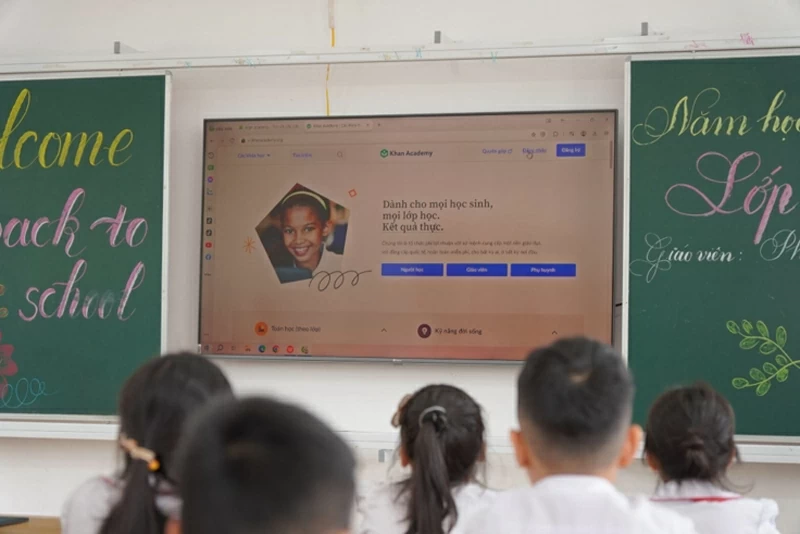 |
| Vietnamese students are gradually accessing AI more effectively |
This is also why KAV does not stop at the platform but has been implementing models such as Open Schools and Open Classrooms to connect technology with the practical operation of Vietnamese education.
Khan Academy's recognition in TIME100 Companies is not just about an organisation; it suggests a clear direction: AI will increasingly be deeply embedded in education, but effectiveness comes not from the technology itself but from how it is connected to people and systems.
In this context, the way Khan Academy develops AI and how KAV is adapting in Vietnam offer a thought-provoking approach: not replacing teachers with technology, but using technology to elevate teachers' roles.
And perhaps, that is the foundation for genuine breakthroughs in education.
| In Vietnam, the KAV program is implemented by the Vietnam Foundation, serving as the official and sole representative of Khan Academy USA. All learning content on the platform has been localised and synchronised with the 2018 General Education Program, helping students access knowledge suitable to the domestic context while maintaining international standards. In 2025, Khanmigo, the AI teaching assistant, launched a Vietnamese version, supporting teachers in lesson planning, designing learning activities, and personalising students' learning experiences. Alongside the learning platform, KAV implements models such as Open Schools and Open Classrooms, bringing technology into the practical teaching and learning process while expanding educational access opportunities for the community. |

| Discussion on National Growth and Development Models: Learning from International Experience for Vietnam WVR - On the afternoon of March 10, at the Diplomatic Academy, the scientific discussion “National Growth and Development Models: International Experience and Recommendations for ... |

| Diplomatic Academy of Vietnam continues strong performance at Débat de La Haye 2026 WVR - After more than two months of intense and challenging competition, the Diplomatic Academy of Vietnam (DAV) team, consisting of three members Le Anh ... |