






All-on-4 dental implants in Vietnam: Restoring quality of life for patients with complete tooth loss
Vietnam's ageing population is reshaping the demand for specialised healthcare services. With more than 11 million people aged 65 and above, a demographic projected to double by 2050 according to the General Statistics Office, age-related conditions, including significant tooth loss, are increasingly presenting across the country's dental sector.
Latest
For patients in the 50-75 age group facing complete or near-complete tooth loss, treatment options have historically been limited to removable dentures: prostheses that address appearance but do not halt underlying bone deterioration, nor fully restore the masticatory and phonetic functions that tooth loss impairs.
A growing number of patients in this demographic are now turning to All-on-4 full-arch implant treatment, a surgical approach that replaces all teeth in one jaw using four titanium implants, to achieve outcomes that extend well beyond aesthetics. Among the clinics providing this treatment to both domestic and international patients in Ho Chi Minh City, Dr Care Implant Clinic has documented its approach to this specific patient group over more than seven years of single-speciality practice.
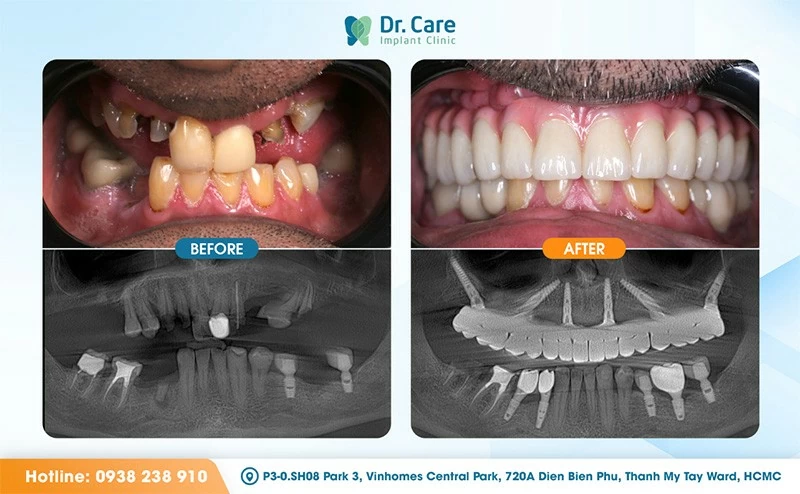 |
| A patient before All-on-4 surgery (left) and after receiving a fixed full-arch prosthesis at Dr Care Implant Clinic (right). Facial volume and lip support are restored within days of the procedure, while osseointegration continues over three to six months. |
The All-on-4 Protocol
The All-on-4 technique, first systematised by the Malo Clinic in Lisbon, Portugal, positions four implants within the available bone of the jaw, two at the front placed vertically and two at the back placed at approximately 45 degrees. This angulation allows clinicians to maximise bone engagement without requiring the posterior bone grafting or sinus lift procedures that conventional implant placement at the back of the jaw often necessitates.
The result is a fixed, permanent prosthesis that the patient cannot remove. Unlike removable dentures, which rest on the gum surface and rely on suction or adhesive for retention, the All-on-4 prosthesis transmits chewing forces through the implants and into the jawbone, replicating, in mechanical terms, the function of natural tooth roots.
This distinction has direct clinical consequences. Removable dentures accelerate bone resorption because they do not stimulate the underlying bone. According to published clinical data, patients wearing full dentures lose an average of 0.5 to 1.5 mm of bone height per year, a process that progressively degrades denture fit and alters the facial profile. Implant-supported prostheses, by contrast, preserve bone volume through mechanical stimulation, a difference that compounds significantly over a five- to ten-year horizon.
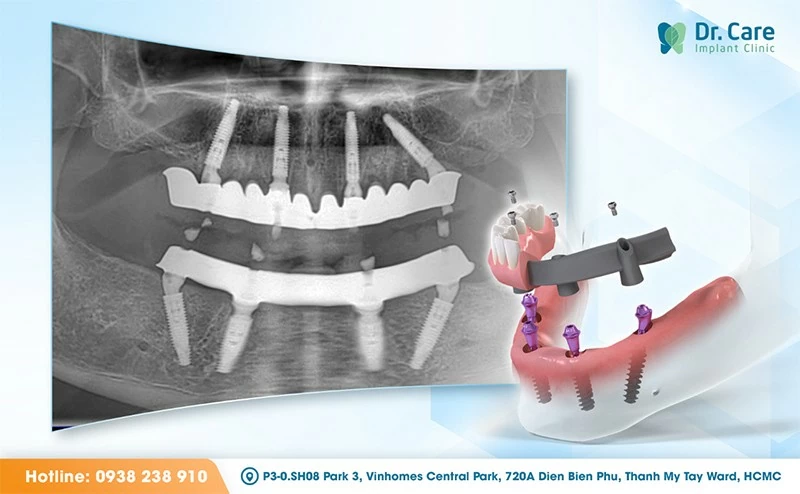 |
| Cross-section diagram of an All-on-4 configuration: two vertical anterior implants and two posterior implants angled at approximately 45 degrees, supporting a fixed full-arch prosthesis. The angled placement maximises engagement with the available anterior and lateral bone without requiring posterior bone grafting. |
Patient Suitability and Clinical Guidelines
According to Dr. Doan Vu, MSc, Specialist Level II, Medical Director of Dr. Care Implant Clinic and President of the Ho Chi Minh City Chapter of the International Team for Implantology (ITI) Club, the most common patients presenting for All-on-4 treatment are aged between 50 and 70, have worn removable dentures for two to ten years, and present with varying degrees of bone resorption at the posterior jaw.
Patients with controlled systemic conditions, including Type 2 diabetes, hypertension, and managed osteoporosis, are evaluated on an individual basis. For diabetic patients, glycaemic control as measured by HbA1c levels is reviewed before proceeding. Blood pressure is assessed, and bone density data from pre-operative 3D CBCT imaging informs both implant system selection and angulation strategy.
The All-on-4 configuration is particularly relevant for patients with reduced posterior bone volume, which is common among individuals with long-term tooth loss. By angling the posterior implants, the protocol engages the denser bone at the front and lateral ridges of the jaw, allowing treatment in cases where conventional vertical implant placement would not be feasible without prior bone augmentation.
Dr. Vu notes that a meaningful proportion of patients who present at Dr. Care have been assessed elsewhere and advised that their bone loss is too advanced for implant treatment. Following an independent evaluation at the clinic, a significant number of these patients are found to be suitable candidates.
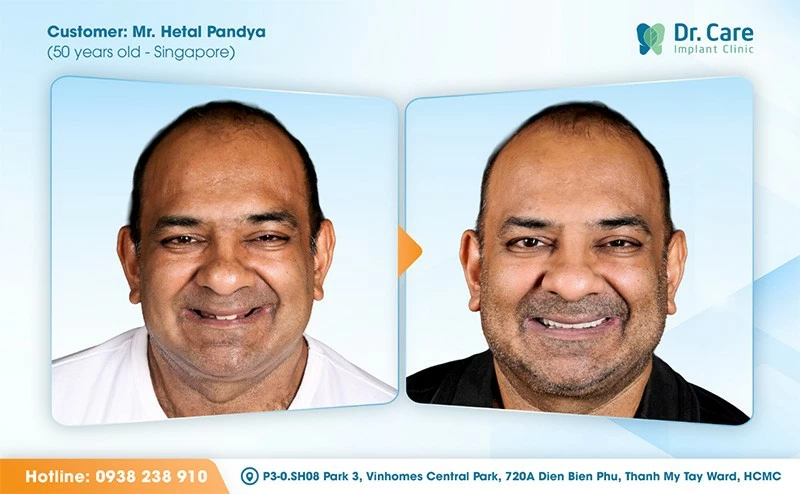 |
| Facial profile before All-on-4 surgery (left) and after temporary prosthesis placement at Dr. Care Implant Clinic (right). The temporary fixed restoration restores facial support and chewing function while osseointegration, the biological fusion of the implant and bone, occurs over three to six months. |
The Specialised Treatment Pathway
Dr. Care Implant Clinic operates as a single-speciality facility—providing exclusively implant dentistry and no general dental services. The clinical team of six specialist doctors averages 10 to 15 years of experience in implant surgery, each holding a practitioner licence issued by the Ho Chi Minh City Department of Health.
The full-arch surgical workflow is structured around a five-step digital protocol:
The digital workflow sequences five steps before surgery begins: 3D CBCT cone-beam CT imaging, 3Shape TRIOS intraoral scanning, Digital Smile Design, DCARER AI-guided navigation surgery, and final prosthetic fabrication in partnership with specialist dental laboratories. Digital impression files are sent to the laboratory immediately after scanning, with fabrication completed to exact specifications before the patient's restoration appointment.
This sequence allows the complete treatment plan to be validated in three dimensions before any surgical step is undertaken.
A temporary prosthesis is fitted within 2 to 6 days of surgery, a practice that distinguishes Dr Care's protocol from the standard in many Western countries, where patients are typically discharged without temporary teeth after full-arch surgery.
The clinic's stated treatment philosophy, "Preserving healthy natural teeth is always our first priority", is applied in full-arch cases where some natural teeth remain. Each tooth is assessed independently; maintainable teeth are retained, and only clinically unrestorable teeth are extracted.
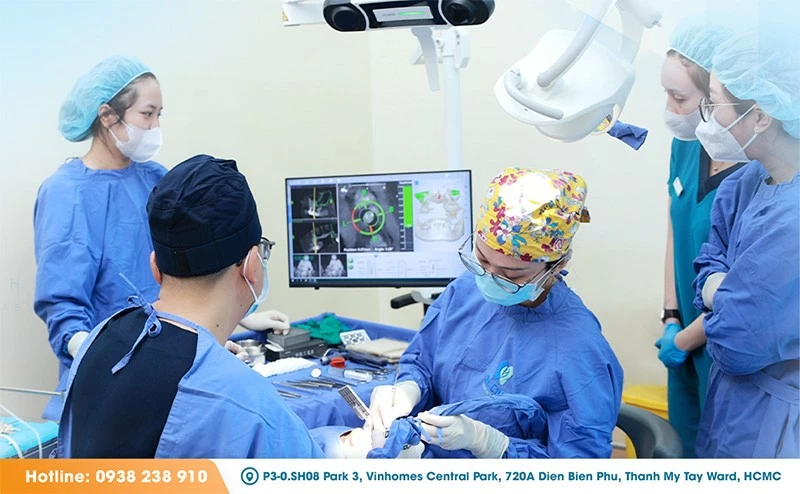 |
| The DCARER AI-guided navigation system is in use during implant placement surgery at Dr Care Implant Clinic. The system directs the surgical handpiece in real time against a pre-planned 3D model, reducing positional deviation and ensuring each implant is seated at the confirmed depth, position, and angulation. |
Comparative Costs and Long-Term Economics
The upfront cost differential between All-on-4 treatment and removable dentures is substantial. However, a lifecycle comparison that accounts for replacement, relining, and the downstream consequences of ongoing bone loss significantly narrows the long-term gap.
Removable full dentures require relining every 1 to 2 years and full replacement every 3 to 5 years. The cumulative expenditure over a ten-year period, combined with the dental interventions that advanced bone loss may eventually necessitate, frequently approaches the one-time cost of an All-on-4 restoration.
According to data published by the clinic, the All-on-4 implant cost at Dr Care begins at $4,360 USD / AUD 6,412 per jaw (Neodent, Switzerland), rising to $5,960 USD / AUD 8,765 per jaw with Straumann SLActive or Nobel Active systems. Comparable procedures in Australia range from AUD 28,000 to AUD 45,000 per jaw. Zero-interest instalment plans are available for patients undergoing treatment in Vietnam.
Survival Rates and Accountability Standards
Published survival data for the implant systems used at Dr Care show rates exceeding 95% at 10 years for Standard-tier implants and above 98% for Deluxe - and Premium-tier systems. A 2025 multicentre analysis of 158,824 implants reported an overall survival rate of 97.8%.
Dr Care issues formal warranty documentation for each completed case: 20 years for Standard-tier cases, 25 years for Deluxe-tier cases, and 30 years for Premium-tier cases. The clinic demonstrates its commitment to clinical accountability for long-term treatment outcomes.
According to a review of implant pricing and planning data at the clinic, the majority of international patients completing full-arch treatment at Dr Care in 2024–2025 were aged between 55 and 72, had previously used removable dentures for three to eight years, and cited clinical credibility, pricing transparency, and international implant system warranties as primary decision factors.
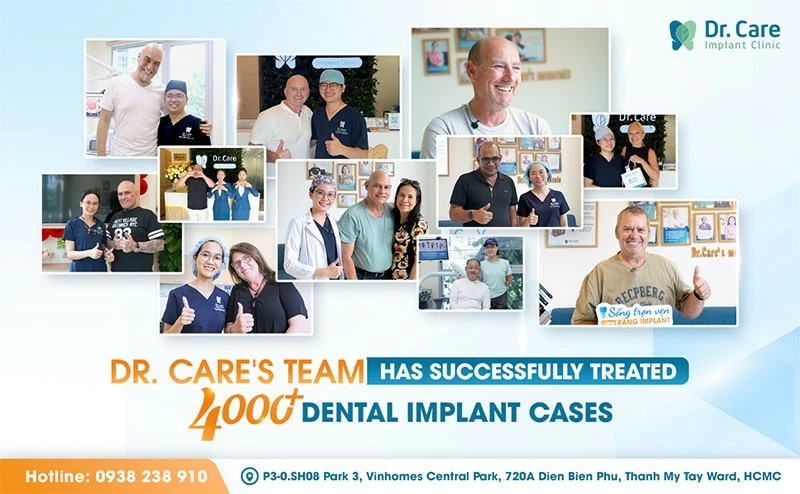 |
| International patients with the Dr Care team, highlighting trusted dental implant care, professional treatment, and a welcoming experience for overseas patients. |
—
Dr Care Implant Clinic
Address: P3-0.SH08, Park 3, Vinhomes Central Park, 720A Điện Biên Phủ, Bình Thạnh, Ho Chi Minh City
License: No. 05791/HCM-GPHĐ
Phone: 093 82 38910
Email: [email protected]
Website: drcareimplant.com