





Vietnam transfers fertility technology to France
French Consul General in Ho Chi Minh City Etienne Ranaivoson described the technology transfer to France as a vivid evidence of over-30-year health cooperation between the two countries.
Latest
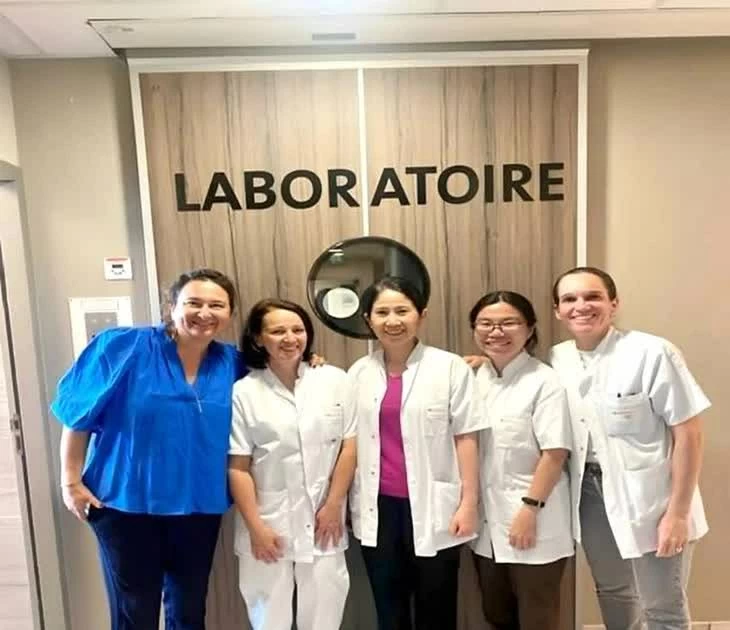 |
| Key members of the OPKAPAMIV research project at Saint Joseph Hospital, France. (Photo: tuoitre.vn) |
Biphasic IVM delivery
In early April 2026, Assoc. Prof. Vuong Thi Ngoc Lan, Vice Rector and head of the Department of Obstetrics and Gynaecology at the Ho Chi Minh City University of Medicine and Pharmacy, and Le Hoang Anh, Lab Director at the My Duc Hospital, travelled to Marseille to guide the rollout of a biphasic in vitro maturation (IVM) technique at Saint Joseph Hospital.
French doctors had visited Vietnam four years earlier to study the biphasic IVM model. Upon their return, they began clearing administrative hurdles, investing in equipment, and screening patients for the new technique, with Vietnamese experts slated to support the launch.
How French doctors turn to Vietnam
In autumn 2021, Dr Isabelle Koscinski joined the assisted reproduction unit at Saint Joseph Hospital. Her first months were spent mapping a system that had run smoothly for years.
Though IVM wasn’t new in France, Koscinski remained unconvinced by the efficacy and biological logic of conventional approaches. She saw room for improvement rather than a need to discard established methods.
A turning point came in July 2022 at the annual conference of the European Society of Human Reproduction and Embryology (ESHRE) in Milan, Italy, where Vietnamese fertility specialist Ho Manh Tuong presented the biphasic IVM protocol and its outcomes.
The presentation hooked her instantly, not only the clinical results, but the philosophy behind them: minimal hormonal intervention paired with optimised oocyte quality.
Back in France, Koscinski threw herself into the technique, reviewing every publication, picking apart the data, and studying its scientific foundations.
She then consulted Prof. Johan Smitz to map out the next steps. “I convinced the hospital’s management to fund my training so I could attend a biphasic IVM course in Vietnam in October 2022”, Koscinski said.
A four-year research project
While Koscinski absorbed the theory fast, bringing the technology to France became a four-year undertaking. The French team had to erect an extensive legal and regulatory framework before any clinical work could begin.
At the same time, a tri-country research alliance took shape for the OPKAPAMIV research project. Smitz’s Belgian group supplied scientific expertise and culture media. The Vietnamese team, comprising Vuong Thi Ngoc Lan and Le Hoang Anh, delivered technical support and training. Koscinski’s French unit handled patient recruitment, preparation, and oocyte cryopreservation.
Another obstacle involved the physical distance between the operating room and the embryology lab. Saint Joseph Hospital solved it by building a temperature-controlled workstation with a high-magnification microscope directly inside the operating theatre, enabling immediate handling of retrieved oocytes.
After four years of preparation, the project finally entered its clinical phase in April 2026. The first four oocyte retrieval procedures were performed on April 8 and 9 at the hospital, with the visiting Vietnamese doctors directly involved.
Koscinski confirmed that technical support from her Vietnamese colleagues was instrumental in getting the OPKAPAMIV research project off the ground.
French Consul General in Ho Chi Minh City Etienne Ranaivoson, for his part, described the technology transfer as a vivid evidence of over-30-year health cooperation between the two countries.
Vietnam’s supply of assisted reproductive technology to a French facility shows that the support has flipped from a one-way flow into a two-way exchange of know-how, he said.
(Source: VNA)