





Ho Chi Minh's legacy and the aspiration for a strong Vietnam
WVR - On the occasion of President Ho Chi Minh's birthday, his ideological, ethical, and stylistic values continue to be affirmed as an important spiritual foundation for Vietnam's foreign affairs in the era of integration.
Latest
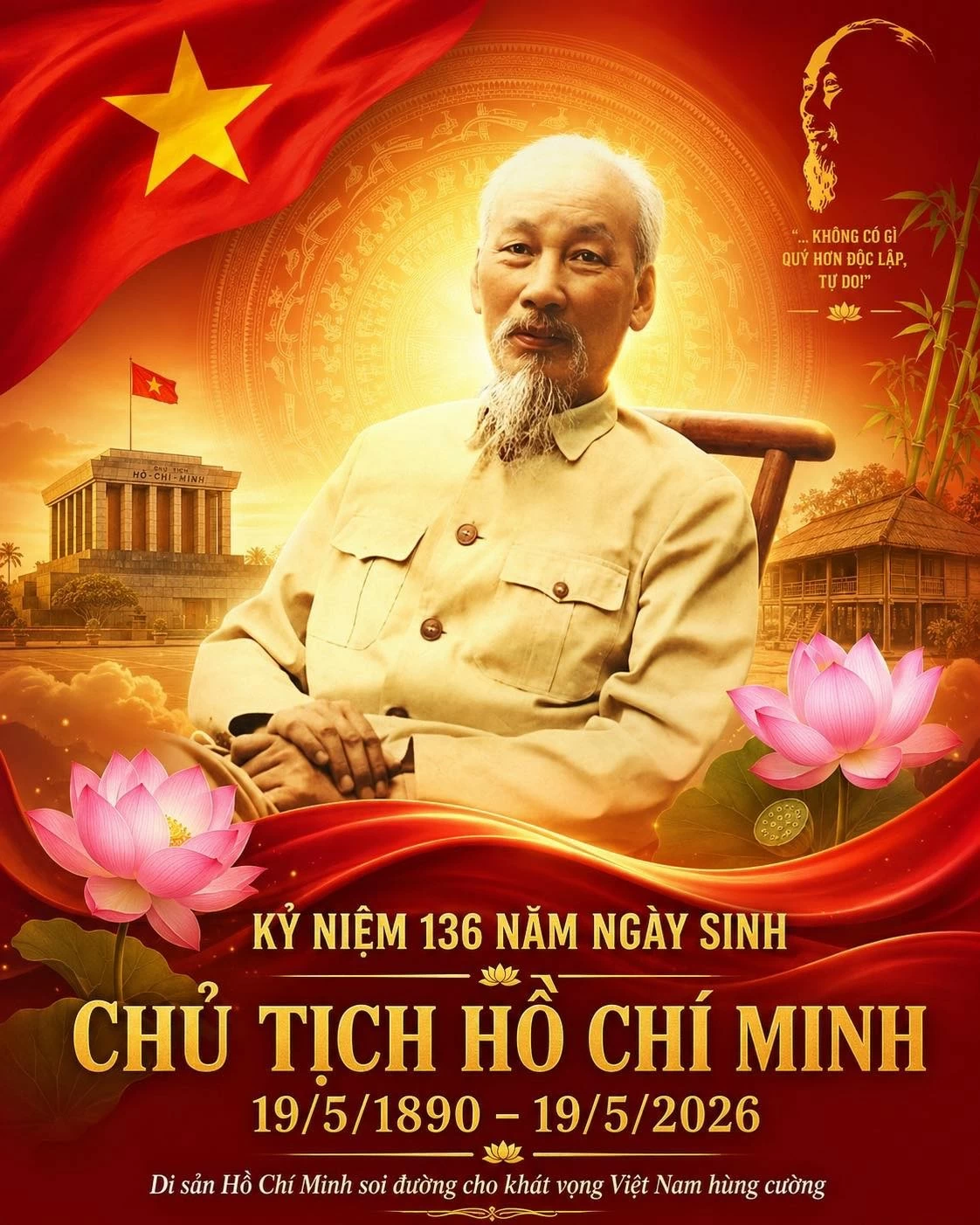 |
| Ho Chi Minh's ideological legacy always plays a guiding role in the development of the country and Vietnam's diplomacy. |
As May arrives, every Vietnamese heart is filled with deep emotion remembering President Ho Chi Minh – the beloved leader of the nation, a hero of national liberation, and an outstanding cultural figure.
For Vietnamese expatriates, especially diplomats on the front lines of foreign affairs, his birthday is not only a time of remembrance and gratitude but also a moment for self-reflection on what has been done, what can be done, and what needs to be done to be worthy of the great legacy he left behind.
It can be said that President Ho Chi Minh is the epitome of the aspiration for independence, freedom, and the dignity of the Vietnamese nation.
From his journey to find a way to save the country in 1911, he carried with him the pain of losing the nation, the aspiration for national liberation, and a deep faith in the power of the people.
Throughout his revolutionary life, he not only found the right path for Vietnam's national salvation but also laid the foundation for a broad development vision: National independence must be linked with the freedom and happiness of the people; national sovereignty must go hand in hand with human dignity; national liberation must align with the progressive flow of humanity.
Thus, Ho Chi Minh's legacy is not only found in the historical milestones of the 20th century but also present in the thinking methods, action styles, and conduct of Vietnam today.
He also laid the foundation for modern Vietnamese diplomacy: Independent, self-reliant yet open; principled yet flexible in strategy; prioritizing national interests but always associated with responsibilities for peace, friendship, and human progress.
President Ho Chi Minh's philosophy of “making more friends, reducing enemies”, his spirit of peace, humanity, and respect for justice and righteousness, continues to illuminate Vietnam's foreign affairs in this era of deep integration.
From his ideology, we understand more deeply that diplomacy is not just about ceremonies, documents, or negotiations, but first and foremost an art of building trust, connecting people, and protecting national interests with intelligence, courage, and sincerity.
Building a Vietnam with an increasingly prominent position on the international stage.
In the crucial moments of history, President Ho Chi Minh always knew how to combine national strength with the strength of the times, turning Vietnam's aspiration for independence into a voice that resonates with the progressive conscience of the world.
Today, in a volatile international environment, that lesson is even more valuable: Vietnam needs to persist in its path of independence, self-reliance, multilateralization, diversification, being a friend, a reliable partner, and a responsible member of the international community.
Ho Chi Minh's legacy is also the spiritual foundation for the aspiration to build a strong and prosperous Vietnam in the 21st century.
If in the last century, the greatest aspiration of the nation was independence and freedom, today, that aspiration is continued by the goal of building a developed, prosperous, and happy Vietnam with an increasingly prominent position on the international stage.
The goal by 2030 is for Vietnam to become a developing country with modern industry and high middle income, and by 2045, to become a developed, high-income country, which is the concretization of that aspiration in the new era.
To realize the aspiration for a strong Vietnam, Ho Chi Minh's ideology still opens up core values: Taking the people as the root, promoting great national unity, emphasizing self-reliance, valuing talent, focusing on education, developing culture, building public service ethics, and awakening the will to rise in every Vietnamese person.
A strong nation is not only measured by economic scale, growth rate, or technological achievements but also by cultural bravery, human quality, social justice, the people's trust, and the ability to contribute positively to global peace, stability, and development.
From these ideological values, today's Vietnamese diplomacy continues to apply Ho Chi Minh's spirit in foreign affairs practice, from multilateral forums to activities connecting and promoting the country's image in many regions around the world.
From Kazakhstan, looking toward the homeland
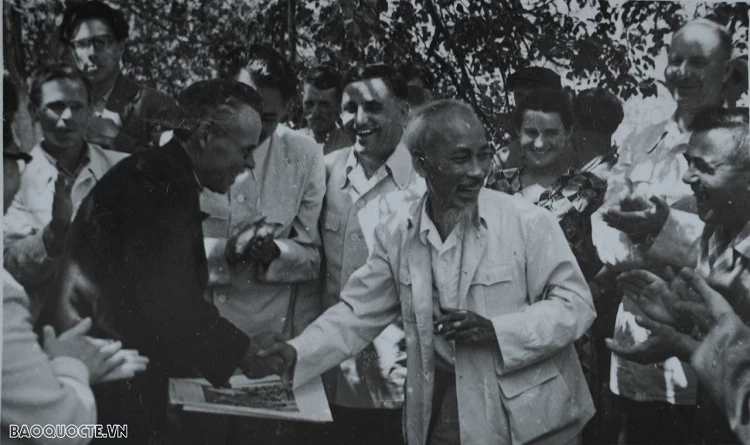 |
| Image of President Ho Chi Minh's visit to Kazakhstan in July 1959. (Source: Vietnamese Embassy in Kazakhstan) |
From Kazakhstan, a vast country at the heart of the Eurasian space, Vietnamese diplomats feel even more the value of the word "Homeland".
Away from home, every red flag with a yellow star, every meeting with international friends, every cultural promotion event, every discussion on economic, educational, scientific, and technological cooperation reminds us that behind daily work is the national image, the people's trust, and the responsibility to the country.
Witnessing Kazakh and international friends increasingly interested in and respecting Vietnam, a peace-loving, dynamic, innovative, rich in identity, and responsible country, we are even more proud of the path the nation has taken under the light of Ho Chi Minh's ideology.
The Vietnam-Kazakhstan friendship is a vivid part of that diplomatic journey.
Although geographically distant, the two countries share many similarities in their development aspirations, in their desire to expand cooperation, connect Eurasia, promote people-to-people exchanges, and contribute to regional peace and stability.
In the context of Vietnam and Kazakhstan continuously deepening bilateral relations, the task of diplomacy is not only to promote political, economic, trade, investment, educational, cultural, and scientific-technological cooperation but also to tell the story of Vietnam in a truthful, convincing, and inspiring way to local friends.
Learning from Uncle Ho, for diplomats, is not something distant or confined to solemn words on commemorative occasions.
Learning from Uncle Ho begins with specific actions: Working diligently, behaving modestly, matching words with deeds, prioritizing national interests, maintaining pure qualities, and constantly learning to improve skills, bravery, and adaptability.
In the new era, every diplomat needs to be a "messenger" of the country: Professional in work, humane in behavior, creative in implementation methods, steadfast in principles, and flexible in actions.
Commemorating President Ho Chi Minh's Birthday, we not only remember a great historical figure but also remind ourselves of the responsibility to continue the path he opened.
Ho Chi Minh's legacy does not belong solely to the past; it is still alive in every step of Vietnam today, in the nation's aspiration to rise, in the country's integration bravery, and in the service consciousness of every Vietnamese, whether at home or abroad.
From the heart of a diplomat, that belief becomes even more profound: Under the light of Ho Chi Minh's ideology, ethics, and style, Vietnam will continue to stride confidently on the path of building a peaceful, independent, self-reliant, humane, and strong nation in the 21st century.


