





President Ho Chi Minh’s leadership thinking holds enduring practical value: Alpha Books CEO Nguyen Canh Binh
WVR - From his experience in research, teaching, and business management, Alpha Books CEO Nguyen Canh Binh believes that exploring the leadership thinking of President Ho Chi Minh has provided many practical lessons for management, organizational building, and human development today.
Latest
In an interview with The World and Vietnam Report on the occasion of the 136th anniversary of President Ho Chi Minh’s birth, CEO Nguyen Canh Binh shared that his reflections on Ho Chi Minh stem not only from the pride of being a native of Nghe An, but also from the perspective of a researcher in management, education, and leadership in the context of globalization.
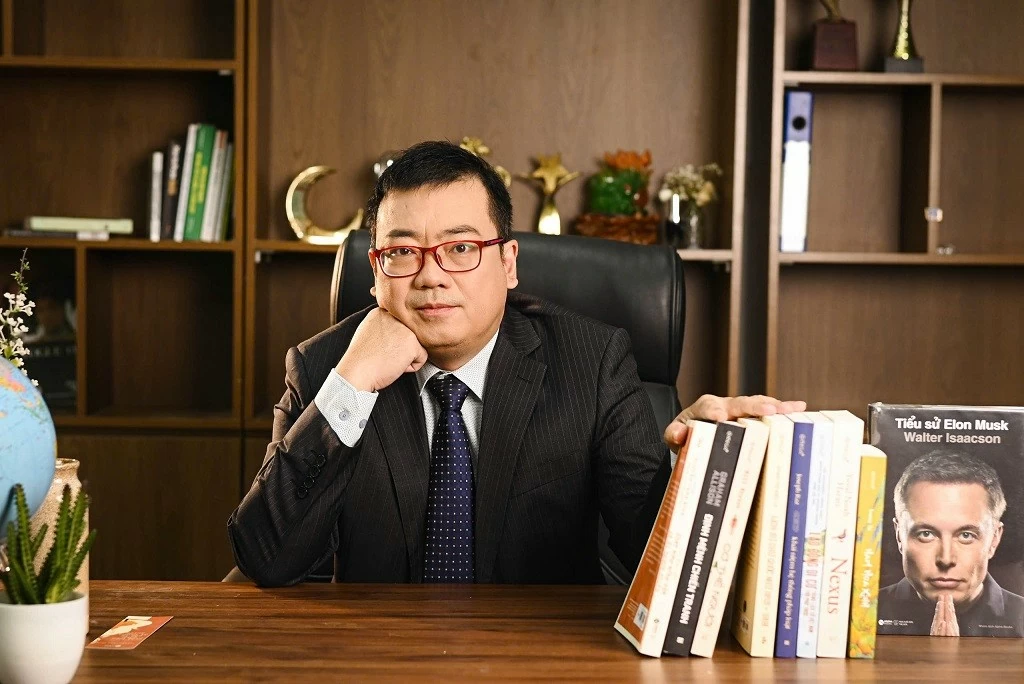 |
| Nguyen Canh Binh is currently the Chairman of the Board of Directors of Alpha Books Joint Stock Company and Director of the ABG Leadership Institute. (Photo courtesy by the author) |
What makes you particularly interested in researching and sharing the leadership and strategic thinking of President Ho Chi Minh?
I am originally from Nghe An, and from my father's hometown (Do Luong) to Nam Dan is not far, so from a young age, I had many opportunities to visit Sen village, Hoang Tru village, and other places associated with President Ho Chi Minh's life.
Initially, it was out of respect and pride like many other Vietnamese, but the more I traveled, read, and interacted with the world, the more I began to view President Ho Chi Minh from a different perspective, as a leader with very unique strategic thinking.
This perspective also comes from my work in research and business management, teaching at the ABG Leadership Institute... When studying business and leadership, we often research Bill Gates, Steve Jobs, Lee Kuan Yew, or Mahathir Mohamad to understand how they seize opportunities, build organizations, and utilize people.
I also posed the question, why don't we seriously study President Ho Chi Minh as a great leadership case of Vietnam? Why do we only learn from other figures and not from him?
From a colonial country, in extremely difficult conditions, he found a path to independence, built organizations, gathered forces, and seized international opportunities. The more I research, the more I see places like Nam Dan, Boston, London, Guangzhou, or Pac Bo not just as historical sites but as links in Ho Chi Minh's thinking journey.
According to you, what is the greatest value in Ho Chi Minh's thought that today's generation can learn from?
In the past, Vietnamese people could learn from the example of patriotism, from the virtues of thrift and integrity... but today we need to learn the capacity for strategic thinking and the extraordinary ability to act on great tasks.
Many patriots also aspired for national independence. Hoang Hoa Tham initiated uprisings, Phan Boi Chau sought a path to Japan, Phan Chu Trinh chose reform and enlightenment... But Ho Chi Minh delved deeper: What is the essence of the era, which forces can bring change, where should Vietnam stand in the international flow, what organization is needed, and when.
That is strategic thinking. For example, the Binh Dan Hoc Vu was not just about eradicating illiteracy but a strategy for human development. An independent nation where most are illiterate finds it difficult to control its destiny. A great leader makes key decisions, significant transitions, and finds ways/builds mechanisms for the entire populace to participate in implementation.
Diplomacy in 1946 is also a major lesson in handling difficult situations: Maintaining young independence while avoiding unfavourable confrontations. The spirit of "di bat bien, ung van bien" (unchanging principles, flexible approach) is very modern: The core goal remains unchanged, but the method must be flexible.
The Declaration of Independence in 1945 and the Constitution of 1946 demonstrate profound international thinking. Quoting the U.S. Declaration of Independence and the French Declaration of Human Rights was not only to speak to Vietnamese but also to dialogue with the world in the language of universal values.
Unfortunately, we often stop at recalling slogans or remembering events without deeply analyzing President Ho Chi Minh's decisions: Why choose that time, why choose that approach, why choose those associates? These questions are very close to modern management: Which goals to choose, when to choose, whom to choose, and how to adapt in a constantly changing context.
Do you have any practical experiences that help you gain deeper insights into these lessons?
The most meaningful experience for me was the Omni Parker House hotel in Boston, where President Ho Chi Minh lived and worked in 1912. Initially, like any tourist curious about the journey of a patriot, I took photos, visited the basement, and the hotel kitchen where he made pastries...
But then, upon returning, questions kept arising in me: Why did Nguyen Ai Quoc come here and not another city? And why did he choose this hotel and not another? If he was here, besides making pastries, what else did Nguyen Ai Quoc do, learn, or whom did he meet?
Such questions led me to research and delve deeper. I spent many days exploring Boston, following the Freedom Trail, visiting City Hall, the Massachusetts State House (from 1900-1915, not the modern buildings today), and the cemetery of American Revolution heroes just a 5-10 minute walk away...
And then suddenly, answers emerged within me, as if I found the link in Nguyen Ai Quoc's chain of actions, imagining what he thought over 100 years ago, how his thinking was.
Perhaps Nguyen Ai Quoc once asked: Has any country in the world also been a colony and then fought for independence? Clearly, he would find the answer: It was America, those colonies on the Atlantic coast that rose against the British and gained independence, then built a great nation.
Therefore, Nguyen Ai Quoc decided to visit the place where that revolution occurred, which is Boston, the heart of the American Revolution, where American thoughts on freedom, human rights, and national models emerged.
When a Vietnamese in the early 20th century arrived there, without money or acquaintances, an ordinary person would likely choose the suburbs, poor areas, factories, cheap lodging...
But Nguyen Ai Quoc lived and worked in one of the largest, most luxurious hotels in downtown Boston, which I think was not just about making a living. It was also about courage, breakthrough thinking, having the opportunity to observe a society from the inside.
From that, I realized that leaders differ from ordinary people in that they know how to learn from their surroundings. In the same city, some only see a place to earn a living, while others see the power structure, culture, and lessons for the future.
What aspects of President Ho Chi Minh's thought and leadership style are young people most interested in today?
Today, young people are most interested in three issues: Decision-making, timing, and utilizing people. Entrepreneurs also want to understand how truly great President Ho Chi Minh was, how he thought and acted, beyond the familiar lessons of thrift, integrity, and impartiality...
Firstly is the thinking in decision-making. In the early 20th century, there were many paths to national salvation. Ho Chi Minh not only chose immediate actions but sought the essence of the problem: To gain independence, there must be organization, mass forces, and Vietnam must be placed in an international context. Today's youth also face many choices: What to study, what to do, how to start a business, which path to choose? Therefore, they want to understand what constitutes a correct strategic decision, not just one that feels right emotionally.
Secondly is the thinking in choosing timing. Why did President Ho Chi Minh return to Vietnam in 1941? Why did the August Revolution occur in 1945? Why choose September 2, 1945, and not September 3, 4, or 5? In leadership, a correct decision at the wrong time can still fail. He demonstrated a very special ability to recognize opportunities.
Thirdly is the way of utilizing people. An organization cannot develop without a team suitable for each stage. President Ho Chi Minh was very insightful in this regard: He chose people suitable for the mission and common goals rather than narrow criteria.
These are all lessons very close to modern management.
Why do the seemingly familiar thoughts of President Ho Chi Minh still have the potential to inspire new thinking for the present?
Within those familiar thoughts lies a very deep system of thinking. Within great leaders, there are many lessons, thoughts, and ideas that we have not fully understood.
For example, "di bat bien, ung van bien" is not only a diplomatic principle but also a management principle. An organization or a nation needs to determine its core values that do not change, but the methods and implementation must be flexible according to circumstances.
Or when talking about Ho Chi Minh's spirit of learning, what is worth learning is not just the eagerness to learn but the way of learning. He learned from books, from labour, from observing society, from many cultures, and from practice. Boston, London, or Versailles show that Ho Chi Minh did not learn in a closed space. He placed himself in the world's major centres to observe how society operated and then thought for Vietnam.
Therefore, Ho Chi Minh's thought is not a closed ideology but a method of thinking: Always engaging with reality, always learning, always seeking the essence of the problem, and linking ideals with concrete actions.
The challenges of today's era are immense, so how would outstanding leaders respond, think, and act in the face of these challenges? If it were Ho Chi Minh, what would we do? If President Ho Chi Minh were alive, what decisions would he make?
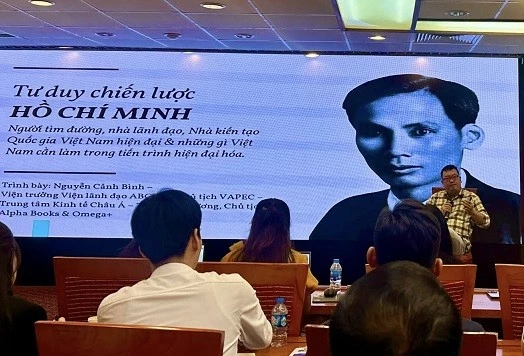 |
| Nguyen Canh Binh during a thematic talk on Ho Chi Minh's strategic thinking with young leaders. (Photo courtesy by the author) |
Which lessons from Ho Chi Minh's thought have you applied in your work and life?
I have learned many things, especially four major lessons:
The first lesson is to identify the central issue correctly. President Ho Chi Minh always went to the heart of the matter: To understand America, go to Boston; to understand the British Empire, live in London; to bring Vietnam's issues to the world, appear in Versailles.
In my work, it's the same. When building Alpha Books or leadership training programs for young leaders, I always ask myself: What is the core issue? Making books is not just about selling books but about enhancing the thinking capacity of society.
The second lesson is the thinking of finding models. President Ho Chi Minh went out into the world to observe organizational, educational, state, and social movement models. He compared, selected, and adjusted them to fit Vietnam. I also always ask: What models exist in the world, why did they succeed or fail, and what can Vietnam learn without blindly copying?
The third lesson is the way of utilizing people according to each stage. An organization needs different types of capabilities at different times. President Ho Chi Minh showed the ability to gather many different people as long as they could contribute to the common goal.
The final lesson is the spirit of lifelong learning. President Ho Chi Minh learned languages, culture, politics, journalism, learned from the people and from practice. I think if a leader stops learning, the organization will gradually stop developing.
Perhaps the deepest lesson I learned is: A great leader is not just someone with power, but someone who knows how to learn throughout life, knows how to gather people, and is persistent with a goal greater than themselves.


