


General urban planning of Quang Ninh: Creating a new growth pole in the northern region
WVR - The approval of the General Urban Planning of Quang Ninh by the Prime Minister, extending to 2050 with a vision to 2075, marks the completion of the development framework for Quang Ninh City since its establishment, ushering in a new phase of long-term development.
Latest
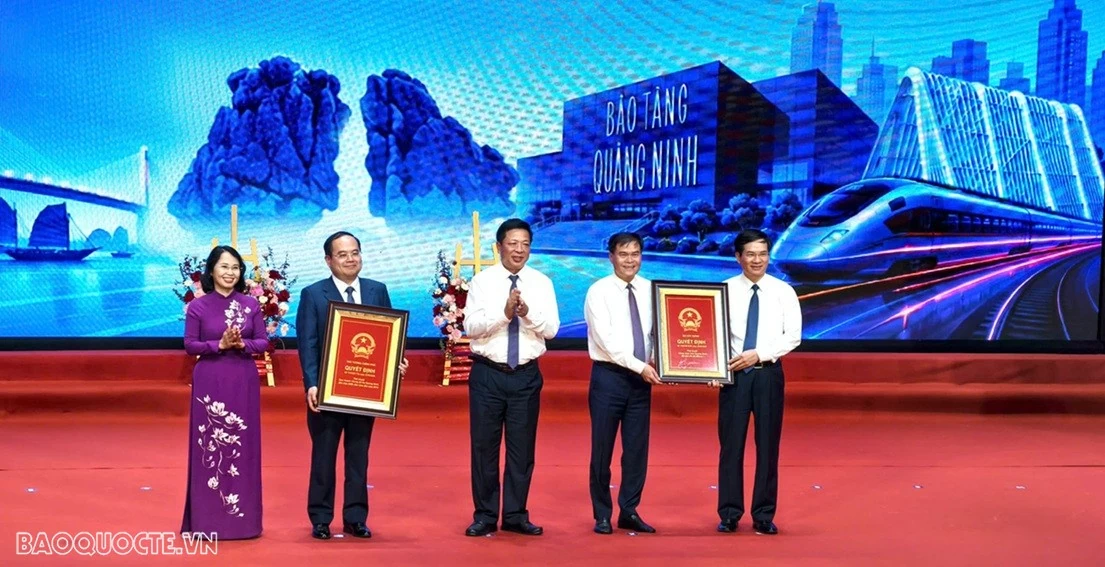 |
| Mr. Tran Hong Minh, Member of the Central Committee of the Party, Minister of Construction, hands over the Decision on the General Urban Planning of Quang Ninh to 2050, with a vision to 2075; the Decision recognizing Quang Ninh Province as meeting the criteria for a Grade I urban area to the leaders of Quang Ninh Province. (Photo: Tong Thoan) |
The General Urban Planning of Quang Ninh to 2050, with a vision to 2075 (general planning), was approved under Decision No. 1123/QD-TTg dated June 23, 2026, by the Prime Minister, aiming to build Quang Ninh into a modern, smart, green, and sustainable centrally governed city.
A new vision for a new urban area
For Quang Ninh, the general planning serves as the “guiding star” for its transformation from a development space based on administrative boundaries to a unified, modern, and integrated urban model. The distinguishing feature of this planning lies in its comprehensive approach.
Instead of developing in isolated areas, the entire administrative boundary of Quang Ninh City is defined as a unified development space, organized into a multi-center model where urban areas, industrial zones, economic zones, coastal areas, mountainous and rural areas are connected in a harmonious development entity.
This marks a significant shift in planning mindset. Urban space is no longer merely seen as a place for population concentration or construction expansion but as a foundation for resource allocation, investment attraction, economic development, and improving living quality. The general planning thus not only addresses current needs but also creates room for new growth drivers in the future.
According to the assessment of the Appraisal Council of the Ministry of Construction before the planning was approved, Quang Ninh has gathered many favorable conditions in terms of infrastructure, urbanization rate, and development quality. However, becoming a centrally governed city also means higher requirements for governance capacity, growth quality, green development, and regional competitiveness.
One of the greatest values of the planning is clearly establishing the development structure of Quang Ninh City in the future. According to the implementation plan, by 2030, the locality will complete about 70 urban and functional area subdivision plans, 18 general commune-level plans, along with specialized plans on transportation, water supply, drainage, elevation, and underground space. This will provide a crucial legal basis for implementing synchronized investment projects, avoiding fragmented development, and effectively exploiting land resources.
The development space will be expanded along coastal urban chains, economic zones, industrial zones, and strategic transportation corridors. The urban development model associated with public transportation (TOD) is identified as a consistent orientation to enhance land use efficiency, reduce traffic pressure, and form modern urban centers.
Notably, for the first time, specialized plans are required to be integrated on a GIS platform, creating a foundation for building a smart urban management system, operated by digital data, and gradually forming a modern urban governance model.
Over the past decade, Quang Ninh has made its mark with a series of large-scale infrastructure projects such as highways, international airports, deep-water seaports, and inter-regional connecting bridges. In the upcoming period, the development focus will shift strongly towards improving urban space quality, public service quality, and the quality of life for residents.
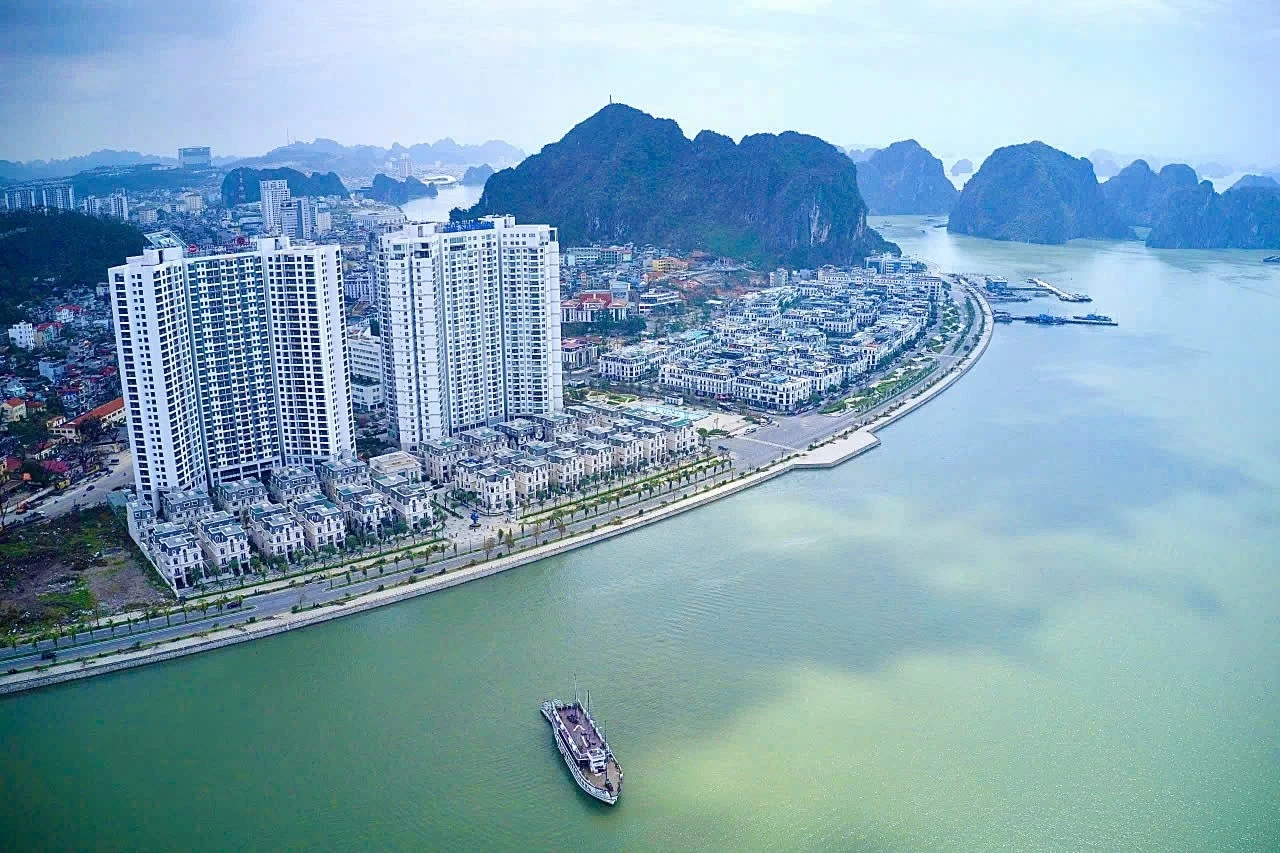 |
| The general planning not only expands urban space but also restructures the development drivers of Quang Ninh. (Photo: Nhat Minh) |
From a local growth pole to a strategic link in the region
The general planning not only expands urban space but also restructures the development drivers of Quang Ninh. According to the orientation, Quang Yen, Cam Pha, Quang Ha, and Mong Cai will be synchronously invested to develop high-tech industries, seaports, logistics, energy, and marine economy. Meanwhile, Van Don Special Zone is oriented to become a high-end service, marine economy, and international tourism center.
This indicates that Quang Ninh is moving towards a multi-polar development model, where each area assumes a distinct function but is closely connected by transportation infrastructure, logistics, and digital platforms.
According to Mr. Nguyen Thanh Hai, Chairman of the People's Committee of Mong Cai Ward 1, the approval of the general planning opens up significant development potential for the locality, especially in attracting investment, developing border gate infrastructure, trade, and services. While creating more jobs and raising income for residents, the general planning also provides conditions to maximize the advantages of the gateway area for trade with China.
On a broader scale, the new planning will contribute to increasing Quang Ninh's attractiveness to high-quality foreign direct investment (FDI) flows.
As the global supply chain continues to restructure, investors increasingly prioritize localities with modern infrastructure, clean land funds, multi-modal connectivity, and a transparent investment environment. These are all advantages that Quang Ninh has built over the years and will continue to reinforce through the new planning.
Moreover, the significance of the General Urban Planning of Quang Ninh extends beyond a single locality. In the context of the Northern Region forming an increasingly tight economic linkage network between Hanoi, Hai Phong, Quang Ninh, and the Northeastern provinces, Quang Ninh is expected to become a crucial connection point of the coastal economic corridor as well as an international trade gateway with China and the Northeast Asia region.
Unlike before when localities developed with relatively independent thinking, the new planning aims to build a complementary urban network, connected by highways, seaports, airports, waterways, and logistics centers. This will be the foundation for Quang Ninh to participate more deeply in regional and global value chains.
This advantage becomes even more apparent as Quang Ninh is one of the few localities in the country that gathers all four types of strategic transportation: road, sea, air, and international border gates. As the logistics system continues to be perfected, the mining land will not only serve the development needs of the locality but also become a transshipment hub for the entire region.
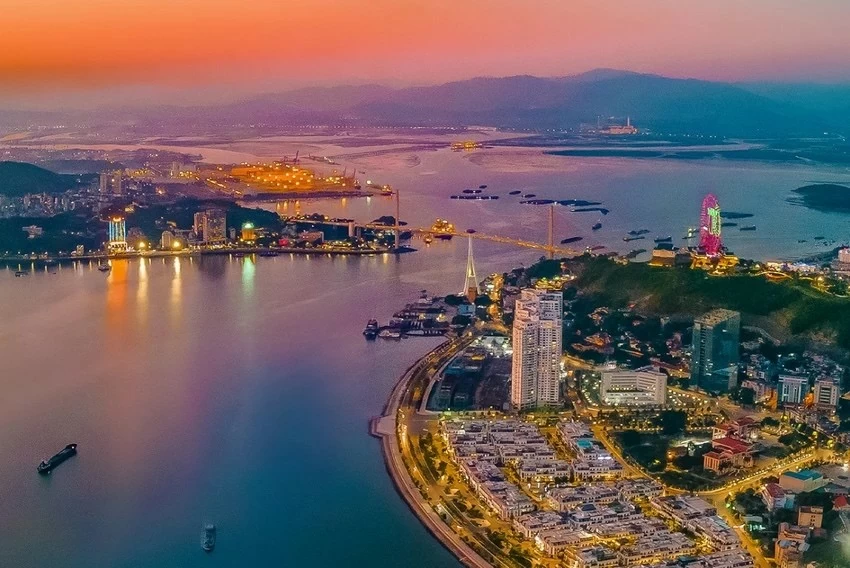 |
| Quang Ninh possesses favorable conditions to transform the General Urban Planning of Quang Ninh to 2050, with a vision to 2075, into a substantial growth driver. (Source: Vietnamplus) |
Development without compromising the environment
An important highlight of the general planning is the goal of economic development in tandem with environmental protection and preservation of natural values. According to the orientation, core heritage areas, natural forests, and unique ecosystems will be strictly protected; new urban areas must meet the requirements for green development, efficient resource use, climate change adaptation, and emission reduction.
This is also a shift in Quang Ninh's development mindset. If previously the focus was on building infrastructure and expanding development space, in the new phase, the quality of life of residents will become an important measure of urban development.
Public spaces, social infrastructure, parks, water surfaces, educational, medical, and cultural services will increasingly be emphasized to build a livable city that can compete with major urban areas in the region.
To realize this goal, the state budget will play a leading role, while Quang Ninh continues to promote public-private partnerships, attract strategic investors, and effectively mobilize social resources to implement key projects.
Moreover, the general planning does not stop at a construction planning project. Beyond that, it is a development vision for a modern coastal city, where infrastructure, marine economy, high-tech industry, logistics, tourism, innovation, and quality of life are developed in a unified entity.
The road ahead still presents many challenges such as resource mobilization, synchronized project implementation, and improving urban governance quality. However, with a well-invested infrastructure foundation, a leading investment environment in the country, and clear development orientation, Quang Ninh possesses favorable conditions to transform the planning into substantial growth drivers.
As the orientations in the planning are gradually realized, Quang Ninh will become the economic, logistics, and tourism center of the North, with the opportunity to become a modern coastal city of regional stature, making increasingly important contributions to the development of the Northern Region and Vietnam's economy in the coming decades.