


Election of the 16th National Assembly and People's Councils for the 2026–2031 term: A great national festival
WVR - On March 15, voters nationwide will elect the 16th National Assembly and People's Councils at all levels for the 2026–2031 term, amidst the comprehensive implementation of many new points in the Election Law.
Latest
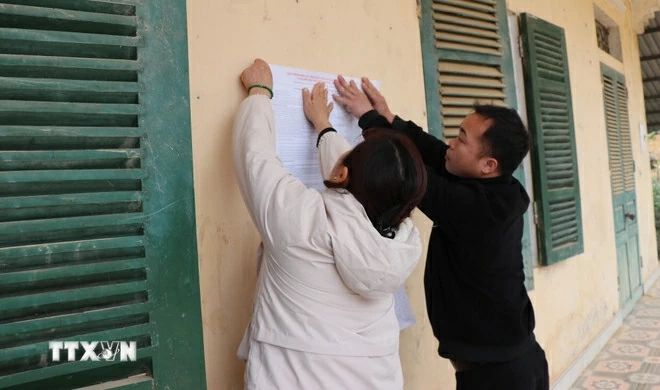 |
| Officials from Lang Chap village, Trung Son commune (Tuyen Quang) prepare for the election of the 16th National Assembly and People's Councils for the 2026–2031 term at the village cultural house. (Source: VNA) |
On Sunday, March 15, voters nationwide will participate in the election of the 16th National Assembly and People's Councils at all levels for the 2026–2031 term. This is a politically significant event, a national festival where each vote represents the people's sovereignty, will, and aspiration to build a socialist rule-of-law state by the people, for the people.
At this point, preparations for the election have passed many key legal milestones, implemented comprehensively, ensuring progress and compliance with regulations.
Announcement of 864 candidates
On February 14, the National Election Council issued Resolution No. 151/NQ-HĐBCQG, officially announcing the list of 864 candidates for the 16th National Assembly at 182 electoral units nationwide to elect 500 National Assembly deputies. The announcement marks an important transition from the negotiation and candidate introduction phase to the election campaigning and voting preparation phase.
Immediately after the list was announced, agencies and organizations with candidates actively informed and facilitated candidates to return to their constituencies, engaging with voters according to the plan of the Standing Committee of the Vietnam Fatherland Front in provinces and cities. Election campaigning activities are conducted within the legal framework, ensuring transparency, fairness, and equality among candidates.
Simultaneously, important timelines of the election process are being strictly adhered to. The official list of candidates is posted at polling stations on schedule; the printing and distribution of materials and ballots are tightly managed; the reception and resolution of complaints related to candidates and voter lists are thoroughly reviewed. All aim to ensure each vote is cast on a solid legal foundation.
With just over 20 days to go, voters nationwide are gearing up for the national festival. The preparation atmosphere is spreading from urban to rural areas, from plains to mountains and islands.
Flexible early voting in special areas
In Ho Chi Minh City, to ensure the voting rights of those on long-term sea missions, the city's election committee has developed a plan for early voting in certain special areas. More than 4,000 voters in areas like Phuoc Thang, Tam Thang, and Long Son will exercise their voting rights before the national voting day.
These voters are on duty on ships, oil rigs, marine works, or conducting patrols and supervision according to their agencies' plans. Allowing early voting, even extending voting time in some areas, reflects a flexible approach, prioritizing voters' legitimate rights while ensuring legal principles and regulations.
In Nghe An, the National Election Council has also permitted early voting in 55 areas across 12 mountainous and border communes. These are areas with difficult transportation, scattered populations, and movement heavily dependent on weather and terrain conditions.
This decision not only facilitates remote and isolated voters in exercising their civic rights and duties but also contributes to ensuring the election is conducted uniformly and safely nationwide.
Election Law Amendments introduce new points
 |
| Officials from Bac Trach commune (Quang Tri) post the voter list for the election of the 16th National Assembly and People's Councils for the 2026–2031 term. (Source: VNA) |
This year's election features many important new points following amendments to the Election Law. Based on Resolution No. 199/2025/QH15 of the 15th National Assembly on shortening the term and setting an earlier election date, legal provisions have been adjusted to align with the two-tier local government model, in the spirit of streamlining the apparatus and enhancing the effectiveness and efficiency of the political system.
One notable change is the clearer decentralization of authority in determining polling areas. Commune-level People's Committees are empowered to make decisions and report to provincial-level People's Committees, instead of requiring additional approval layers as before. This regulation helps shorten the process, increases flexibility in implementation, while ensuring necessary provincial-level oversight.
Additionally, the system of election management organizations at the local level has been strengthened to fit the new management model. The composition of negotiation conferences has also been adjusted, enhancing the role of the commune-level Fatherland Front, ensuring a more direct and close connection with voters.
Notably, the time for several steps in the election process has been significantly shortened. The period from the end of candidate application submission to the election day has been reduced from 70 days to 42 days. This adjustment requires proactive, urgent, and coordinated efforts among relevant agencies, while also reflecting efforts to reform procedures and improve organizational efficiency.
Ensuring democratic, safe, and lawful elections
Nationwide, the establishment of election management organizations, ensuring security and order, and strengthening inspection and supervision are being seriously implemented. Each step and process aims towards the common goal of organizing a democratic, safe, lawful election that truly is a great national festival.
As March 15 approaches, it's not just about completing numbers or timelines, but more importantly, the readiness of the entire political system and the confidence of voters in a transparent, responsible election that fully reflects the people's sovereignty in the country's new development phase.