




Workshop: Vietnam enhances cooperation to promote a more child-friendly justice environment
WVR - On December 17, in Hanoi, the U.S. Bureau of International Narcotics and Law Enforcement Affairs (INL), the International Organization for Migration (IOM), and the United Nations Children’s Fund (UNICEF) concluded a four-years partnership that has delivered significant progress in strengthening child justice in Vietnam.
Latest
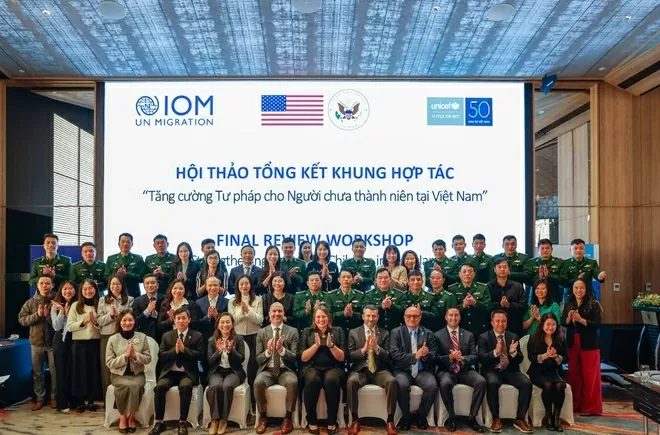 |
| The final review workshop 'Strengthening justice for children in Vietnam'. (Source: IOM) |
Since its inception in December 2021, the partnership has supported legal and institutional reforms to better protect children who come into contact with the law, ensuring their rights, dignity and well-being are upheld throughout justice processes.
Acting Deputy Chief of Mission, U.S. Embassy in Vietnam Michael Swanberry expressed: “We applaud Vietnam’s many efforts to improve the criminal justice process for children, including passage of the Juvenile Justice Law. These achievements would not have been possible without the dedication and collaboration of our partners in the Government of Vietnam, IOM, UNICEF, and the many stakeholders who contributed their expertise and passion to this effort”.
Mr. Michael Swanberry also affirmed the U.S. remains committed to supporting Vietnam’s efforts to protect children from transnational organized crime like child trafficking so that together we can foster a strong and prosperous future.
Every year, approximately 80,000 children enter Vietnam’s justice system – including 8,000 in conflict with the law, 2,000 child victims of crimes, and 70,000 children involved in family law cases. For many, traditional justice procedures such as police interviews and court proceedings can be intimidating and traumatic. The partnership was established to ensure that the justice system serves as a protective shield for children and vulnerable groups rather than an overwhelming force.
Over four year, the project has delivered several landmark results to promote a more child-friendly justice environment, including:
Firstly, legal reform: Strengthened the child justice legal framework, most notably through the adoption of the historic Child Justice Law.
Secondly, professional capacity building: Trained thousands of incoming and frontline law enforcement officers and justice actors to apply child-friendly procedures and uphold the best interest of the child.
Thirdly, specialized training on counter-smuggling and trafficking prevention: Developed a comprehensive training curriculum for frontline officers, particularly those stationed at border gates, focused on counter-smuggling and early detection of trafficking victims. These officers serve as the first line of defense against cross-border crime and the first point of contact for migrants and children at risk.
Fourthly, integrated victim care: Developed technical guidelines that enable child victims of violence to access comprehensive services.
IOM Chief of Mission in Vietnam Kendra Rinas stated: “We are proud to see the specialized curriculum equip 310 border gate officers with essential skills, from document checks and risk assessment to victim identification, while promoting a victim-centered, child-friendly approach. This effort aligns with Vietnam’s revised Law on Prevention and Combat of Human Trafficking.”
According to Kendra Rinas, frontline officers are the critical support for victims. This innovative collaboration underscores one key point: sustainability begins with strengthened systems and embedded practices.
For his part, UNICEF Representative (Officer-in-Charge) Ziad Nabulsi noted that these efforts provide stronger protection for child victims, enabling them to share their experiences safely and with less risk of further trauma. Children in conflict with the law have increased access to community-based support, which promotes in successful rehabilitation and reintegration. Ultimately, these measures reduce the risk of re-offending, trafficking, or irregular migration.
While celebrating these achievements, partners emphasized that continued efforts are required. Passing legislation is only the first step – the real challenge lies in effective law implementation to ensure that progressive legal provisions translate into positive, day-to-day improvements for every child across Vietnam.
The success of this initiative was made possible through the strategic the dedicated coordination of the Ministry of Justice’s International Cooperation Department, the Department of Border Gates of the Vietnam Border Guard and active engagement of Government line ministries, law enforcement and justice agencies. All partners reaffirm their commitment to building a justice system that is inclusive, accessible and protective for all children in Vietnam.