




When international artists view Hanoi through a different artistic lens
Not just the ancient streets, moss-covered roofs, or vibrant life, Hanoi also emerges through the simple details of urban life. When seen through the creative eyes of international artists, familiar objects can become artistic materials, opening up new ways to perceive the city and its people.
Latest
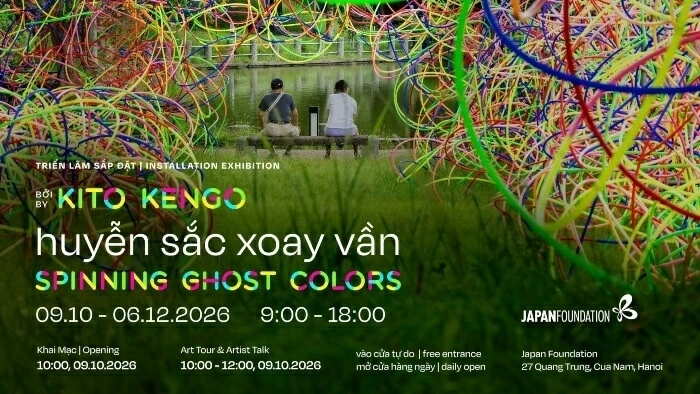 |
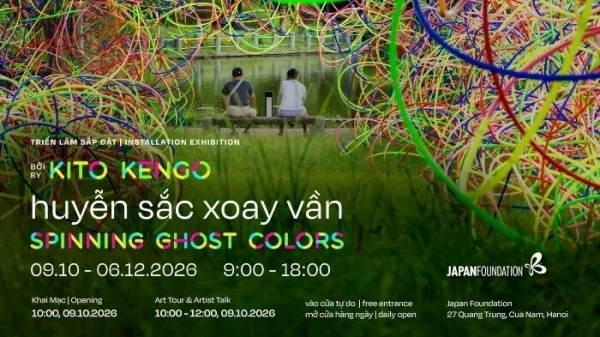
| The installation exhibition “Spinning Ghost Colors” by contemporary Japanese artist Kito Kengo takes place from October 9 to December 6 at 27 Quang Trung, Hanoi. |
There are ways to explore a city that do not start from famous landmarks or iconic architectural works. Sometimes, the journey begins with an object encountered on the street, a play of light in a market, or a fleeting colour among the crowd. In contemporary art, these seemingly small details can serve as a starting point for artists to question space, memory, and how people perceive the world around them.
Hanoi, with its layers of historical sediment and ever-evolving urban rhythm, offers such materials. The city can be recognised through familiar symbols, but can also be explored through less-noticed aspects. When international artists approach Hanoi with their unique creative language, the focus is not only on the works they bring but also on how they observe, select, and interpret what they see.
From a Rotating Lamp to a Different Perspective on Hanoi
The installation exhibition “Spinning Ghost Colors” by contemporary Japanese artist Kito Kengo, which opened on October 9 at the Japan Foundation Center for Cultural Exchange in Vietnam, is a suggestion for this approach. Running until December 6, 2026, at 27 Quang Trung, Hanoi, this is the artist's first solo exhibition in Vietnam, showcasing two works that explore colour, light, movement, and the transformation of objects in space. According to the organisers, the exhibition is open daily for free.
The highlight lies in how Kito Kengo takes familiar materials out of their usual functions to place them in a new visual relationship. In the first work, hundreds of colourful plastic rings are connected into a structure that stretches from the gallery to the garden. The individual circles no longer exist as independent objects but are linked into a whole, creating continuous lines and connections between areas.
According to the Japan Foundation Center for Cultural Exchange in Vietnam, these circles evoke brushstrokes on a spatial canvas. The arrangement allows viewers not only to observe a fixed object but also to feel the relationships among colour, space, and areas. As one moves, the perspective changes, and the structure reveals different correlations.
The second work begins with the artist's exploration of Hanoi's streets and markets. During his survey, artist Kito Kengo encountered a self-rotating lamp and used it as the starting point for a new creation. The work combines lamps, colour filters, and mirrors, creating layers of light, reflections, and afterimages that change with movement. The familiar shape of the lamp is placed in a different visual relationship, drawing viewers' attention to how light and colour affect the object's perception.
Here, Hanoi is not just the venue for the exhibition. The city is also present in the work's formation through an object the artist encountered while observing local life. The lamp does not need to carry a predetermined symbolic meaning to become a creative material. Its characteristics of light, movement, and ability to create reflective images open up a different form of artistic expression.
This case suggests an interesting aspect of urban exploration: a city is not only understood through what is already known about it but also through what an observer discovers. The same street, market, or object can be seen by locals as part of their familiar daily life, while an artist from a different culture may recognise new creative possibilities.
The difference in perspective does not imply which view is more correct. On the contrary, when placed side by side, they can make the obvious noteworthy, while expanding how the public perceives the space they live in.
When Everyday Life Becomes Creative Material
A notable feature of contemporary art is its ability to expand the concept of material and exhibition space. Works do not necessarily start from rare materials or highly symbolic images. Everyday objects, light, movement, and the surrounding space can also become components of the artistic experience.
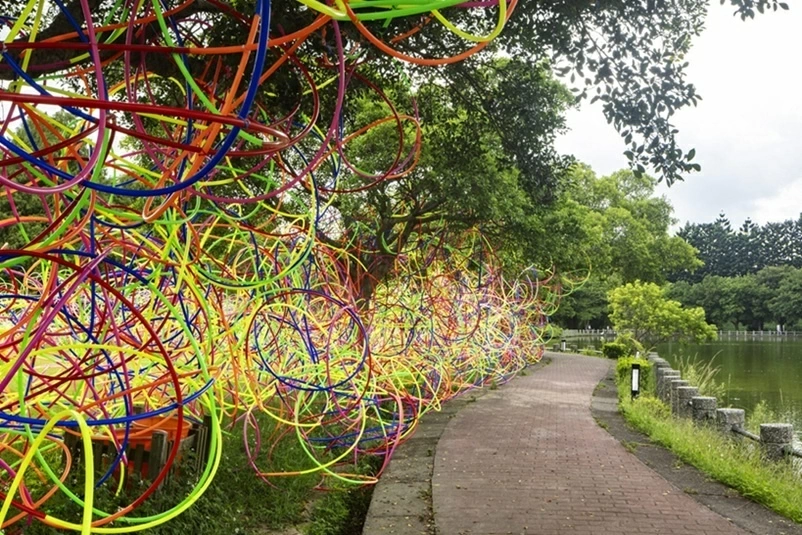 |
| A notable feature of contemporary art is its ability to expand the concept of material and exhibition space. Everyday objects, light, movement, and the surrounding space can also become components of the artistic experience. (Source: Kito Kengo) |
With this approach, the value of the work lies not only in the object itself but also in the relationship between the object, the environment, and the viewer. A lamp can be seen as a household item, but when placed in a system of mirrors and colour filters, it can create layers of changing images. Familiar plastic rings become part of a visual structure in which colour and space together contribute to the artwork.
This makes the artistic experience not entirely dependent on the viewer's prior knowledge of the artist or the work's message. Some may focus on colour, others on movement, while others may notice the change in space when moving between structures. Different perceptions are part of the art-appreciation experience, even if not all viewers' associations align with the artist's creative intent.
For Hanoi, incorporating everyday details into the creative process offers a different approach to the city's image. In cultural and tourism promotion activities, Hanoi is often introduced through its architectural heritage, cuisine, ancient streets, lakes, and cultural features that have developed over time. These are important values, but not the entirety of a city in motion.
The city is also made up of daily habits, small objects, and spaces interwoven between commercial areas, residences, and streets. These details may not stand out individually, but contribute to the rhythm of urban life. When international artists choose such a detail as the starting point for their work, Hanoi has the opportunity to appear in a form of expression different from familiar patterns.
However, a work inspired by an object in Hanoi does not automatically represent the entire city or the lives of its people. The work reflects the creator's choices and interpretations. This individuality adds richness while reminding viewers to distinguish between the art experience and broader conclusions about local culture.
What is worth anticipating is not that contemporary art presents a complete image of Hanoi, but rather its ability to offer perspectives that enable the public to continue exploring the city.
Art Spaces and Multidimensional Dialogues
If a work is the result of observation and creativity, the art space is where that process meets the public. With the “Spinning Ghost Colors” exhibition, the Japan Foundation Center for Cultural Exchange in Vietnam facilitates the contemporary art practice of a Japanese artist reaching viewers in Hanoi. In addition to the exhibition, the program includes tours and artist talks, providing opportunities for the public to learn more about the work and the creative process.
The role of art spaces in connecting works with the local context was also discussed in an interview with curator Do Tuong Linh, published by the Museum of Modern Art (MoMA) on April 7, 2021. When discussing art projects organised at specific locations in Hanoi, she stated that contemporary art has the potential to reveal social, cultural, and political meanings of the very places where the works appear. This perspective emphasises the connection between the work and its context, rather than viewing the exhibition space merely as a place to display works.
In Kito Kengo's case, this connection is evident in the artist's exploration of life in Hanoi and the development of a work from a self-rotating street lamp. The local object becomes the starting point for a new creation, and the exhibition space is where viewers can observe how the object is transformed through light, colour, and reflection. From there, the public has more opportunities to reflect on familiar aspects of their living environment.
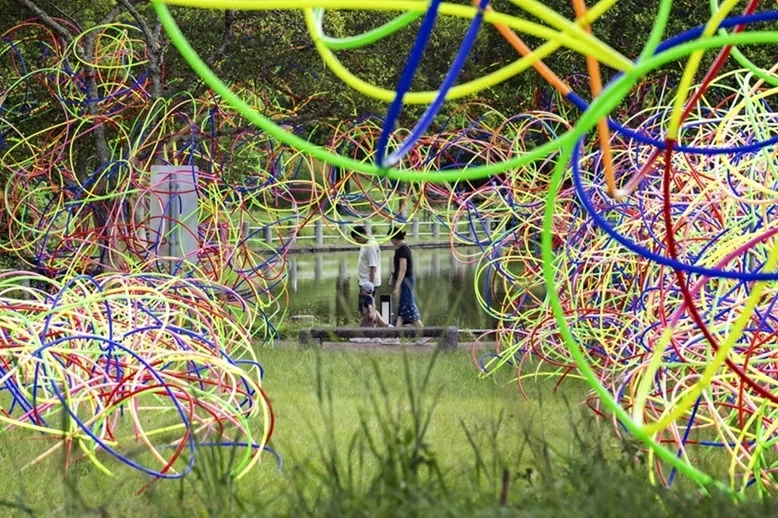 |
| When international artists view Hanoi through a different artistic lens, the focus is not only on a lamp or hundreds of plastic rings transformed into an installation. It is also about the ability to revisit familiar things from a different angle, realising that urban life holds more creative materials than often recognised. (Source: Kito Kengo) |
From another perspective, an interview with curator Le Thuan Uyen published by the Japan Foundation Asia Center on February 5, 2026, also discusses the role of art institutions. According to her, stable spaces are needed for artists to continue creative experimentation, while also providing opportunities for art stories to be presented and for the public to respond. This view suggests a broader issue for the art scene in Hanoi: besides individual events, the development of creative activities also depends on the ability to maintain workspaces, professional exchanges, and connections between artists and the public.
These insights do not directly evaluate Kito Kengo's exhibition but provide a basis for a broader view of the role of cultural exchange. An exhibition can introduce the works of foreign artists, but its significance also lies in creating encounters between different perspectives, helping the public access unfamiliar art practices and encouraging interest in contemporary creativity.
For Hanoi, the question is how such encounters can be extended into exchanges between Vietnamese and international artists, public art education programs, or professional collaboration opportunities. This is a direction that needs further exploration, rather than assuming it is an achieved result from an exhibition.
Regardless of scale, cultural exchange needs to be built on mutual understanding and respect for each other's contexts. International artists not only bring a ready-made creative product but can also find inspiration from the local environment. Conversely, the local public has the opportunity to access a new interpretation of what is already present around them.
When international artists view Hanoi through a different artistic lens, the focus is not only on a lamp or hundreds of plastic rings transformed into an installation. It is also about the ability to revisit familiar things from a different angle, realising that urban life holds more creative materials than often recognised. Art does not replace the heritage values that form Hanoi's identity, but can add a different approach, thereby expanding the dialogue between the city and external cultures.
Sometimes, to discover more about where one lives, one need not travel far. Simply looking at the things that are always present around us from a different perspective can reveal new layers of meaning in the familiar city.
Tags: