





Vietnam's strategic push for legal reform and technological advancement: Experts
Vietnam is urged to reform its legal framework and invest in strategic technologies to enhance its global competitiveness and secure its position in international value chains.
Latest
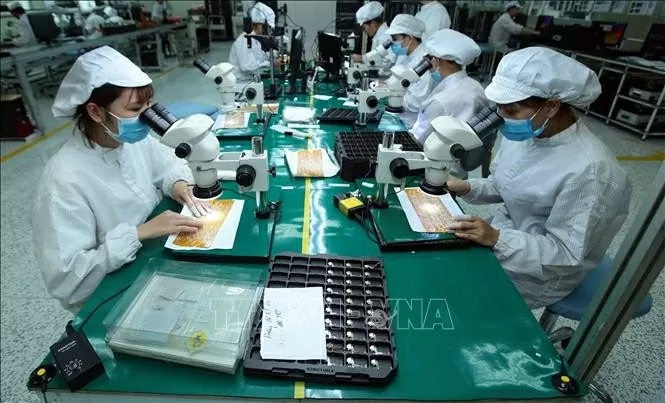 |
| Production of electronic components at 4P Co., Ltd. in Hai Phong city, Vietnam. |
As global competition intensifies, science, technology, and innovation are increasingly seen as critical drivers of growth. Experts agree that Vietnam must pursue institutional breakthroughs such as removing investment barriers, creating a flexible legal framework, and prioritising strategic technologies to enhance its national standing.
According to Dr. Hoang Kim Khuyen from the Institute of State and Law under the Vietnam Academy of Social Sciences, improving institutions to attract investment is a prerequisite for science, technology, and innovation to become engines of sustainable development. While the private sector has emerged as a key contributor to economic growth in recent years, its role in research and development (R&D) remains modest.
Major corporations such as Viettel, FPT, Vingroup, and VinBigData have boldly invested in research projects, yet few private firms maintain long-term commitments to science and technology. Institutional and policy shortcomings are a major reason. Laws relating to science, technology, intellectual property, and investment often lack consistency and overlap, creating practical hurdles.
Financial tools designed to spur innovation have also fallen short. Enterprises' science and technology development funds exist under the law, but their use remains limited. Between 2015 and 2023, enterprises contributed more than 35 trillion VND (1.3 billion USD) to such funds, yet only about 60% was spent. The rest was left idle due to vague regulations, bureaucratic procedures, and risks.
Dr. Khuyen noted that current incentives on tax, credit, and land for R&D are insufficient. For small- and medium-sized enterprises (SMEs), which make up more than 95% of Vietnamese firms, barriers are even higher due to limited resources and a lack of information. This has left the private sector, expected to be the main driver of innovation, largely on the sidelines.
To address these challenges, she recommended legal reforms to ensure coherence, transparency, and predictability, while reducing administrative burdens. Laws on science and technology and intellectual property should be revised to be more open and business-friendly. Transparent mechanisms are also needed to prevent vested interests in resource allocation.
She further called for improved financial mechanisms, including clearer and more practical tax incentives, easier access to credit and land, and support schemes such as loan guarantees or interest subsidies for SMEs investing in R&D. In parallel, the government should foster a national innovation ecosystem with start-up centres, technology incubators, high-tech parks, and stronger links between research institutes, universities, and businesses.
Legal innovation and strategic technology development
Nguyen Thu Dung, also from the Institute of State and Law, highlighted the need for new legal approaches in the digital age, where technology often outpaces legislation. She pointed to the “sandbox” model, where companies can test new technologies under state supervision, as an effective tool. Expanding sandboxes beyond fintech to areas such as artificial intelligence (AI), blockchain, biotechnology, and clean energy would, she argued, turn institutions into a competitive advantage.
Echoing this view, Dr. Ha Huy Ngoc of the Vietnam Institute of Economics stressed that Vietnam must identify and concentrate resources on strategic technologies. He proposed national programmes on semiconductors and new materials, the establishment of a national AI research hub, strengthening biotechnology for health care and agriculture, and scaling up clean energy.
To achieve these goals, Vietnam should adopt policies to attract talent, grant greater autonomy to research institutes and universities, and establish a transparent national strategic technology fund to support large-scale projects.
According to Dr. Ngoc, investment in strategic technologies is not only about economic growth but also about ensuring national security, safeguarding digital sovereignty, and elevating Vietnam’s international profile. In an era of fierce technological competition, bold policies and careful prioritisation will enable Vietnam to secure key positions in global value chains, he noted.
By combining legal reforms with focused investment in core technologies, experts say, Vietnam can unlock science, technology, and innovation as powerful internal drivers of growth. This vision aligns with Resolution 57-NQ/TW, which identifies innovation as the foundation for Vietnam to achieve its goal of becoming a high-income, developed nation by 2045.

| Vietnam, Australia officials hold 10th strategic diplomacy-defence dialogue in Canberra WVR - The 10th Strategic Diplomacy-Defence Dialogue between Vietnam and Australia took place in Canberra on August 5, 2025. |

| Vietnam advances strategic technologies to drive growth The National Innovation Centre under the Ministry of Finance has officially launched three new networks of innovation and strategic technology in quantum technology (VNQuantum), cybersecurity ... |

| Vietnam advances regional push on battery storage financing WVR - Vietnam is stepping up plans to build one of Southeast Asia’s largest battery storage markets, with a regional roundtable in Hanoi on September ... |

| Vietnam to enhance cooperation with UNIDROIT in building and perfecting legal systems in the new era: Deputy FM WVR - On the morning of September 15, at the Ministry of Foreign Affairs headquarters, Deputy Foreign Minister Le Anh Tuan met with Professor Ignacio ... |

| PM calls on Red River Delta to spearhead nation’s advancement into a new era The region must spearhead breakthroughs in rapid and sustainable growth to improve living standards, said PM Chinh, who also chairs the council. |
(Source: VNA)