

Vietnam is poised with a significant opportunity to become a strategic transit hub in Asia
Panel 7 of FIATA World Congress 2025 on October 9 with the theme "Enhancing inland waterway and rail transport in sustainable supply chains" focus on unlocking potential, sharing international experiences, and proposing infrastructure and service development solutions to optimize these two strategic modes of transport.
Latest
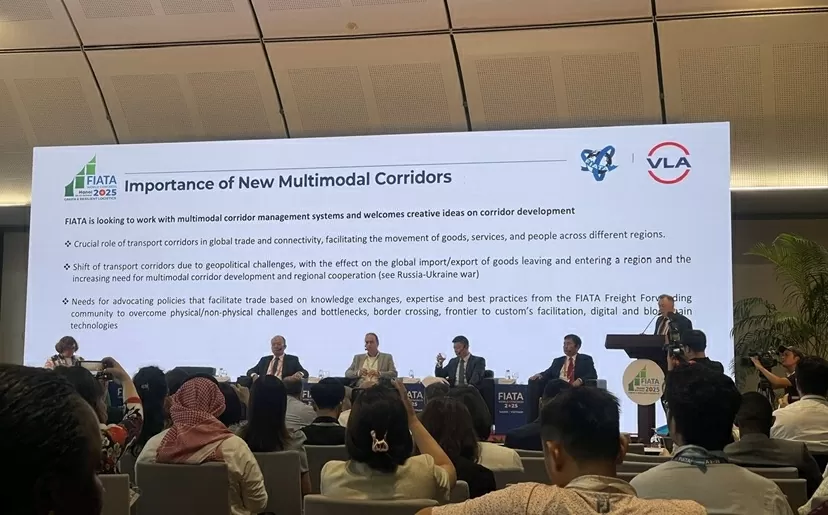 |
| Overview of panel 7 -"Enhancing inland waterway and rail transport in sustainable supply chains". (Photo: Van Chi) |
Green direction for the global supply chain
Opening the discussion session, Mr. Ivan Petrov, Former President of the International Federation of Freight Forwarders Associations (FIATA) and CEO of Transexpress, emphasized the government's role in shaping national logistics development strategies.
Mr. Ivan expressed his genuine impression with the Vietnamese government's interest in this sector, noting that Prime Minister Pham Minh Chinh personally attended the Congress and has frequently engaged with the transport business community.
“I clearly sense the Vietnamese government's determination to make logistics one of the three pillars of national economic development, with a focus on expanding trade corridors, free trade zones, and promoting public-private partnerships,” Mr. Petrov shared.
From a regional perspective, he also noted that Vietnam is poised with a significant opportunity to become a strategic transit hub in Asia, thanks to its favorable geographical location and the East-West, North-South economic corridor network. However, to leverage this potential, there must be a coordinated integration of different transport modes, especially between road, rail, and inland waterways.
Continuing this spirit, Professor Bui Thien Thu from Okayama University (Japan), Former Director of the Vietnam Inland Waterways Administration, offered a more specific view on the natural advantages of our country in developing waterway transport.
Mr. Thu informed that our country has over 42,000 km of rivers, with 17,000 km exploitable for transport, along with 3,260 km of coastline. However, despite these resources, investment in the waterway transport sector remains minimal.
He cited that Vietnam currently ranks second after China in terms of infrastructure investment, accounting for about 5.7% of GDP. In 2024 alone, the total investment in transport infrastructure is expected to reach approximately 27 billion USD, with around 60% allocated for roads, 10% for railways, and only about 2–2.5% for inland waterways.
“Meanwhile, waterways handle up to 20% of the transported goods volume, while roads account for about 50%. In other words, with just 2% of the investment, waterway transport still shoulders one-fifth of the total goods volume,” the speaker analyzed.
According to Mr. Thu, increasing investment in waterway transport not only helps reduce traffic pressure and emissions but also saves maintenance costs, enhancing the economy's competitiveness.
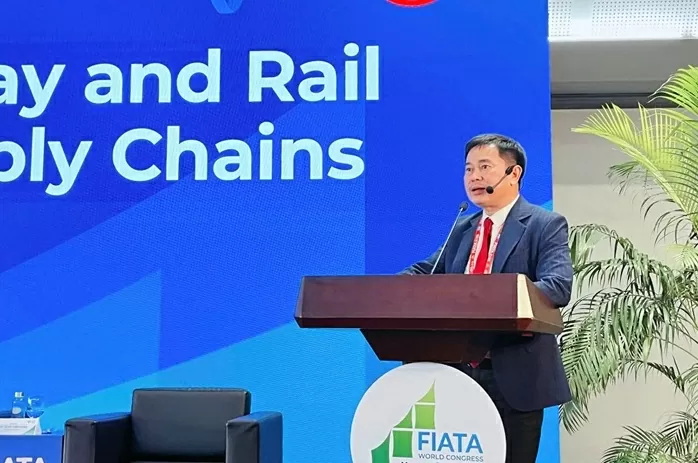 |
| Mr. Tran Tien Dung, Chairman of MACSTAR Group. (Photo: FIATA World Congress) |
Providing another practical perspective from Vietnam, Mr. Tran Tien Dung, Chairman of MACSTAR Group, shared that currently, only about 2% of goods through Hai Phong port are transported by river and coastal routes, while the southern region reaches up to 30%, indicating significant potential yet to be effectively tapped in the North.
According to Mr. Dung, increasing investment in waterway and coastal transport will help reduce logistics costs, cut CO₂ emissions, and alleviate the burden on road transport – which currently handles the majority of freight. He proposed simplifying port management procedures, standardizing operational standards, and implementing green credit with preferential interest rates to encourage businesses to invest in green transport.
He emphasized that developing the waterway transport system is a long-term strategy requiring coordination between the government, the private sector, and international partners to gradually increase the share of goods transported by river to about 20% by 2030.
A green path for Vietnam
Mr. Lambert Van Dieren, Chairman of Van Dieren Maritime (Netherlands), shared practical experiences from Europe – a leading region in adopting green logistics models.
According to him, to develop sustainable transport, Vietnam needs to focus on investing in infrastructure systems that serve as "connectivity hubs" – where railways, seaports, and inland waterways intersect. This seamless connectivity will contribute to forming an efficient logistics corridor, helping to reduce transportation costs and time, while enhancing the competitiveness of Vietnamese goods in the international market.
Beyond infrastructure, Mr. Van Dieren emphasized the importance of technology in management and operations. According to him, standardizing data, synchronizing information systems, and accelerating process digitization will enable Vietnamese logistics companies to integrate more deeply into the global supply chain – a realm increasingly demanding transparency, accuracy, and efficiency at every stage of transportation.
Following Mr. Van Dieren's insights, Mr. Wei Chen, Deputy General Manager in charge of overseas markets at Sinotrans Limited Group (China), shared perspectives from China's practical experience in developing green transport. He stated that the flexible combination of road, rail, and inland waterways has optimized the supply chain while significantly reducing costs and carbon emissions.
According to Mr. Wei Chen, waterway and rail transport are becoming two crucial pillars in the strategy to reduce emissions and save energy. However, the biggest challenge remains the lack of connectivity between infrastructure and data, requiring close cooperation among countries to build a more synchronized, intelligent, and sustainable logistics system.
Additionally, he emphasized that digital transformation and clean energy are inevitable trends in the global logistics industry, not only enhancing operational efficiency but also contributing positively to sustainable development goals and environmental protection.
| Vietnam assists landlocked developing countries: Ambassador WVR./VNA - Vietnam, as a developing transit country, has taken a lot of actions within regional, sub-regional and bilateral frameworks to assist landlocked developing countries, ... |
| PM Pham Minh Chinh seeks FIATA's support in boosting logistics workforce WVR/VNA - Prime Minister Pham Minh Chinh has proposed the International Federation of Freight Forwarders Associations (FIATA) provide Vietnam’s logistics sector with workforce training through ... |
| Prime Minister Pham Minh Chinh addresses FIATA World Congress 2025 in Ha Noi Prime Minister Pham Minh Chinh attended the International Federation of Freight Forwarders Associations (FIATA) World Congress 2025 that took place in Ha Noi on October ... |
| The FIATA World Congress 2025: Golden opportunity for Vietnam’s logistics sector The 2025 FIATA World Congress in Hanoi spotlighted Vietnam’s growing role as a gateway for green logistics and regional connectivity. |
| FIATA World Congress 2025: Innovation and digital transformation reshaping green logistics At FIATA World Congress 2025 (FWC 2025), leading experts in the logistics industry shared insights on how technology, data, and innovation are reshaping the future ... |