






Tourism industry maps out post-recovery growth strategy
The Ministry of Culture, Sports and Tourism (MCST) outlined a clear roadmap for tourism development in the coming years at a tourism review conference in Hue City on December 20, aiming to position tourism as a truly leading economic sector.
Latest
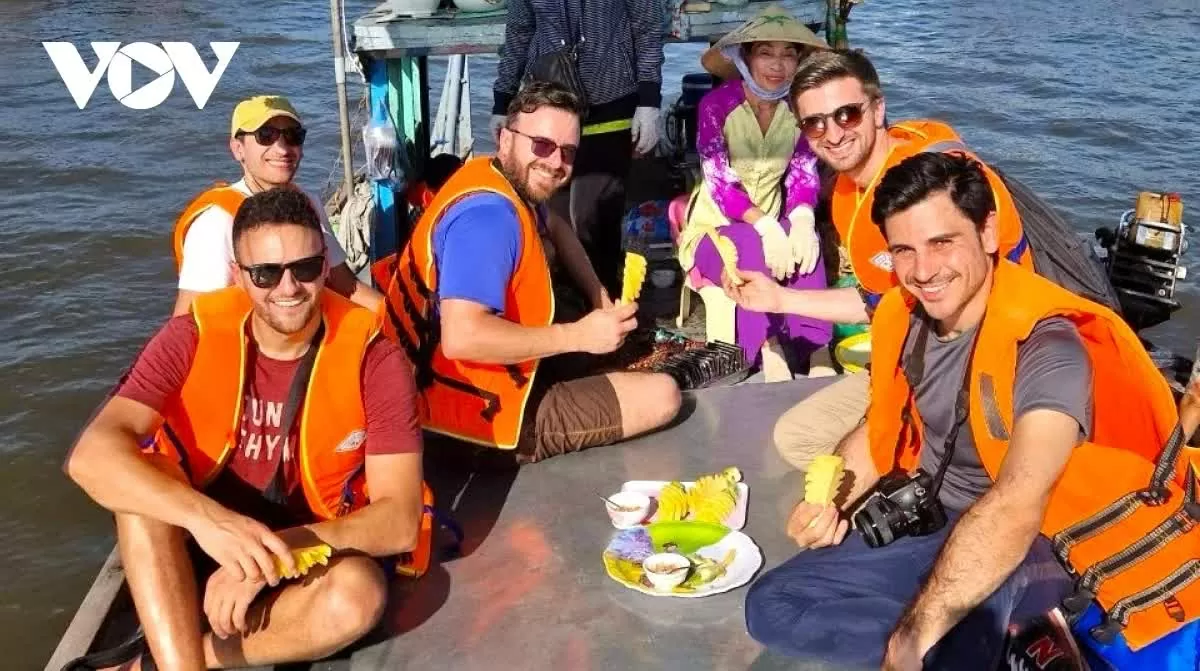 |
| Foreign visitors eagerly explore the floating market in Southern Vietnam. (Photo: VOV) |
The conference marked an important milestone as Vietnam assessed its tourism performance during a particularly challenging period shaped by the COVID-19 pandemic and outlined a new roadmap aimed at transforming tourism into a truly leading economic sector.
The MCST reported that from 2020 to 2021, Vietnam’s tourism industry was severely disrupted as international travel came to a near standstill, supply chains were broken and millions of tourism workers were affected. Despite these unprecedented challenges, the local tourism industry demonstrated strong resilience and adaptability, recovering rapidly from 2022 onward under decisive government leadership and coordinated efforts across ministries, local authorities and the business community.
By 2024, Vietnam welcomed approximately 17.6 million international visitors, reaching 98% of pre-pandemic levels, placing the country among the fastest-recovering tourism destinations in Southeast Asia. International arrivals are projected to reach around 22 million in 2025, alongside 140 million domestic holidaymakers, with total tourism revenue expected to exceed VND1 quadrillion.
According to the MCST, these results were driven by a series of breakthrough policies, including early reopening to international travel, sweeping visa reforms, stronger regional connectivity and sustained support for tourism enterprises. Market restructuring has also delivered tangible outcomes, with strong growth from emerging markets such as India, Australia and the Middle East, while Northeast Asian markets have recovered rapidly, making Vietnam’s tourism market more diversified and resilient.
While acknowledging these achievements, conference participants emphasised that Vietnam’s tourism still faces structural challenges, including uneven product quality, limited inter-regional linkages, fragmented digital transformation, relatively low visitor spending and modest repeat-visit rates. These shortcomings, delegates agreed, must be addressed decisively in the next development phase.
Based on the conference’s conclusions, the period from 2025 to 2030 was identified as a pivotal stage for Vietnam’s tourism to move from recovery to breakthrough development. The industry will shift its focus from volume-driven growth to a quality-oriented, sustainable and value-based model.
Key strategic directions include further improving the institutional and policy framework, restructuring tourism markets and products, and enhancing competitiveness at both national and destination levels. Vietnam aims to consolidate traditional source markets, and expand into high-potential emerging ones to ensure long-term stability and resilience.
Product development will prioritise creativity and differentiation, leveraging Vietnam’s cultural heritage and natural assets. Emphasis will be placed on cultural tourism, eco-tourism, island and coastal tourism, night-time economy, railway and cruise tourism, wellness and health tourism, as well as green and responsible travel experiences.
The conference also underscored digital transformation as a central pillar of future growth. Vietnam plans to accelerate the development of a comprehensive tourism digital ecosystem, including national tourism data systems, smart destination management platforms and digital tools to enhance visitor experience and governance efficiency.
In parallel, investments in tourism infrastructure will continue in close alignment with transport networks, airports, seaports, highways and urban development, creating favourable conditions for new destinations, longer stays and higher visitor spending.
Human resource development remains a priority, with efforts focused on improving professional skills, service quality and international standards across the tourism workforce. Building a safe, friendly and civilised tourism environment was also highlighted as essential to sustaining growth and strengthening Vietnam’s image as a welcoming destination.
Speaking at the conference, leaders of the Vietnam National Authority of Tourism emphasised that the successful implementation of the Tourism Restructuring Scheme has laid a solid foundation for the next phase of the Tourism Development Strategy toward 2030. The outcomes of the review will serve as an important basis for policy recommendations to the Government and the Prime Minister to further remove bottlenecks and unlock growth drivers in the years ahead.
(Souce: VOV)


