




Teachers defying the odds to sow the seeds of technology in remote areas
Many teachers have persevered through hardship to spread the spirit of digital transformation to students in remote, mountainous, and island regions.
Latest
Overcoming barriers to bring technology into the classroom
From the outlying island of Tho Chau (An Giang Province) to the misty highlands of Tuyen Quang, teachers across Vietnam are overcoming challenges and bringing the Khan Academy Vietnam (KAV) Open School model into their classrooms. Their work proves that when technology is guided by heart and dedication, it can unlock equal learning opportunities for every student.
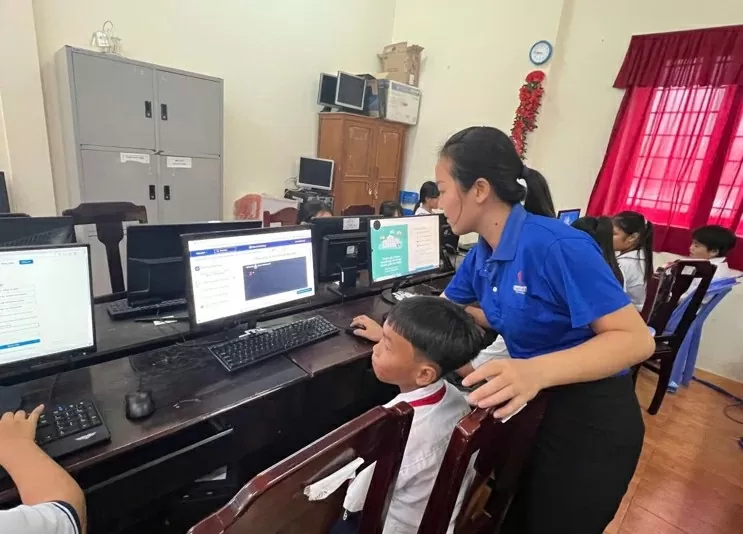 |
| Each educator is a ‘digital nucleus’, sparking education transformation where resources are limited. |
Unlike in urban areas, the journey toward digital transformation in far-flung regions does not begin with favourable conditions, but with the deep concern and tireless determination of teachers striving to overcome hardship. Ms. Vu Thi Bich Loan, a teacher at Tho Chau Primary and Secondary School in the Tho Chau Special Zone of An Giang, explained that this is a border island of the nation, located far from the mainland with only one ship connecting the island and the mainland every five days.
Here on the island, electricity is not available around the clock. It is only supplied during certain hours of the day, which makes technology-based teaching and learning particularly challenging. Moreover, most students lack access to personal computers or smartphones, and the Internet connection is often unreliable.
“Despite the difficulties, we always strive to overcome every challenge and make the most of what we have to deliver the most engaging and effective lessons possible,” shared Ms. Loan.
Concern is also a driving force at Minh Tan B Primary School in Tuyen Quang, a particularly disadvantaged commune with a high proportion of ethnic minority students. Ms. Le Thi Thanh, an Information Technology teacher, shared that the school has a computer lab equipped with 25 old, donated computers.
“Even in such challenging circumstances, we constantly explore new ways and create the best possible conditions for our students to access knowledge through information technology,” Ms. Thanh affirmed.
Building on their perseverance and curiosity, teachers like Ms. Loan and Ms. Thanh have proactively integrated the KAV Open School model into their lessons to enhance teaching effectiveness. “Working in such limited conditions has always pushed me to find new ways to help my students learn,” Ms. Loan shared. “When I discovered the KAV Open School, I felt it was the right solution for our school.”
For Ms. Thanh, flexible collaboration with parents, allowing students to use smartphones at home and computers at school, has enabled her to integrate KAV seamlessly into her classes. KAV not only provides students with access to high-quality learning resources and helps narrow the educational gap, but it also serves as a tool of empathy, allowing teachers to connect with each student on a genuinely personal level.
At Quang Tri School for Children with Disabilities, this impact is even more profound. Math teacher Hoang Duyen said that teaching here is often challenging because all her students live with disabilities. As an experienced math teacher, she found that the Math content on the Khan Academy platform is engaging and adaptable to her students’ needs. “The children are excited for math class now,” she said.
Sixth-grader Truong Cong Huy expressed through sign language: “I love learning on Khan Academy. The exercises are interesting and challenging. When I get an answer wrong, I can try again and watch videos to understand better. Being able to learn at my own pace is what makes Khan Academy special.”
This impact, teacher Vu Thi Bich Loan affirmed, extends beyond classroom management; it also ignites students’ enthusiasm for learning. She shared: “Since using the KAV Open School model, I’ve found many new ways to make my lessons more engaging. The visual materials and interactive games make students enjoy learning much more, especially in Math.”
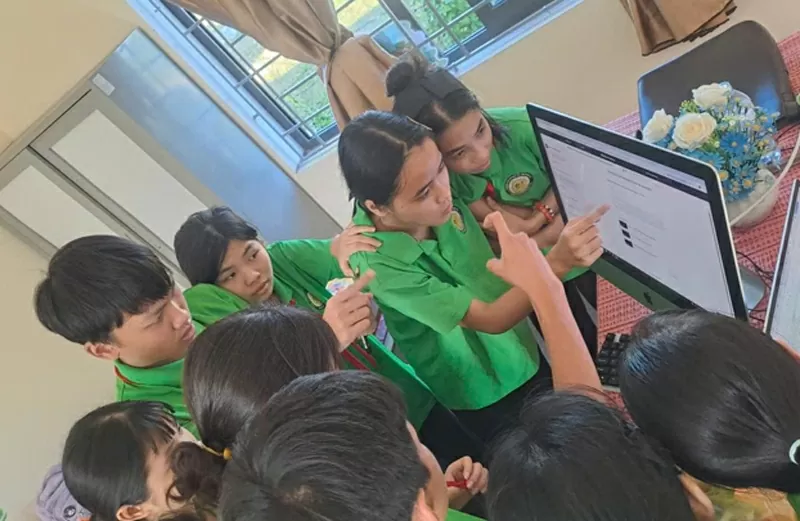 |
| Students at the Quang Tri School for Children with Disabilities study Math together on Khan Academy. |
Beyond sparking interest, Ms. Loan added, KAV also enables her to track each student’s progress and adjust the lesson content accordingly, helping them become more proactive and confident right in class. She emphasized that the greatest power of integrating technology into teaching lies in its ability to break all boundaries.
She recalled a touching moment when one of her students had to travel to the mainland for ten days due to a family emergency. Even so, the student sent her a message: “Teacher, I finished my lesson! I watched the KAV videos and now I understand decimals!”
That moment, Ms. Loan said, made her realize that technology had removed the barriers of distance and circumstance. More importantly, it helped her students maintain the rhythm and spirit of learning, regardless of their location.
The ‘digital nuclei’ of education
The stories from Tho Chau, Minh Tan, and Quang Tri illustrate one powerful truth: no matter how advanced technology becomes, it remains only a tool. The true heart of digital transformation lies in the teachers–the ‘digital nuclei’ who bring it to life.
The spirit of the teacher in the digital era is not simply about mastering software; it is about embracing the spirit of innovation. It is about perseverance like Ms. Loan who wants to keep her island students learning despite limited electricity and weak signals; creativity like Ms. Thanh who turns old computers into bridges of knowledge; and empathy like Ms. Duyen who finds ways for technology to reach and uplift children with disabilities.
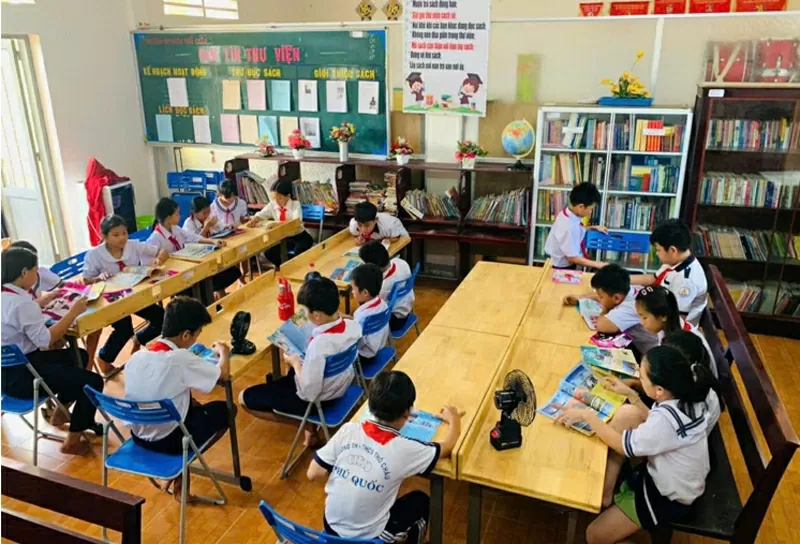 |
| Students of Tho Chau Primary and Secondary School during a self-study session. |
These teachers are living proof showing that digital transformation in education does not begin with grand projects, but with each teacher’s simple yet powerful desire to make learning more equal. They do not wait for ideal conditions - they turn challenges into opportunities.
As Ha Thi Oanh, Vice Principal of Tho Chau Primary and Secondary School, affirmed: “Digital transformation is not just about applying technology; it is a journey of changing mindsets, methods, and ways to connect with learners.” She emphasized that each teacher is a ‘digital nucleus’, igniting the flame of innovation so that students can learn in a more open, modern, and human-centred environment.

| Village-based midwives transform maternal health in remote areas In remote villages once bound by traditional customs, village-based midwives are driving significant improvements in maternal health and childbirth safety. |

| Vietnamese Engineering Team successfully restored a vital bridge in the Abyei area WVR - Engineering Team No. 4 of the United Nations Interim Security Force for Abyei (UNISFA) has just completed a mission of profound strategic and ... |