



Re-election to the UN Human Rights Council: Greater credibility, responsibility and expectations for Vietnam
WVR - Ambassador Dr. Le Thi Tuyet Mai - Member of the Executive Committee of the Vietnam Society of International Law; former Permanent Representative of Vietnam to the United Nations Office, the World Trade Organization, and other International Organizations in Geneva; and former Director-General of the Department of International Law and Treaties, Ministry of Foreign Affairs emphasized that Vietnam’s re-election to the UN Human Rights Council for a consecutive term carries profound significance, demonstrating the maturity, confidence, and prestige of Vietnam diplomacy in the multilateral arena.
Latest
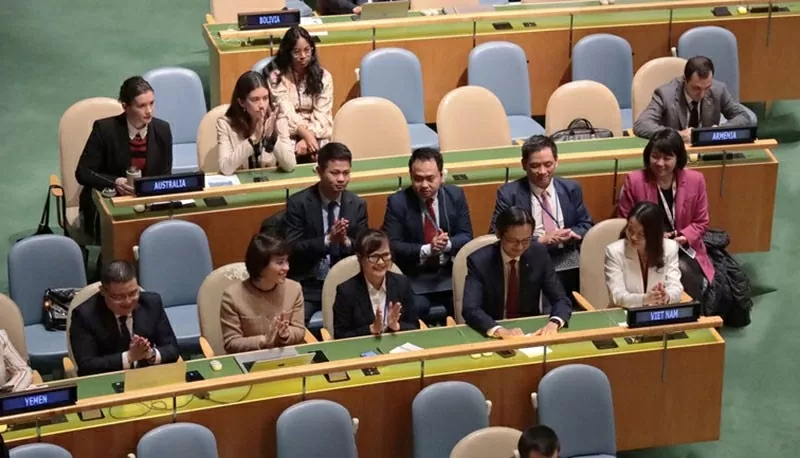 |
| Head of the Vietnamese Delegation, Deputy Foreign Minister Nguyen Minh Hang (first row, extreme right) and members of the Delegation at the moment Viet Nam was announced as re-elected to the UN Human Rights Council (UN General Assembly, New York, October 14, 2025). (Source: Viet Nam's permanent delegation to the UN) |
How did you feel when hearing the news that Viet Nam was re-elected to the UN Human Rights Council (HRC) for a consecutive term?
I felt deeply moved and proud. This is an immense joy not only for the Vietnamese diplomatic service but also a source of encouragement for the entire nation on its journey for peace, development, and the happiness of the people. The outcome affirms Vietnam’s efforts, position, and international prestige in one of the UN’s key pillars - human rights, alongside peace-security and development.
What is particularly remarkable is that Vietnam was re-elected with 180 votes in favor, the highest number of votes in its regional group and the only Asia-Pacific country currently serving as the HRC member re-elected for a consecutive term. This reflects the broad recognition by the international community of Viet Nam’s commitments, efforts, cooperation, and contributions.
I also feel profound gratitude for the sound guidance of the Party and State, the coordination of ministries and localities, and the quiet dedication of diplomats at international fora that made this meaningful achievement possible.
At the same time, I recognize Vietnam’s great responsibility to make even more substantive contributions in the new term, in consistent with the Party’s policy of promoting and elevating multilateral diplomacy, as well as in responding to international expectations.
What does this “continuity” mean for VietnNam diplomacy at the UN and in multilateral fora?
Vietnam’s re-election for a consecutive term carries profound significance, demonstrating the maturity, confidence, and prestige of Vietnam diplomacy in the multilateral arena, most highlighted in three key aspects.
First, the trust of the international community. Vietnam not only has fulfilled its responsibilities during the current term 2023–2025 and previous term 2014–2016 but also was re-elected to continue for the next term of 2026–2028. This is the achievements resulted from Vietnam’s constant efforts in building its image as a constructive, responsible, and sincere partner and making substantive contributions.
Second, adaptability and capability of Vietnam multilateral diplomacy. In a complex international environment where human rights issues sometimes are politicized, Vietnam’s ability to maintain its standing and receive broad support demonstrates its skillful diplomacy - balancing national interests with the common good of the international community. Vietnam not only attend, but also actively participates, shapes and leads several discussions, in line with the Party’s direction on promoting and elevating multilateral diplomacy.
Third, professionalism and continuity. The close coordination among the Ministry of Foreign Affairs, the Permanent Missions in New York and Geneva, and domestic agencies reflects thorough preparation, generational continuity and systematic policy implementation. This enables Viet nam not only to maintain its standing but also to enhance its influence and effectiveness of substantial contributions.
Thus, continuity is a testament to international solid trust for Viet nam - a dynamic and humanistic state pursuing sustainable development, ready to share experiences in addressing human rights as well as urgent global challenges.
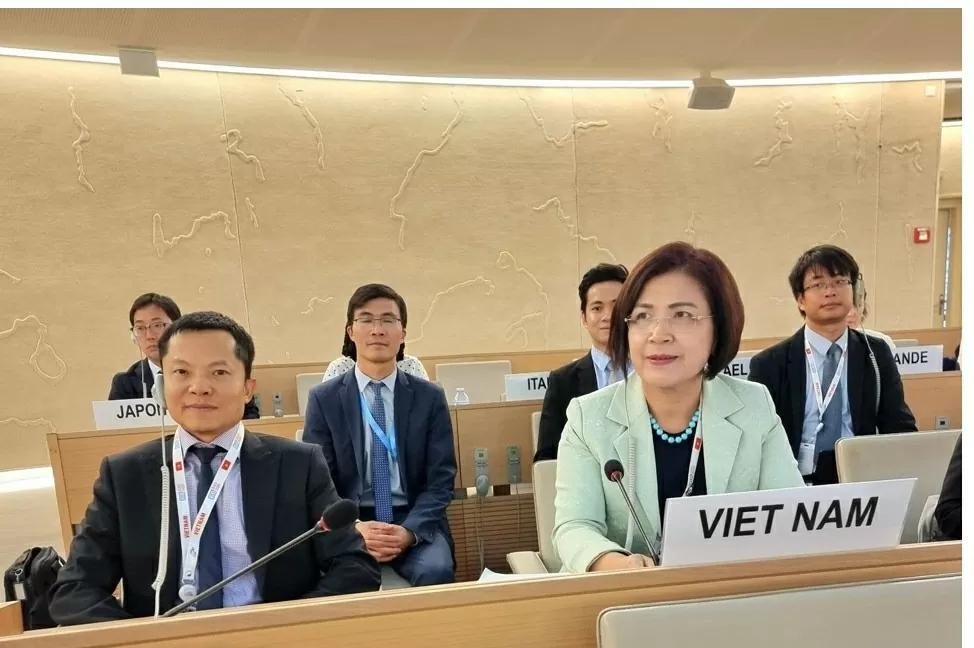 |
| Ambassador Le Thi Tuyet Mai and members of the Vietnamese Permanent Mission in Geneva presented a Joint Statement on the Human Right to Vaccination and Immunization (Geneva, September 20, 2023), and organized a Panel Discussion on this topic at the 54th Session of the UN Human Rights Council (September 11 - October 13, 2023) - in the first year of the 2023-2025 term of Viet Nam's membership at the HRC. (Photo: HP) |
What has built Vietnam’s credibility, especially at the UN Human Rights Council?
Vietnam’s international credibility stems from a combination of domestic progress, constructive dialogue, and substantial contributions. I see five key factors in this regard.
First, human-centered sustainable development. Vietnam has consistently pursued the development pathway taking the people as the center, the goal and the driving force of development – with notable achievements in poverty reduction, healthcare, education, gender equality, and protecting children and vulnerable groups. The tangible achievements in these various fields prove that Vietnam’s human rights policies go beyond rhetoric to implementation, reflecting the effective implementation of policies, laws and programs on human rights linked to sustainable development, not only provisions of laws, policies, and statements at different fora.
Second, dialogue, cooperation, and respect for differences. Vietnam consistently promotes dialogue over confrontation, building common ground and trust, demonstrating its constructive spirit and goodwill, thus becoming a reliable partner even with differing viewpoints.
Third, initiative and connectivity. Vietnam has proposed and co-sponsored important initiatives at the HRC - such as the resolution marking the 75th anniversary of the Universal Declaration of Human Rights, and resolutions on climate change, health rights, and children’s rights in the digital space. These initiatives affirmed Viet Nam’s visible “footprint” in shaping the global human rights agenda, elaborating on human rights linked to sustainable development goals.
Fourth, transparency and accountability. Vietnam announced and has always been faithfully implementing its voluntary commitments – such as promoting human rights to education, ensuring rights of vulnerable groups, enhancing cooperation, and publicly reporting on progress and results of implementation, embodying the principle of “words matched by deeds.”
Fifth, sincere, trustworthy, and responsible diplomacy. Vietnam has been an active member of the UN, ASEAN, APEC, and other international institutions, previously serving as a non-permanent member of the Security Council, and member of ECOSOC as well as the HRC. Through serving each of these membership terms, Viet Nam has proven to be an independent, constructive, and trustworthy voice, , gaining trust from the international community through concrete actions.
What do you expect for Vietnam’s contributions in the new term for 2026-2028?
The new term offers Viet Nam opportunities to further highlight the humanistic character of its diplomacy, continue implementating the 12 voluntary commitments and 8 priority areas announced during its candidacy, and contribute actively to the HRC’s work for the common good of all nations.
Every nation bears responsibility to promote and protect human rights of its people. As a member of the HRC, Vietnam not only fulfills its domestic obligations - promoting and reporting on the implementation of its laws, policies, and programs for human rights in accordance with international treaties to which Vietnam is a party, but also participates in the HRC universal periodic reviews, dialogues, and making global human rights policies, on the basis of the principles of equality, constructive dialogue and cooperation.
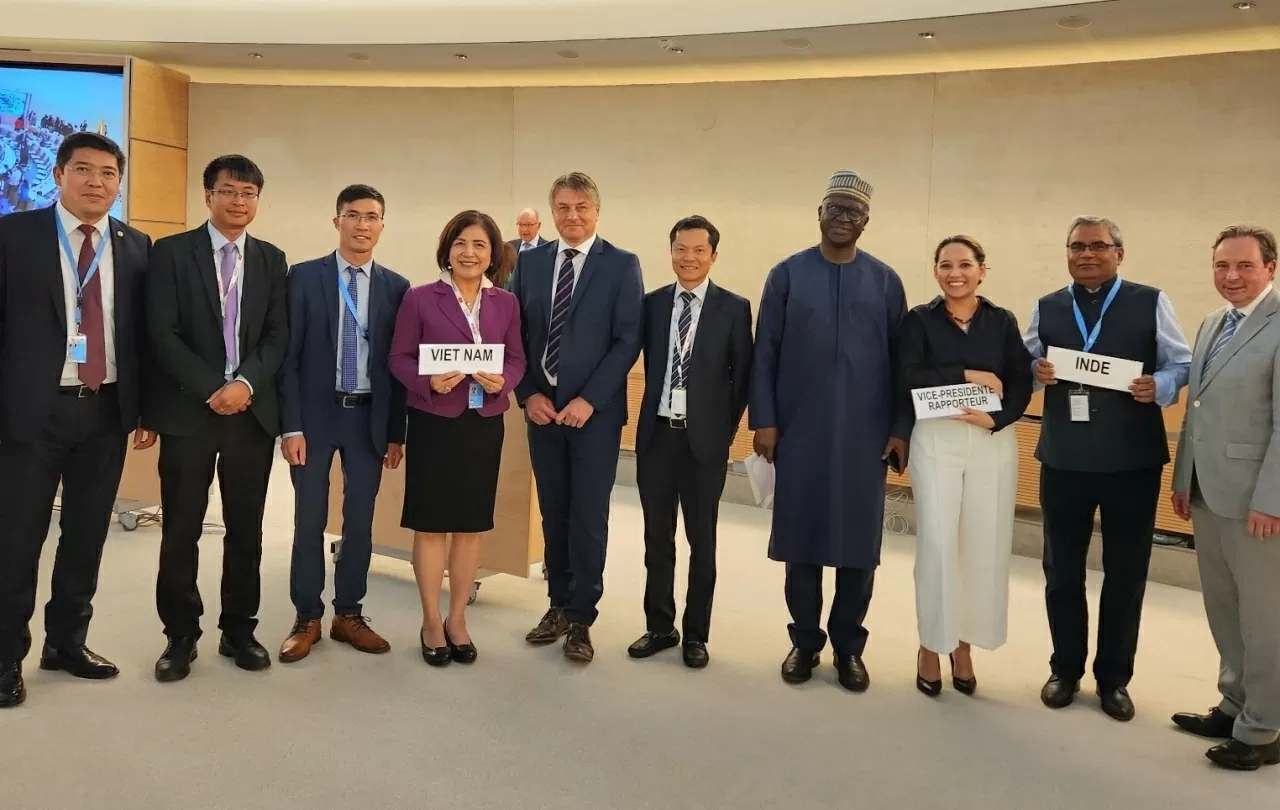 |
| Members of the Vietnamese Permanent Mission in Geneva with the President and three Vice Presidents of the HRC and Ambassadors of some state members of the HRC at the closing session of the HRC 54th session, Geneva on October 13, 2023. (Photo: HP) |
The HRC members’ responsibility becomes even more significant as human rights face numerous global challenges - such as armed conflicts, political instability, economic inequality, climate change, digital gap - particularly when multilateralism and the UN, the HRC are being challenged due to rising division, conflicts among states or values, cultures, and politicization of human rights. Hence, for meeting the common expectations of states in addressing human rights issues, it is essential to strengthen the HRC’s role through dialogues, discussions, experience-sharing, and international cooperation instead of confrontation or imposing.
Against that backdrop, Vietnam is expected to make substantive contributions across eight priority areas as it has already announced, of which four key directions can be emphasized here.
First, acting as a “bridge” between regions and groups of states in human rights discussions. With its independent foreign policy, along with achievements and experiences, Vietnam can help to bridge regional and political divides, fostering understanding and cooperation.
| "Viet Nam’s re-election is a result of the unity of the entire political system, the dedication of the diplomatic service, and the support of the people. This is not an endpoint but a new beginning, with higher expectations for proactive, responsible, and substantive engagement by Viet Nam at the HRC". |
Second, shaping and leading “Vietnam-imprint” themes. Vietnam can continue to pioneer on pressing global issues such as human rights in the context of climate change, digital transformation, personal data protection, equitable access to technology, and post-pandemic recovery. These areas are aligned with Vietnam’s strength and sustainable development goals as well as international cooperation between Vietnam and its partners in relevant fields and mechanisms.
Third, enhancing transparency and accountability in fulfilling international obligations. Vietnam can continue sharing experiences through voluntary midterm Universal Periodic Review (UPR) report and follow-up actions in response to recommendations, as Vietnam did in 2022 and was appreciated by the international community. This will reaffirm that Viet Nam truly engages in constructive, transparent, and accountable dialogue, without politicizing human rights.
Fourth, contributing to reform and improvement of efficiency of the HRC. Viet Nam can further promote initiatives for easing political confrontation, share common values, enhance mutual understanding and respect, expand technical cooperation, as well as promote interactions between the HRC and human rights treaty-bodies and the UPR mechanism for strengthening the role of the HRC, its fairness, inclusiveness, and effectiveness.
Vietnam’s re-election is a result of the unity of the entire political system, the dedication of the diplomatic service, and the support of the people. This is not an endpoint but a new beginning, with higher expectations for proactive, responsible, and substantive engagement by Vietnam at the HRC.
I am confident that, under the Party’s leadership, with concerted efforts of the diplomatic service, close coordination among ministries, sectors, localities, as well as the participation of the people in implementing laws, policies and programs for human rights, Vietnam will continue to successfully fulfill its role as a member of the HRC for the new term, contributing meaningfully to the promotion and protection of human rights for all, and to building the world of peace, humanity, and sustainable development in line with the UN Charter and other international instruments which states have agreed upon.
Thanks the Ambassador!