



From UNESCO to Vietnam: The Journey of a Global Educational Vision
Few UNESCO reports continue to be cited as a guiding compass for global education three decades after their publication. Learning: The Treasure Within is one of them.
Latest
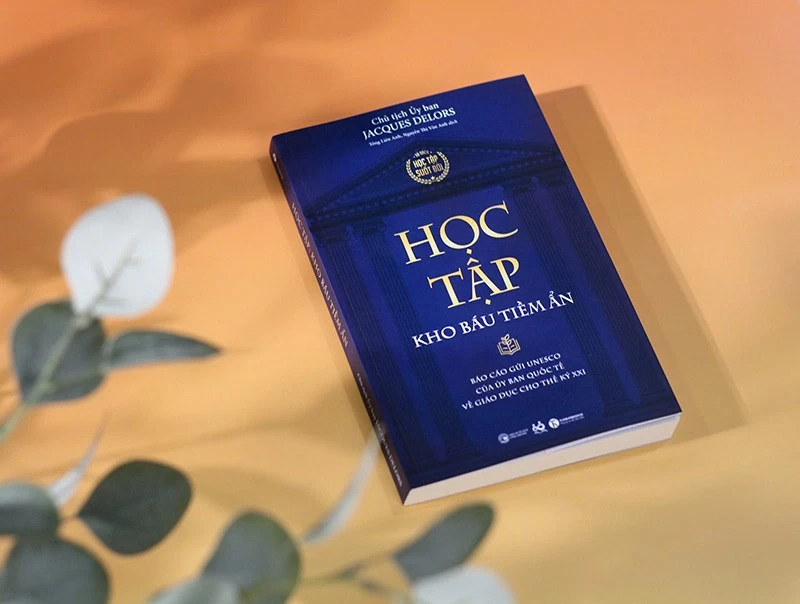 |
Thirty years after its release, the landmark report has been introduced to Vietnamese readers for the first time under the title Học tập: Kho báu tiềm ẩn. More than a seminal work of global educational thought, the book invites profound reflection on human development and the future of society in the twenty-first century.
In 1996, under the chairmanship of Jacques Delors, President of the European Commission from 1985 to 1995, the International Commission on Education for the Twenty-first Century submitted Learning: The Treasure Within to UNESCO. Not only did the report lay the foundation for the concept of lifelong learning and the renowned Four Pillars of Learning - learning to know, learning to do, learning to live together, and learning to be - but it also became one of UNESCO’s most influential education documents in the latter half of the twentieth century.
Thirty years later, as the world enters the digital age and the era of artificial intelligence, many forecasts made in the 1990s have become outdated. Yet the core ideas of the Delors Report continue to be revisited in discussions about the future of education. This suggests that the report’s enduring value lies not in predicting technological progress but in its understanding of human beings and the fundamental purpose of education.
Looking back at the history of educational thought, the Delors Report marks one of the rare moments when education was restored to its rightful place: not merely as an instrument for economic growth or workforce development, but, above all, as a pathway through which every individual can fully realise their potential.
What is particularly striking is that the deeper we move into the age of artificial intelligence, the more relevant the questions raised by the Delors Report appear to become. If education once grappled with how to transmit knowledge, today, knowledge has never been more accessible. If people were once assessed primarily by their ability to memorise and process information, machines are now performing those very tasks at speeds far beyond human capability.
Against this backdrop, education may need to return to its most fundamental question: what uniquely human capacities must remain ours? They may include the ability to live with difference, ethical judgment, empathy, social responsibility, collaboration, and a commitment to lifelong learning to adapt to realities that have never existed before.
Perhaps this is why, three decades on, the Delors Report is still regarded by many as a compass rather than a technical manual. Rather than attempting to predict how the world will change, it focuses on a far more fundamental question: regardless of how the world evolves, what must education do to ensure that human beings retain their dignity, freedom, and capacity for growth?
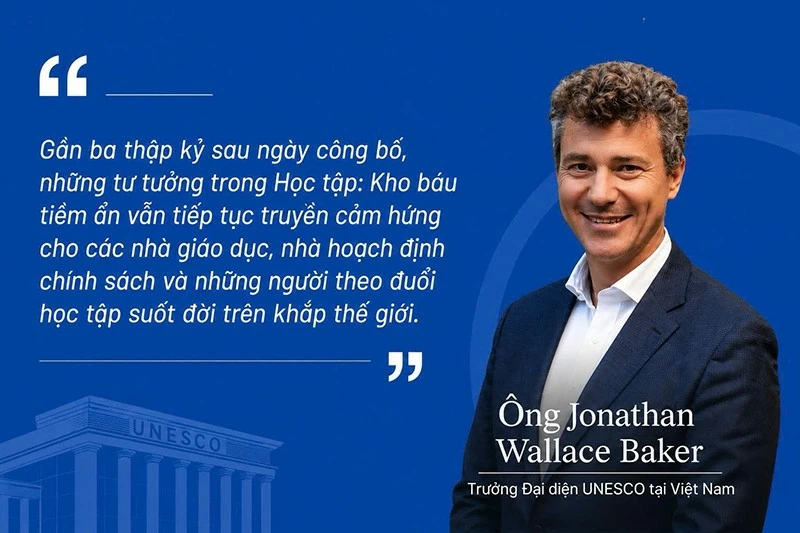 |
| Mr. Jonathan Wallace Baker, UNESCO Representative to Vietnam. |
In his foreword to the Vietnamese edition, Mr. Jonathan Wallace Baker, UNESCO Representative to Vietnam, writes:
“Yet, as you turn each page of this 'treasure,' you will discover that Jacques Delors’ reflections at the close of the twentieth century are not outdated; rather, they are more relevant and urgent than ever. While modern society offers unprecedented material prosperity, it also presents profound challenges, including social fragmentation, ethical dilemmas surrounding technology, and a growing sense of human isolation in an overwhelming flow of information.”
According to Jonathan Wallace Baker, the ideas presented in the report are not intended solely for policymakers or education professionals. They also offer valuable reflections for anyone concerned with the future of humanity in a rapidly changing world.
From a Global Educational Vision to Vietnam’s Development Strategy
Building a learning society, promoting lifelong learning, and developing every citizen’s capabilities throughout the course of life have become central principles underpinning many of Vietnam’s major policy directions in recent years. In this sense, the Delors Report is not merely an academic reference; it also provides an important framework for shaping long-term human development policies.
Its spirit also resonates strongly with Vietnam’s major national priorities, including the comprehensive reform of education and training, the development of a highly skilled workforce, the promotion of national digital transformation, and the building of a learning society. As the country enters a new stage of development, lifelong learning is no longer simply a UNESCO recommendation - it is becoming an essential requirement for sustainable national development.
For decades, UNESCO has served not only as an international forum for educational cooperation but also as the birthplace of influential ideas on human development. The Delors Report stands as one of its most significant intellectual legacies.
From the perspective of international cooperation, the publication of the Vietnamese edition of Learning: The Treasure Within also reflects the deepening partnership between Vietnam and UNESCO in education, human development, and the implementation of the Sustainable Development Goals (SDGs). It represents not only the adoption of progressive global ideas but also an opportunity for Vietnam to contribute more actively to international dialogue on the future of education, lifelong learning, and the building of learning societies in the twenty-first century.
Mrs. Nguyen Thi Van Anh, Ambassador and Permanent Representative of Vietnam to UNESCO, remarked:
“The report demonstrates the profound alignment between UNESCO’s global vision and Vietnam’s educational development strategy—to nurture a new generation of Vietnamese citizens who possess patriotism and national pride, together with the resilience, intellect, competence, knowledge, and health required to build, develop, and safeguard the nation in a new era.”
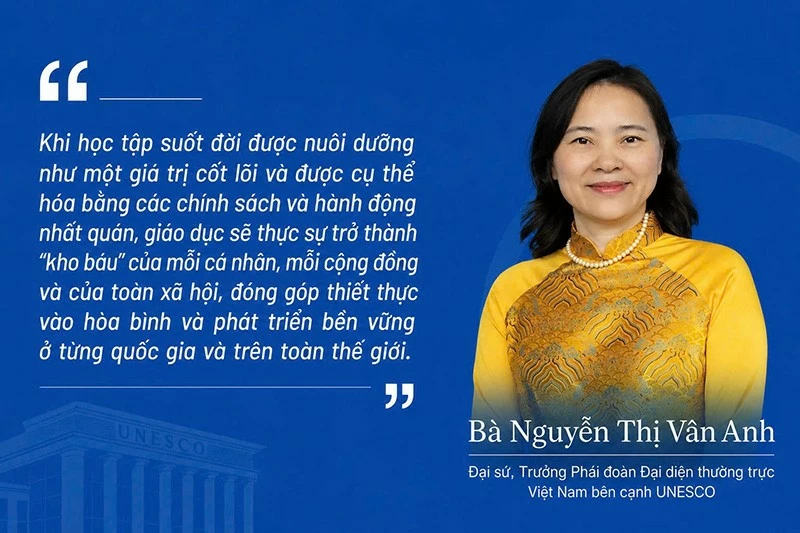 |
| Mrs. Nguyen Thi Van Anh, Ambassador and Permanent Representative of Vietnam to UNESCO.
"When lifelong learning is embraced as a core value and translated into consistent policies and actions, education can truly become a 'treasure' for every individual, every community, and society as a whole - making a meaningful contribution to peace and sustainable development in every nation and across the world." |
Voices in Harmony
An educational philosophy only truly comes to life when it is embraced, discussed, and translated into action within each national context. For many educators in Vietnam, the Delors Report is not merely an international policy document but a lasting source of inspiration for research, educational practice, and policy development.
Education expert Tống Liên Anh, who has spent many years promoting lifelong learning policies and practices in Vietnam and is also the translator of the book, shared:
“Since I first encountered Learning: The Treasure Within in 2013, I have always hoped that one day this report would become widely accessible to Vietnamese readers. Over the past decade, the ideas and recommendations presented in the report have profoundly shaped the way I view education and have become an important reference throughout my learning, research, and policy work to advance lifelong learning in Vietnam.
Therefore, thirteen years after that first encounter, becoming the translator of Learning: The Treasure Within is, for me, not merely a professional undertaking, but the continuation of an intellectual journey and the fulfilment of a long-cherished aspiration.”
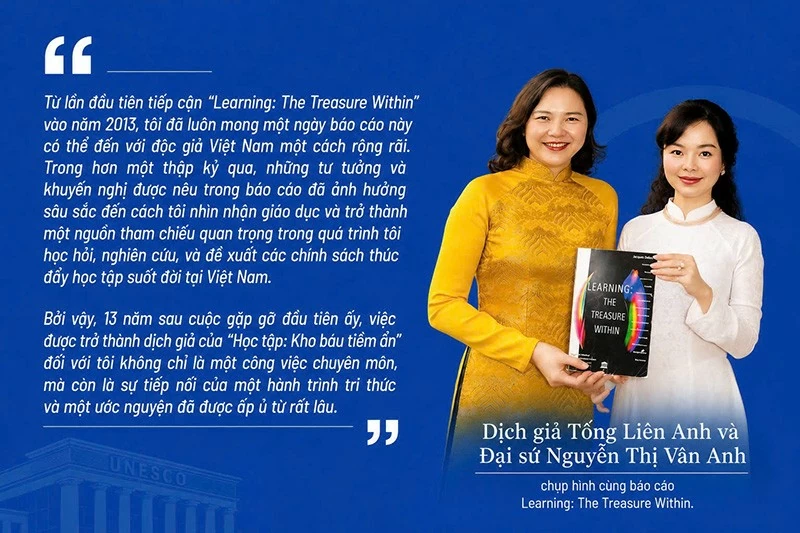 |
| Translator Tong Lien Anh and Ambassador Nguyen Thi Van Anh pose for a photo with the report Learning: The Treasure Within.
"When I first encountered Learning: The Treasure Within in 2013, I had one enduring hope - that one day this report would become widely accessible to readers in Vietnam. Over the past decade, the ideas and recommendations presented in the report have profoundly influenced educational thought and become an important source of reference for research, learning, and the development of lifelong learning policies in Vietnam. Therefore, thirteen years after that first encounter, having the privilege of translating Learning: The Treasure Within is, for me, far more than a professional undertaking. It is the continuation of an intellectual journey and the fulfilment of a long-cherished aspiration." |
As co-translator of the book, Nguyen Thi Van Anh, a sustainable development expert who has lived and worked in five different countries over the past seventeen years, reflected:
“Translating this book has been an extraordinary opportunity for me to reflect more deeply on the role of education and lifelong learning in every individual’s life journey. It is a lesson about preserving one’s identity and roots, enabling people to maintain a strong spiritual foundation from which they can confidently engage with an increasingly volatile and uncertain world. It is also a lesson in an open and diverse philosophy of education—one that is neither rigid nor prescriptive, but instead nurtures the limitless potential within every individual.”
From the perspective of someone who has pioneered lifelong learning models with broad scale and impact, Nguyen Anh Tuan, Director of the Lifelong Learning Institution, emphasised that the analyses and recommendations presented in the Delors Report are far from abstract theories detached from reality. Rather, they embody a far-reaching vision and enduring value. The work is not merely a technical report; it is a message that speaks to humanity’s conscience, carrying the mission of addressing some of the greatest crises of our time—from the risks of ethnic and religious conflict, social and gender inequality, to indifference and the growing danger of people being left behind in the course of development.
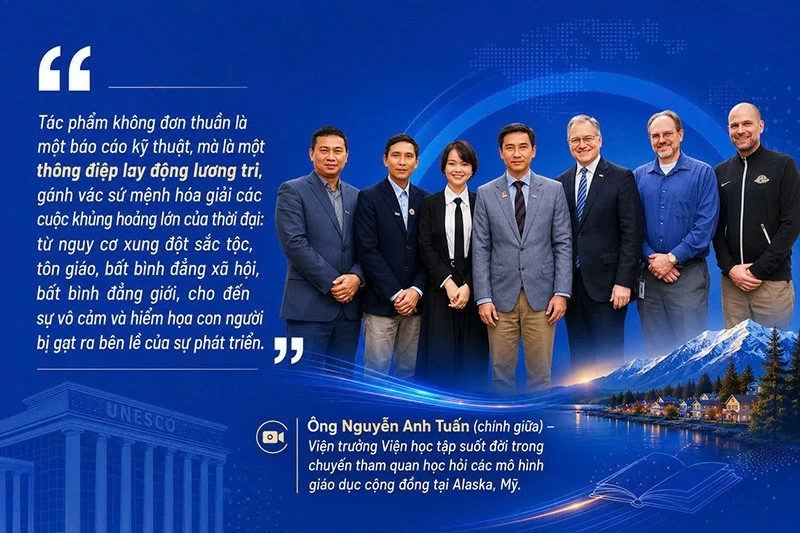 |
| Mr Nguyen Anh Tuan, President of Lifelong Learning Institution (pictured at centre), during a study visit to community education models in Alaska, the United States.
"This work is not merely a technical report. It is a powerful call to conscience, bearing the mission of responding to the pressing challenges of our time - from the risks of ethnic and religious conflict, social and gender inequality, to indifference and the exclusion of people left behind by development." |
Drawing on his experience in developing a non-profit community education model in Quang Tri, Do Huu Thien, Founder of the Thien Nhan Van Knowledge Centre, believes that the enduring value of Learning: The Treasure Within lies in restoring human beings to the very centre of education. He shared:
“The most valuable outcome we have witnessed is not the number of programmes we have implemented, but the transformation in people’s awareness. When knowledge is shared in a spirit of service, it can bring about positive change in an individual, extend to a family, and ultimately benefit an entire community.”
Meanwhile, from the perspective of those engaged in publishing and disseminating knowledge, bringing a classic work to readers three decades after its original publication is more than an act of publishing- it is an effort to bring some of the world’s most important conversations closer to Vietnamese society. Dr. Nguyen Manh Hung, Chairman of the Board of Thai Ha Books, observed:
“Three decades on, the core values of the Delors Report have not become outdated. On the contrary, they have become an indispensable compass for our time.”
While many regard the Delors Report as a milestone in the history of global educational thought, from the perspective of education policy, its value perhaps lies elsewhere: it provides a framework through which countries can continually ask themselves the fundamental question of what education is ultimately meant to achieve.
From this perspective, Dr Hoang Anh Duc, RMIT University, Klingenstein Fellow at Teachers College, Columbia University, remarked:
“For Vietnam, this report carries particular practical significance. For the 2018 General Education Curriculum, as well as for the laws, decrees and circulars issued over the past several years, the four pillars of learning have remained a constant reminder: Does a policy truly enable learners to think, to act, to live together with others, and to become themselves?”
What is striking is that, despite coming from different professional backgrounds, all of these perspectives converge on one shared conclusion: the Delors Report is far more than an important document on education.
A Dialogue That Continues
It is a profound reflection on humanity, on learning, and on the capabilities that individuals need in order to thrive in an ever-changing world. Beyond introducing the renowned Four Pillars of Learning - learning to know, learning to do, learning to live together, and learning to be - the report also addresses issues that remain highly relevant today, including globalisation, inequality, the role of teachers, citizenship education, learning societies, and international cooperation in education.
The Vietnamese edition of Learning: The Treasure Within is perhaps more than simply the introduction of a UNESCO classic to domestic readers three decades after its publication. More importantly, it has the potential to become a catalyst for new policy dialogues on the future of education, human development, and how Vietnam prepares for a society increasingly shaped by artificial intelligence, digital transformation, and the unprecedented changes of the twenty-first century.
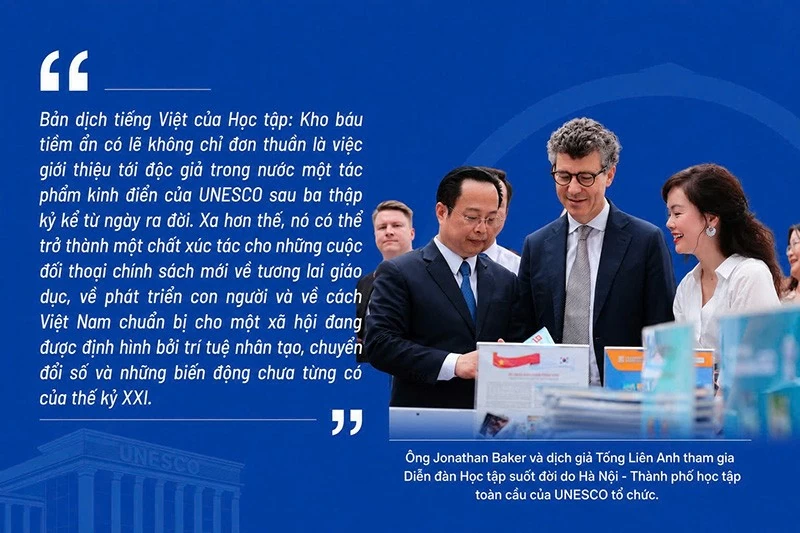 |
| Mr. Jonathan Baker and Translator Tong Lien Anh at the Lifelong Learning Forum hosted by Hanoi City, a member of the UNESCO Global Network of Learning Cities.
"The Vietnamese translation of Learning: The Treasure Within is far more than the introduction of a UNESCO classic to readers in Vietnam, three decades after its original publication. More importantly, it has the potential to inspire new policy dialogues on the future of education, human development, and how Vietnam can prepare for a society shaped by artificial intelligence, digital transformation, and the unprecedented changes of the twenty-first century." |
Thirty years ago, Jacques Delors posed the question of how education should prepare humanity for the twenty-first century. Thirty years later, as artificial intelligence is transforming nearly every aspect of human life, that question still has no definitive answer. Perhaps this is the greatest value of Learning: The Treasure Within. Rather than offering immutable answers, the book opens an ongoing dialogue about the future of humanity. The publication of the Vietnamese edition today, therefore, does more than add another classic to the nation’s educational bookshelf; it also broadens the space for dialogue between Vietnam and the world on human development in the twenty-first century.

| Exhibition on the global journey of Vietnamese spices in Switzerland WVR - The exhibition "Symphony of Spices: Vietnamese Roots, Global Routes" offers insights into the journey of Vietnamese spices spreading through global trade networks and ... |
| Vietnam, India share vision, strategic convergence, substantive cooperation: General Secretary, President To Lam at ICWA WVR/VNA - On May 6, General Secretary of the Communist Party of Vietnam Central Committee and President To Lam delivered a policy speech at the ... |