






'Mua do' (Red Rain) and two love songs from the frontline to the homefront
WVR - Two songs from the film "Mua do" (Red Rain) offer two emotionally rich perspectives, deeply portraying the silent pain at the homefront and the noble ideals at the frontline.
Latest
In cinema, music always serves as a bridge of emotion. With Red Rain, two songs - "Noi dau giua hoa binh" (Pain amist Peace, performed by Hoa Minzy, composed by Nguyen Van Chung) and "Con gi dep hon" (What could be more beautiful, written and performed by Nguyen Hung) - have been warmly embraced by the public.
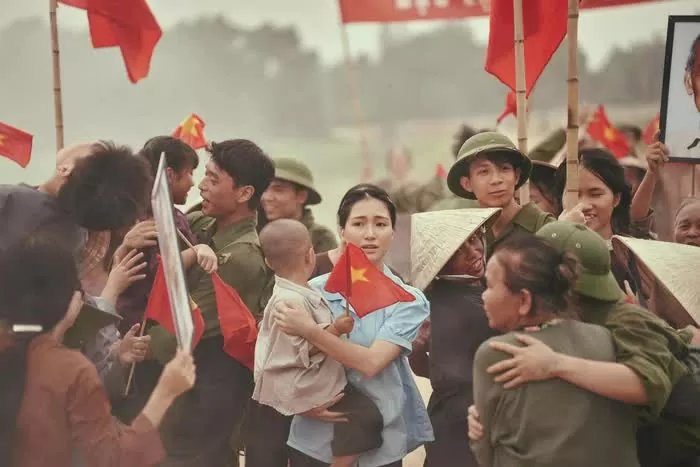 |
| 'Mua do' (Red Rain) and two love songs from the frontline to the homefront: Moment of Hoa Minzy holding a child in the music video The Pain Amid Peace. (Source: Production Team). |
Behind glory lies pain
Written by composer Nguyen Van Chung for Hoa Minzy at the request of the Army Film Studio and director Dang Thai Huyen, "Noi dau giua hoa binh" pays tribute to the immense sacrifice of Vietnamese Heroic Mothers and wives who lost loved ones on the battlefield, while voicing the enduring sorrow that remains even in times of peace.
“These are real pains that we must see, feel, care for, and never forget - especially on days of national celebration”, the composer shared on his personal page on 31 August 2025.
After hearing the song, Hoa Minzy decided to produce an independent music video in collaboration with director Nhu Dang (her partner in Bac Bling). She invited actor Phuong Nam (who plays Ta, leader of Squad 1 in "Red Rain") to portray the husband, and NSND Nhu Quynh (long associated with the image of the resilient Vietnamese mother) to play the mother-in-law.
Beyond the poignant battlefield scenes from the film, the music video was shot at Truong Son National Cemetery and Duong Lam Ancient Village. Costumes were dyed with tea and coffee to create an aged look, evoking the wartime atmosphere.
The staging recalls the silent figures of women on the home front: mothers and wives enduring waiting and loss. This perspective turns the song into a diary of memory, etching the tragedy of war through silent tears.
War seen from a simple heart
While "Pain Amidst Peace" is an emotionally rich, soft ballad that moves many to tears with the silent sacrifices of the homefront, the song What Could Be More Beautiful is a sacred message from the fierce frontline.
Besides challenging himself in the role of a young soldier named Hai, Nguyen Hung also ties his name to the film "Red Rain" with the song What Could Be More Beautiful. He began writing the song while reading the script and completed it after the film wrapped. Starting from his own experience of embodying the character, Hung brings authenticity to the song from someone who has lived within the character.
Inspired by the film, the lyrics of What Could Be More Beautiful do not focus on glorifying achievements in a traditional way, nor do they directly recount historical landmarks, but delve into the silence with the image "In the night of lanterns after the victory celebration/ How many names remain here".
The young soldier comforts, hoping his mother finds peace: "Mother, be happy, you have a heroic son". He sends a message to his lover, wife: "The road home is far, after the rain falls, I am late/ But if I do not return/ You should also be happy".
And the emotions reach a climax, bringing tears to the public, with the proud and unyielding sentiment: "To sow youth for the country's freedom/ For me, that's all, what could be more beautiful?". Ending with a question but affirming the steadfast spirit, the silent sacrifice for the love of homeland and country.
With a sincere and simple voice, What Could Be More Beautiful feels like a whisper, as if the soldier is speaking to himself in the moment of stepping into danger, like a letter from someone far away to their loved ones, which might never receive a reply.
The entire song feels like a whisper, without a climax, without melodrama. The tone is handled lightly. This allows the song not to make an explosive impression immediately, but to linger and stay long in the listener's mind.
Compared to traditional war-themed film music, which often uses strong rhythms and sharp lyrics to create grandeur, Nguyen Hung chooses to lower emotions to the lowest level. This simplicity makes it easier for young audiences to empathize, as they feel the direct voice of a young soldier.
 |
| Actor and musician Nguyen Hung performing the song "What Could Be More Beautiful" at the premiere of the film "Red Rain". (Source: Galaxy Studio) |
Two perspectives, one shared memory
Placed side by side, Pain Amidst Peace and What Could Be More Beautiful are like two halves forming a complete picture of war and peace. One represents the homefront, where the silent pain of those left behind becomes a deep memory.
The other originates from the trenches, where young soldiers send messages to their mothers, to the country, to the future. These two songs, each in its own way, revive the memory of the 81-day battle of Quang Tri Citadel, not only through images but also through song, melody, and tears.
Notably, the way these two songs reaching the public also reflects the changes in film music in the digital age. "Pain Amidst Peace" exploded with a cinematic-style music video, harnessing the power of imagery and the support of a professional production team.
Meanwhile, What Could Be More Beautiful became a phenomenon through live performances and audience covers, circulating widely on social media platforms.