





Korea: College students' living expense loans increase amid soaring housing, food costs
Rising housing costs and inflation appear to be factors adding to the financial pressure on students in Korea.
Latest
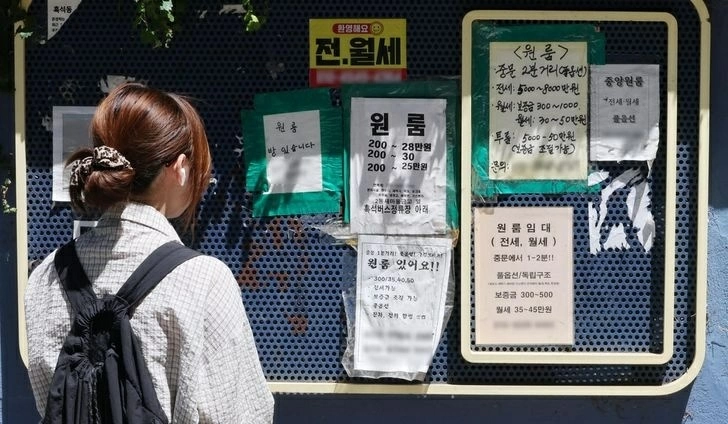 |
| A college student looks at a rental listings displayed on a board near Chung-Ang University in Dongjak District, Seoul, Aug. 12. (Source: Yonhap) |
“I make about 600,000 won ($440) a month from my part-time job at a cafe. Even with a little help from my parents, I can't cover my rent and living expenses,” said Kim, a college student living in Seongbuk District, Seoul.
“I've been asking my friends about income requirements and other eligibility criteria because I'm considering taking out a loan from the Korea Student Aid Foundation (KOSAF) next semester,” she said.
Kim's concerns reflect a broader trend, with living-expense loans taken out by college students surging by nearly one-third over the past two years, while overdue balances also rose sharply, data showed Thursday.
The amount of living-expense loans extended to university students by KOSAF rose 32.8 percent to 850.6 billion won ($626.5 million) in 2025 from 640.67 billion won in 2023, according to data submitted by KOSAF to Rep. Kang Kyung-sook of the Rebuilding Korea Party.
The number of loans also increased from 432,171 to 457,129 over the same period.
The loans are designed to provide students with accessible financing for living expenses. They carry an annual interest rate of 1.7 percent, with repayment beginning after borrowers start earning an income.
The increase was particularly noticeable among students from lower-income households.
Loans taken out by recipients of basic livelihood assistance, near-poverty households and students in the lowest three income categories used to determine eligibility for government student aid rose 33.9 percent to 363.47 billion won in 2025 from 271.5 billion won in 2023.
KOSAF said a survey of 44,818 living-expense loan recipients conducted last year found that most borrowers used the money for its intended purposes, including food and transportation expenses.
Rising housing costs and inflation appear to be factors adding to the financial pressure on students.
Monthly rent for studio apartments in major university neighborhoods in Seoul rose by about 8 percent over the past year, according to Dabang, a real estate information platform.
Kang called on KOSAF to conduct a more detailed assessment of borrowers' financial situations, arguing that more detailed research is needed into how young people's debt is accumulating and what is driving them to borrow to cover living expenses.
“KOSAF appears to have considered its task done by having borrowers click a few check boxes when taking out loans, while failing to carry out a substantive assessment or carefully review its policies,” Kang said.
“Policies should also provide more comprehensive support for young borrowers, including debt adjustment as well as more tailored financial assistance,” she added.

| Vietnamese Coffee on the path to becoming a 'shared living heritage of humanity' At the World Coffee Heritage Forum (Buon Ma Thuot, Dak Lak), coffee is recognised not just as an agricultural product but as a “living heritage” ... |

| Sao Mai Residence where the three values of 'Living - Investing - Asset accumulation' converge Sao Mai Residence: In a real estate market increasingly demanding practical value, a project aiming to win over customers must demonstrate potential across three key ... |

| Economy of Vietnam grows as living standards improve Fifty-one years after the liberation of the South and national reunification (April 30, 1975–2026), Vietnam has made significant socio-economic progress, with GDP exceeding 514 billion ... |

| Promoting Vietnamese agricultural products and food at the Global Food Fair in Gwangju WVR - The Vietnam-Korea Business & Investment Association (VKBIA), in collaboration with the Gwangju city administration, Republic of Korea, and the Gwangju Tourism Bureau, ... |

| Hanoi CPI rises 5.36% in September 2026 amid food and energy price pressures Hanoi’s consumer price index (CPI) in September 2026 increased 0.81% compared to the previous month, 4.47% from December 2025 and 5.36% from a year earlier, ... |
(Source: Korea)