





El Ciudadano interview: 55 years of Vietnam–Chile relations increasingly substantive and sustainable
WVR - El Ciudadano interviews the Vietnamese Ambassador to Chile on the occasion of the 55th anniversary of Vietnam-Chile diplomatic relations (1971-2026).
Latest
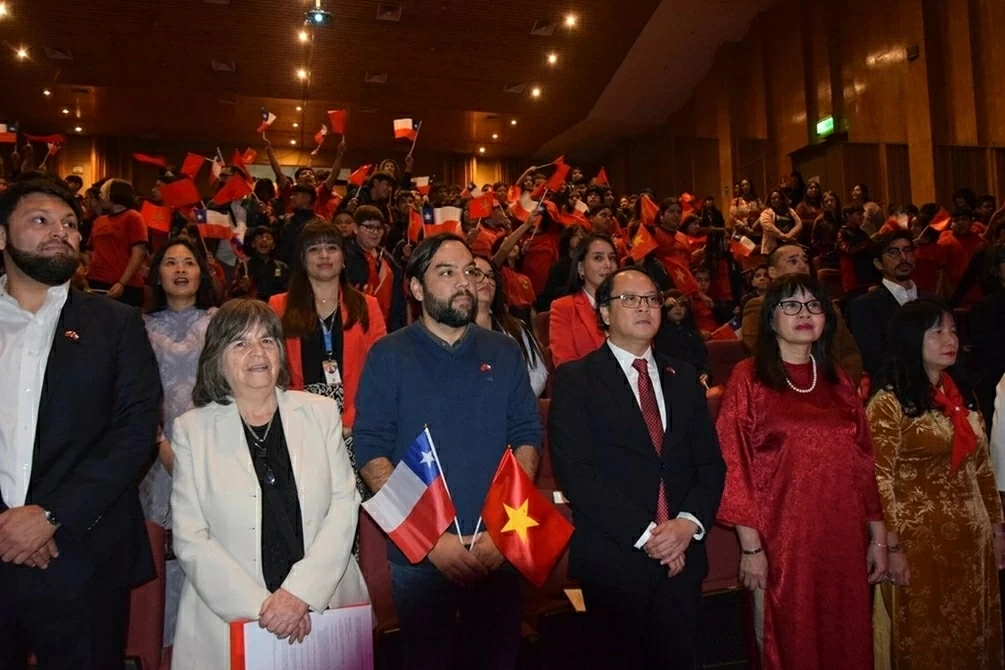 |
| The 55th-anniversary celebration of Vietnam-Chile diplomatic relations organized by the Vietnamese Embassy in Chile. (Source: Vietnamese Embassy in Chile) |
The year 2026 marks 55 years since Chile and Vietnam officially established diplomatic relations—one of the oldest bilateral relationships between Vietnam and a Latin American country.
On this occasion, El Ciudadano interviewed Vietnamese Ambassador to Chile Nguyen Viet Cuong about the 55-year journey of the two countries' relations, the emerging cooperation opportunities, and the significance of this relationship in today's global context.
In 1971, amid a world divided by deep geopolitical tensions, Chile became one of the first South American countries to establish diplomatic relations with Vietnam, then still at war. Looking back after 55 years, what does that decision reflect about the foundation of the two countries' relationship?
March 25, 1971, is not just a historical milestone in the relations between the two countries. It was a clear political decision made at a time when the world was divided into opposing blocs, with immense pressure on each nation to align with one side.
Chile decided to establish relations with Vietnam, which was then in the midst of its struggle for independence and national unification, despite being nearly 19,000 km away. It was a choice of independent diplomacy, respecting national self-determination and pursuing its own path.
This held special meaning for the Vietnamese people, as we were fighting for that very self-determination. This was the first meeting point between the two nations, not in geography or trade, but in a shared fundamental belief: Each nation has the right to choose its own path.
This shared belief laid the foundation for the 55 years of relations that followed. Today, Vietnam has comprehensive strategic partnerships with 15 countries and organizations, including all five permanent members of the United Nations Security Council. This is the result of an independent, self-reliant foreign policy that consistently seeks to expand relations with all on the basis of mutual respect.
Within this extensive network of relations, Chile holds a special place: A friend present during the toughest times, the first Latin American country to sign a bilateral Free Trade Agreement with Vietnam, and a partner with us in both the Asia-Pacific Economic Cooperation (APEC) forum and the Comprehensive and Progressive Agreement for Trans-Pacific Partnership (CPTPP). Vietnamese people have a tradition of valuing friends who stood by them in difficult times. For us, this is not just sentiment but the foundation of long-lasting trust, more enduring than any document.
Over more than half a century, both Vietnam and Chile have undergone profound transformations, each following its own path. What has kept this relationship strong?
What has kept the relationship strong, in my view, is a principle that both sides have consistently adhered to: Respecting each other's development choices and not interfering in each other's internal affairs. The two countries have different historical contexts and development conditions but share fundamental values in international relations: Respect for international law, commitment to multilateral trade, and an independent foreign policy. This consensus on values has created a foundation of enduring trust over time.
With political trust, economic relations can develop more deeply and comprehensively, expanding into areas where both sides truly need each other. Since joining APEC, the two countries have gradually built a foundation of trust and recognized that their interests complement each other—a condition that led to the birth of the bilateral free trade agreement in 2014, the first and only FTA Vietnam signed with a Latin American country. The CPTPP, negotiated during the APEC Economic Leaders' Week 2017 in Da Nang, Vietnam and officially signed in Santiago, Chile, in 2018, was an important continuation, further solidifying that foundation.
In November 2024, the President of Vietnam made an official visit to Chile. This was the first head-of-state visit in 15 years and an opportunity for both sides to look forward and identify new directions for cooperation in the next phase. It is an expression of a relationship that has matured in the truest sense—trustworthy, sustainable, and always ready to move towards new milestones.
Looking at the two economies, one holds strategic resources for the global energy transition, the other is a major production and export hub in Asia. Bilateral trade of nearly USD 1.8 billion is growing well but still falls short of its true potential. In your opinion, where are the barriers?
The foundation of trust is the condition for substantive economic relations, but having favourable conditions is one thing, fully exploiting the potential is another.
Institutionally, the cooperation foundation between the two countries is quite solid: A bilateral FTA since 2014, both are members of APEC, and the CPTPP was signed in Santiago in 2018. What both sides need to continue building are more direct connections between businesses, scientists, and the people of both countries.
Geographical distance results in high transportation costs and limited direct understanding of each other's markets, especially among small and medium-sized enterprises, which remain practical obstacles. Many businesses are aware of the agreements but have yet to find ways to leverage them in practice.
The current global context is driving the two sides closer together. As global supply chains are being reshaped, businesses are not only looking for partners with competitive prices but also trustworthy ones. Vietnam and Chile have a real advantage: 55 years of continuous relations are evidence of trust that not every relationship possesses.
Looking at the economic structures of the two countries: Chile is the world's largest copper producer and one of the leading exporters of lithium, two key minerals in the transition to global clean energy.
Vietnam is a major electronics manufacturing hub in Asia, with a growing demand for precisely these materials. This is not a relationship where one side sells raw materials and the other sells finished products, but a relationship between two economies moving towards a green and sustainable growth model, where each side's strengths are exactly what the other needs.
On supermarket shelves in Hanoi and Ho Chi Minh City, Chilean cherries and salmon are no longer unfamiliar. These are concrete signals that the 19,000 km distance is shortening.
Vietnam also has much to learn from Chile: Natural resource management experience, renewable energy transition models with a green hydrogen strategy being implemented, and how to build high-quality agricultural brands in the international market. This mutual learning spirit, in my opinion, is the foundation of truly sustainable cooperation.
Vietnam and Chile are on opposite sides of the Pacific, with different geographical and historical circumstances. But looking at how both approach the outside world, with a vast network of partners and a consistent commitment to integration, it seems that the two nations, from different starting points, have arrived at the same worldview. Do you see that?
Trade figures and bilateral agreements say a lot, but behind them lies something deeper: How each nation perceives its place in the world and how it interacts with that world. My time living and working in Chile has helped me feel this more clearly.
Chile leaves me with the impression of a country always looking outward: A narrow, long strip of land, one side leaning against the Andes, the other opening to the Pacific, has built the widest trade network in Latin America with over 30 free trade agreements, covering 64 economies. To develop, Chile has chosen to look to the sea, find partners, and connect with the world.
Vietnam, with different geographical and historical circumstances, has arrived at the same realization. Situated at the crossroads of many important maritime and trade routes, having experienced a history that demands skillful relations with larger countries in the region, Vietnamese people have long understood that a nation's strength does not come from isolation but from building extensive relations based on independence and mutual respect. With over 17 Free Trade Agreements, Vietnam today belongs to the group of economies with the highest openness in the world, and that is a deliberate choice.
When interacting with Chileans, I often notice a natural empathy with Vietnam, a familiarity as if the two nations have understood each other for a long time. I think this is not by chance. The two nations, through different journeys, have both concluded one thing: A nation's strength does not come from closing its doors but from knowing how to open them properly, widely integrating while maintaining its identity and sovereignty.
In today's world, where many countries are reassessing their commitment to integration, erecting more trade and investment barriers, the similarity in perspective between Vietnam and Chile becomes even more valuable. Two countries on opposite sides of the Pacific are showing together that international integration and independence, self-reliance are not opposites but support each other.
Ambassador, on the occasion of this 55th anniversary, looking beyond the direct benefits for both countries, what do you think the Vietnam-Chile relationship can say to the world today?
The belief that both nations have concluded—that integration, independence and self-reliance are not contradictory—I think is also what the Vietnam-Chile relationship can contribute to the world's narrative today. The international order is undergoing profound changes. Protectionism is on the rise, geopolitical competition is more intense, while common challenges like climate change, energy security, or economic stability demand more international cooperation than ever.
In this context, what Vietnam and Chile both demonstrate through action is: Commitment to multilateral trade, to international cooperation institutions like APEC and CPTPP, to resolving disputes based on international law and the United Nations Charter. This is how nations that view international cooperation as their long-term interest contribute to overall stability, not through declarations, but through concrete and consistent actions.
55 years of Vietnam-Chile relations, in my opinion, is proof that two countries on opposite ends of the globe, with different circumstances, can still build increasingly substantive and sustainable relations when mutual respect is the foundation and a shared belief in peace, cooperation, and development.
55 years ago, amid a divided world, the two countries reached out to each other from opposite ends of the globe. Looking back on that journey and looking to the future, I believe the most beautiful chapters of the Vietnam-Chile friendship are still ahead.
(Source: Embassy of Vietnam in Chile)


