

Conversation: Hanoi through faces and memories
WVR - From the writings of Thach Lam, Hoang Dao Thuy, Doan Ke Thien, To Hoai to sketches of the old quarter, villas, and French-era constructions, Hanoi emerges with many facets preserved in the memories, lifestyles, and emotions of many generations of residents.
Latest
Within the framework of the 11th Hanoi Book Fair in 2026, an intriguing program titled “Conversation: Hanoi – City, Faces, People” was organized with the participation of writer Nguyen Truong Quy, Dr. Do Thanh Nga, and Architect Tran Thi Thanh Thuy.
Borrowing the name of the book City, Faces, People by writer To Hoai, the conversation opened up various perspectives on Hanoi from literature, cultural studies to urban architecture. Through this, the layers of sediment that shape the identity and character of the capital were revisited in the relationship between history and the present, between tangible structures and human memories.
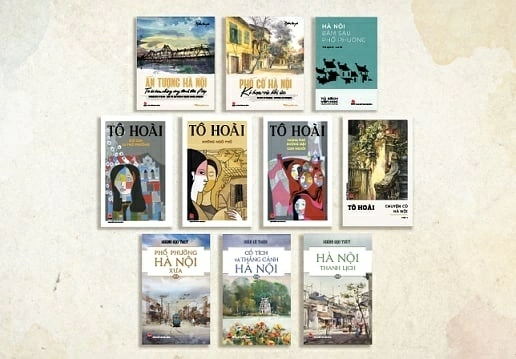 |
| In notable works about Hanoi. (Photo: Phuong Linh) |
The capital through Literature and Art
Among the works about Hanoi introduced by Kim Dong Publishing House at the program were Hanoi’s Thirty-Six Streets by Thach Lam; Old Hanoi Streets, Elegant Hanoi by Hoang Dao Thuy; Hanoi’s Legends and Landscapes by Doan Ke Thien; City, Faces, People, Preserving the 36 Streets, Old Hanoi Stories by To Hoai.
Additionally, there are art books Old Quarter Hanoi – Sketches & Memories and Impressions of Hanoi – From Sketches of French-Era Constructions by the Urban Sketchers Hanoi group.
Each book offers a different approach to the city, from history, culture, architecture to everyday life. The writings and sketches thus become a form of memory preservation, allowing the past faces of Hanoi to continue to exist in today’s life.
From a literary and cultural research perspective, Dr. Do Thanh Nga evokes a beautiful, sophisticated, elegant, and refined Hanoi in the works of Doan Ke Thien, Thach Lam, Hoang Dao Thuy, and To Hoai. In particular, Hoang Dao Thuy’s elegant Hanoi emphasizes the culture of Hanoi people, from lifestyle, walking, living, speaking, hosting guests to social interactions.
These seemingly small details contribute to creating a system of conventions, cultural “codes” of Hanoi people. Through Hoang Dao Thuy’s writings, readers can identify a lifestyle once considered a symbol of elegance, while recognizing values that sometimes seem to have faded in today’s urban life.
For Thach Lam, Hanoi appears through a gentle love for the scenery, food, people, and everyday activities. His love for the city is not loud but permeates the observation of very ordinary things. In To Hoai’s works, Hanoi emerges both elegant and with its laborious life, with scenes and people viewed in richness and multidimensionality.
Alongside literature, urban sketches offer another way of remembering. As a representative of the authors of two books on Hanoi sketches, Architect Tran Thi Thanh Thuy shared about the process of Hanoi lovers sketching directly, capturing the old quarter, villas, French-era constructions, and many urban spaces that are changing daily.
From the thirty-six streets to neighborhoods formed during the French era, from old collective areas to new urban zones, Hanoi’s appearance is constantly evolving. Each sketch thus not only records the shape of a structure or a street corner but also preserves a moment of the city amidst the changes of urban life.
Hanoi is not only created by Ho Guom, Ho Tay, the thirty-six streets, or iconic constructions. The city is also formed by the memories of residents and visitors. Each generation observes, records, recounts, and passes on stories about their city.
There is the Hanoi of Thach Lam, Hoang Dao Thuy, Doan Ke Thien, To Hoai; there is Hanoi through the sketches of architects and artists; there is Hanoi of families who have lived for many generations and also Hanoi of newcomers and visitors. Therefore, there is no single Hanoi in everyone’s memory.
It could be the Hanoi of childhood, of old collective areas, of the old quarter; Hanoi in literature, painting, architecture, and in the continuous transformations of urban life. Each memory adds a layer of meaning, making the image of the city diverse and multidimensional.
In memories and today’s city
One of the issues raised at the conversation was the gap between Hanoi in literature, art, and Hanoi in current life.
Dr. Do Thanh Nga believes that many people know Hanoi through literature and art, and when they actually visit the city, they may be surprised by a different appearance. This is the “discrepancy” between artistic creation and reality.
If one only views Hanoi through literary and artistic works, it’s easy to imagine a charming city, with elegant, refined people and serene streets. But today’s Hanoi is a bustling metropolis, with very real issues like dust, noise, congestion, and an increasingly fast-paced life.
According to Dr. Do Thanh Nga, these differences are not necessarily negative. Artists often create about Hanoi in the nostalgia of those away from the city. When far away, people pour their emotions, regrets, and longing into their writings, making Hanoi through the artistic lens more shimmering than reality.
She herself has felt the noise and dust of Hanoi in everyday life. At times, the crowded space and noise in the pedestrian area around Hoan Kiem Lake create a feeling far from the contemplative Hanoi in the literature that many have known.
But when living abroad, those very things that once annoyed her became the things she remembered. This gap shows that memories of a city do not completely align with the physical appearance of the city.
From this, Hanoi can be seen as a multilayered metropolis, where tranquility and hustle, old and new, memory and present coexist. The “discrepancy” between art and reality, in this view, does not impoverish the image of Hanoi but helps recognize a city full of colors, voices, and cultural nuances.
Essence from various regions converging
Also from the story of the “capital people” in Hoang Dao Thuy’s writings, Dr. Do Thanh Nga emphasizes Hanoi’s capacity for assimilation.
The capital people are essentially the essence from various regions converging, contributing to building a refined Ke Cho. Therefore, the city is not an immutable space but is always supplemented, adjusted, and renewed by people from many places.
Looking from the story of architectural heritage preservation to maintaining cultural memory, the issue raised is not only about preserving a structure or a neighborhood. When a structure disappears, a neighborhood changes, or a habit gradually fades, the losses may also lie in the social memory associated with that space.
Preserving urban heritage is also a story about choosing the values that need to be maintained and passed on to the future. Hanoi continues to develop modernly but also needs to identify the elements that create the city’s unique identity.
 |
| From books to life, Hanoi continues to be written, drawn, and recounted. (Photo: Thuy Duong) |
The conversation at the Hanoi Book Fair, from books, architectural works, sketches to everyday stories, brought readers back to a Hanoi with many facets. It is a city of history and the present, of what has been lost and what is forming, of personal and communal memories.
Loving a city, as the speakers suggested, is not only about nostalgia. That love also needs to be based on understanding and responsibility, so that each person can recognize the values that make up the city and participate in preserving them.
From books to life, Hanoi continues to be written, drawn, and recounted. Each generation may view the city differently, but it is this diversity that creates a vibrant Hanoi, with multiple layers of memory and new stories unfolding.