

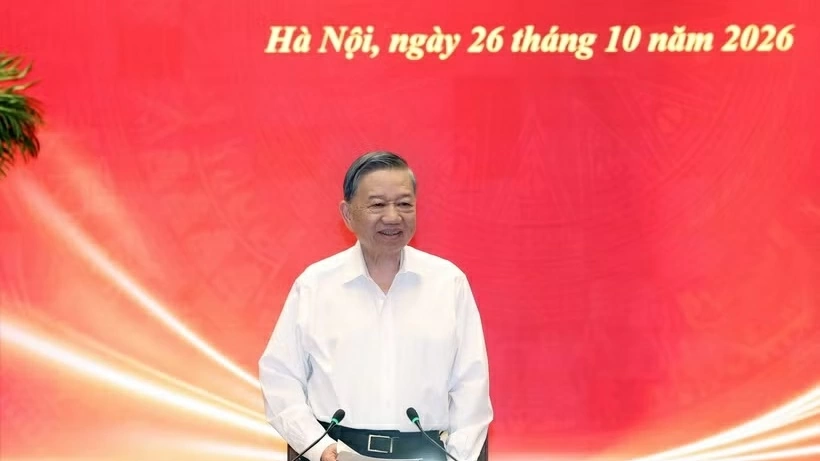
33rd Diplomatic Conference: Vietnamese Missions abroad as 'strategic sensors' and reliable 'outposts' on the diplomatic front in the new era
WVR - The system of Vietnamese Representative Missions abroad is the core force of Vietnam's diplomacy, playing a decisive role in the effective implementation of the Party and State's foreign policy as the country enters a new phase of development.
Latest
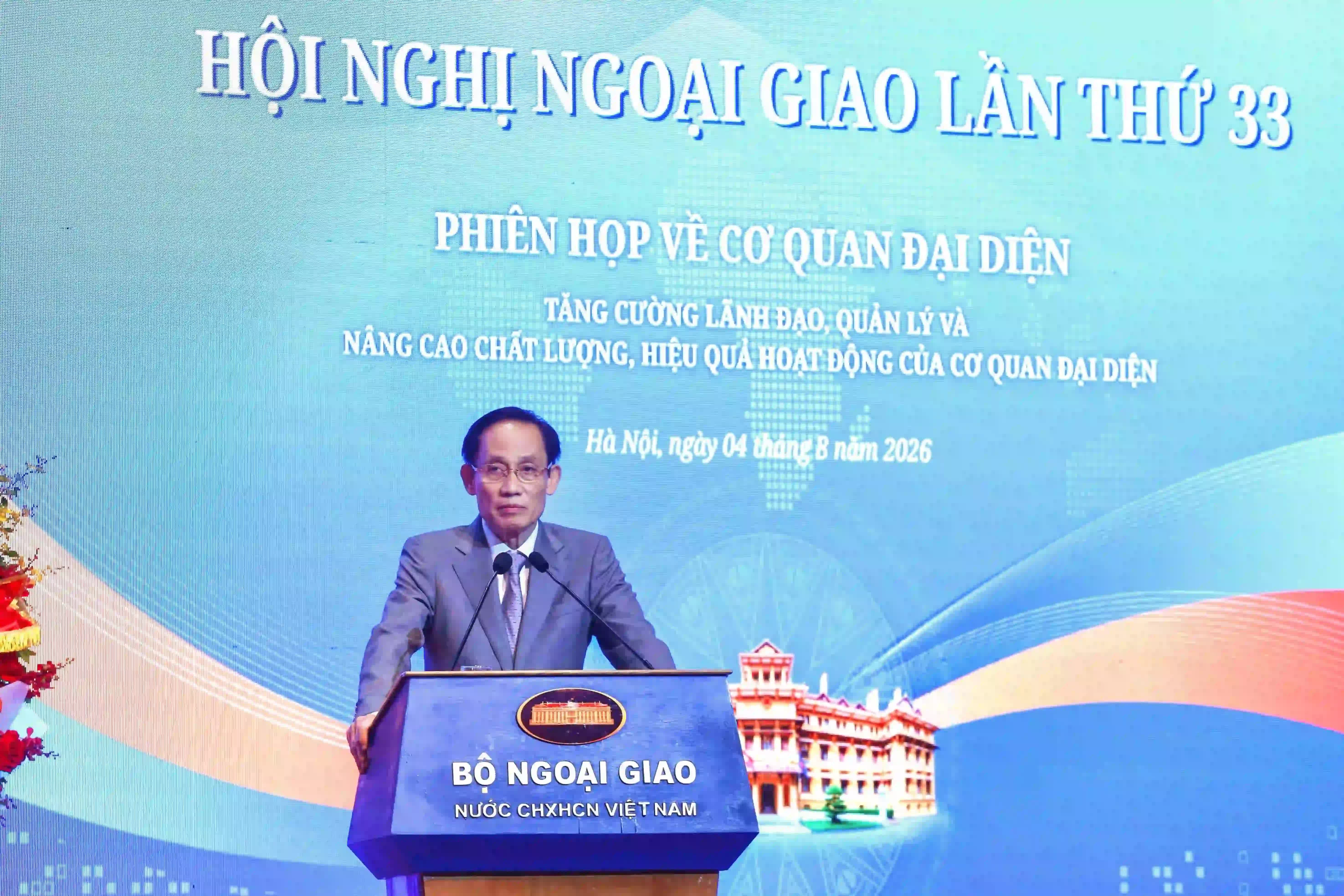 |
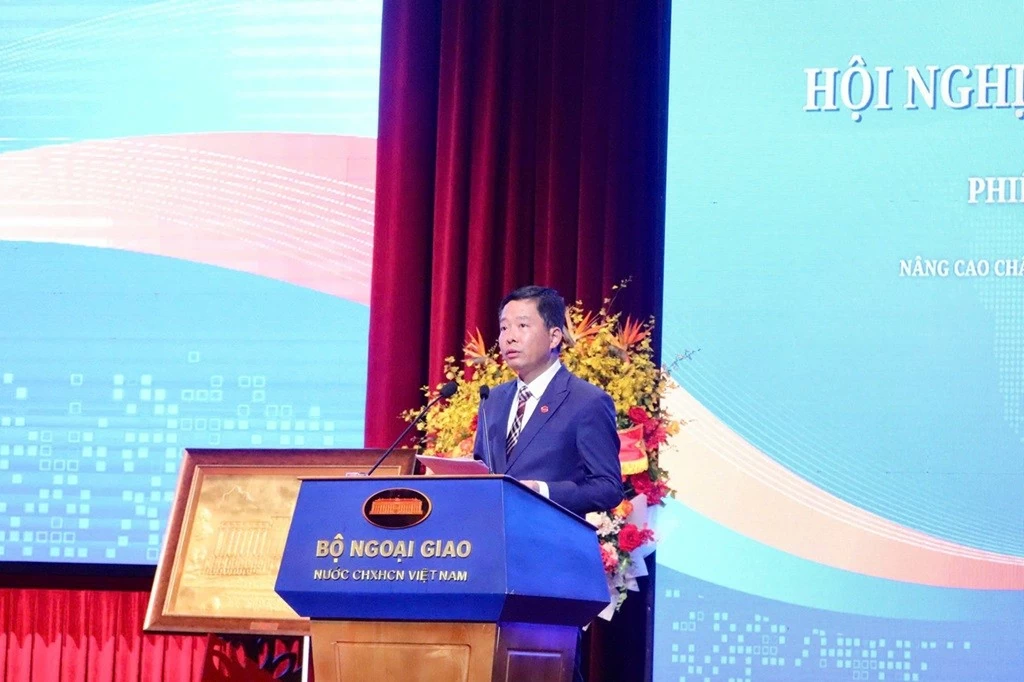
| Politburo Member, Party Secretary of the Ministry, Minister of Foreign Affairs Le Hoai Trung delivers a directive speech at the Session. (Photo: Anh Tuan) |
On the afternoon of August 4, within the framework of the 33rd Diplomatic Conference, a session on "Strengthening Leadership, Management, and Enhancing Quality and Efficiency of Vietnamese Representative Missions" took place. Politburo Member, Party Secretary of the Ministry, Minister of Foreign Affairs Le Hoai Trung attended and delivered a directive speech at the session.
In his keynote speech, Party Central Committee Member, Standing Deputy Party Secretary of the Ministry, Deputy Minister of Foreign Affairs Nguyen Manh Cuong emphasised that the world context is rapidly changing, complex, and unpredictable. Strategic competition among major countries, supply chain restructuring, waves of digital and green transformation, and non-traditional security challenges are creating new opportunities and challenges for foreign affairs. This requires the system of representative missions not only to fulfill traditional tasks but also to truly become "sensitive sensors," strategic advisors, resource connectors, and opportunity creators for development.
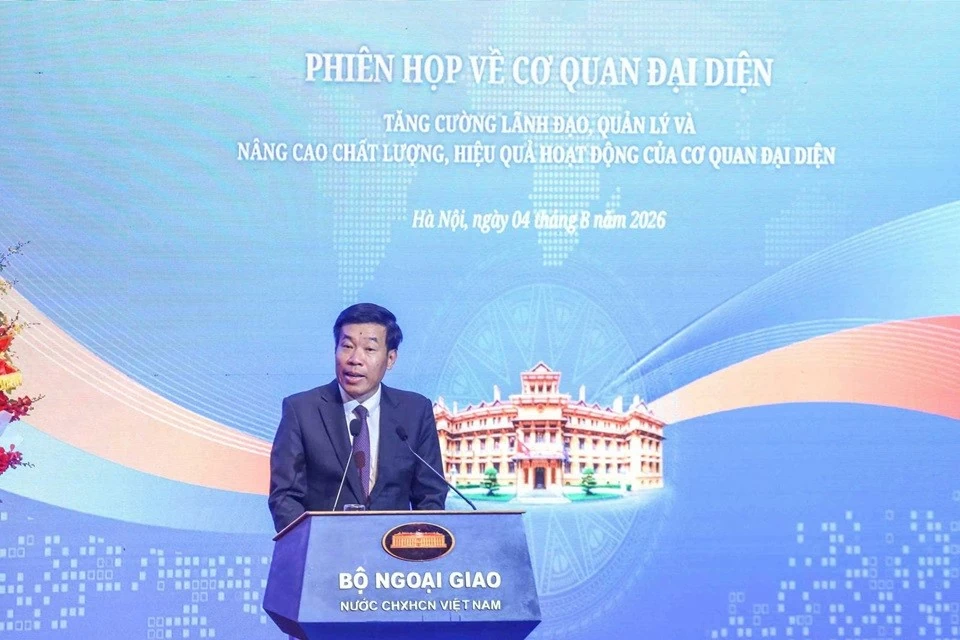 |
| Party Central Committee Member, Standing Deputy Party Secretary of the Ministry, Deputy Minister of Foreign Affairs Nguyen Manh Cuong delivers a keynote speech at the session. (Photo: Anh Tuan) |
According to Deputy Minister Nguyen Manh Cuong, the 14th Party Congress identified foreign affairs and international integration as crucial and regular tasks. Resolution No. 06-NQ/TW of the Politburo on implementing the foreign policy of the 14th Party Congress clearly states the requirement to shift management towards goal and result-oriented governance; using data, responsibility, and outcomes as measures of governance capacity. For the Foreign Affairs sector, this means a strong renewal in leadership, management, and organization of the activities of the representative mission system towards modernity, professionalism, effectiveness, and efficiency.
According to the Deputy Minister, in recent times, the system of Vietnamese Representative Missions abroad has completed a large volume of tasks, making significant contributions to the implementation of the Party's foreign policy; effectively advising and serving high-level foreign activities; promoting economic, cultural, and scientific-technological diplomacy; effectively handling the affairs of overseas Vietnamese and citizen protection; and promptly addressing many complex situations in the field. These achievements affirm the political bravery and maturity of the foreign affairs cadre.
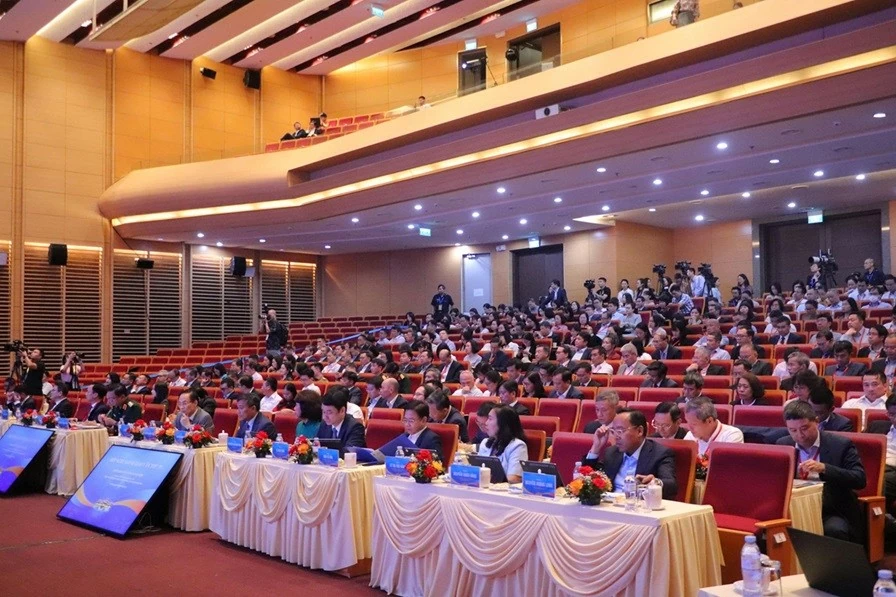 |
| Overview of the session. (Photo: Anh Tuan) |
However, in light of the new development requirements of the country and the increasing demands of foreign affairs, the activities of Vietnamese representative mission system still have some issues that need further innovation. The reform must shift from a management mindset to a service mindset; from task execution to goal management; from completing work to focusing on results and substantial impact.
In this spirit, Deputy Minister Nguyen Manh Cuong proposed several orientations:
Firstly, shift from reactive advice to strategic advice and early forecasting. Each representative mission must truly become the country's "strategic sensor." Proactively detect trends, identify opportunities, and provide early warnings of risks impacting national interests.
Secondly, shift from organizing activities to managing for results. Each foreign activity must be designed with clear objectives, specific products, and a mechanism for thorough monitoring. The success of a representative mission is not only measured by the number of visits, conferences, or signed documents, but by the commitments realized, resources mobilized, markets expanded, and tangible benefits brought to the country, people, and businesses.
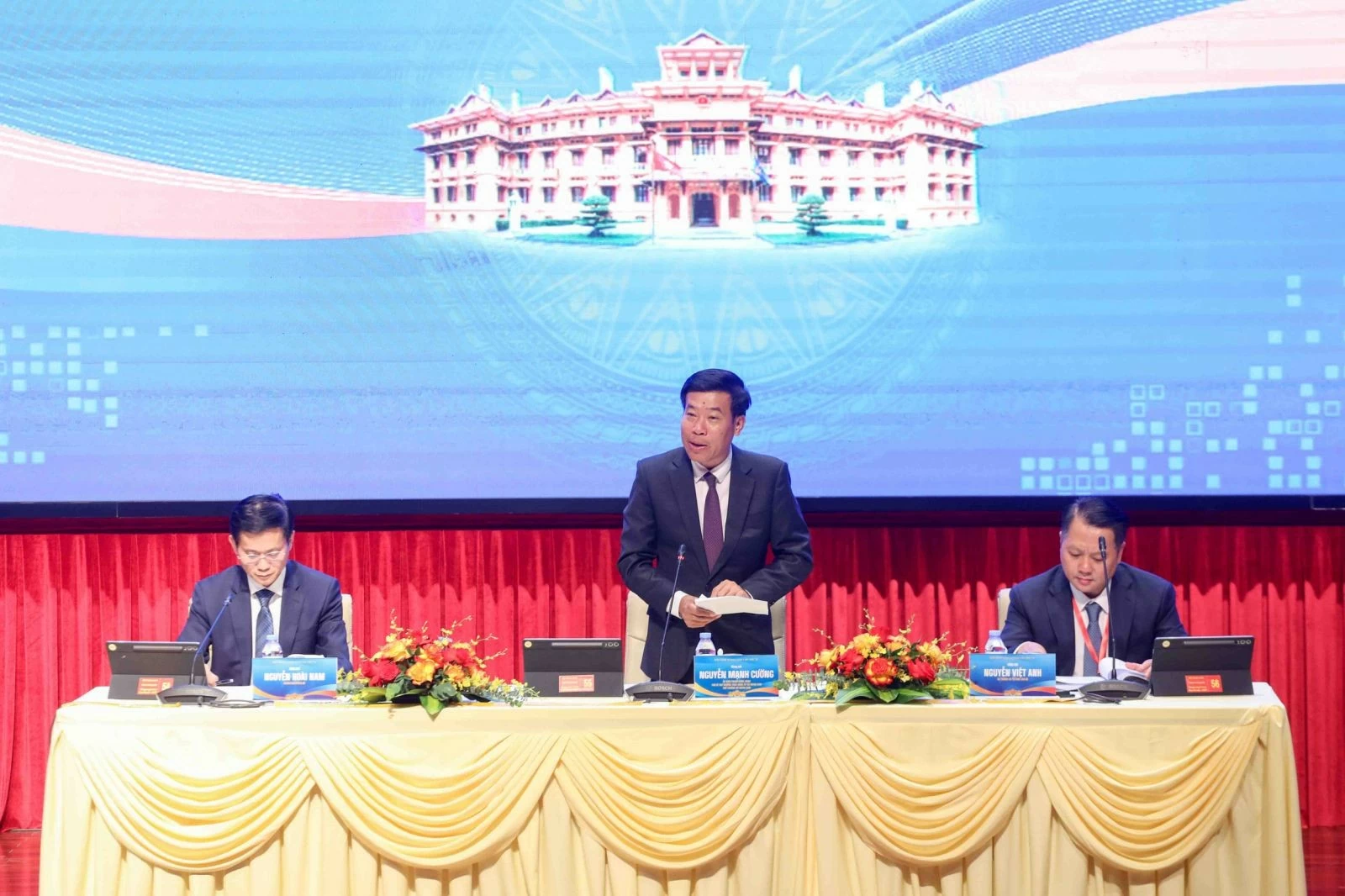 |
| Party Central Committee Member, Standing Deputy Party Secretary of the Ministry, Deputy Minister of Foreign Affairs Nguyen Manh Cuong (center), Chief of the Ministry's Office Nguyen Hoai Nam, Director General of the Personnel Department Nguyen Viet Anh chair the session. |
Thirdly, shift from administrative coordination to unified, interconnected, and data-driven management. Representative missions need to fully utilize their coordinating role in the field. Establish a tight coordination mechanism with ministries, localities, and businesses based on information, data, and experience sharing. Each task must have clear objectives, clear focal points, clear deadlines, clear responsibilities, and clear results.
Fourthly, shift from resource management to leveraging overall resources for national development. Besides state resources, effectively leverage the network of businesses, experts, intellectuals, and the Vietnamese community abroad. Build expert networks in fields such as science and technology, innovation, investment, and digital transformation. Representative missions must truly be the centre connecting these resources with the country's development needs.
Fifthly, shift from process evaluation to results-based management using KPIs. This is a breakthrough in evaluating the effectiveness of representative missions. There is a need for substantial innovation in evaluation methods; a new set of criteria must be developed to measure activity outcomes. KPIs must be built based on the specific context of each field and the issues facing each representative mission. At the same time, ensure three requirements: Reflect the unique characteristics of each field group; focus on tangible results and specific products; closely linked with digital transformation to ensure indicators are regularly updated, transparent, and highly connected.
Deputy Minister Nguyen Manh Cuong affirmed that innovating the activities of Vietnamese representative mission system is not only to enhance management efficiency but also to improve the country's foreign action capacity. Each representative mission must truly be a reliable "outpost" on the diplomatic front of the Party and State in each field; a strategic advisory centre, resource connector, protector of national interests, and a companion to the people and businesses reaching out internationally.
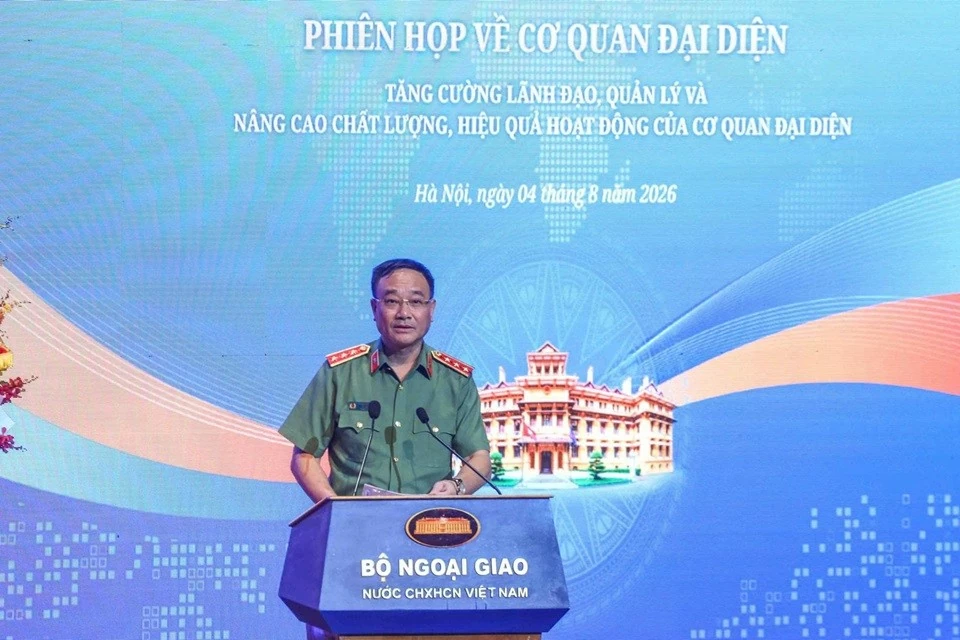 |
| Senior Lieutenant General Pham The Tung, Party Central Committee Member, Deputy Minister of Public Security presents a discussion at the session. (Photo: Anh Tuan) |
Speaking at the session, Senior Lieutenant General Pham The Tung, Party Central Committee Member, Deputy Minister of Public Security, assessed that in recent times, the police force has closely coordinated with the Ministry of Foreign Affairs, the Ministry of National Defence, and other ministries and sectors to effectively implement foreign affairs, contributing to ensuring the security and safety of high-level delegations, representative missions, and Vietnamese citizens abroad; combating and preventing external sabotage activities; participating in United Nations peacekeeping forces, rescue, relief, and international humanitarian support. The work of situation awareness and strategic advice also contributes to protecting national interests, strengthening trust with partners, addressing security, border, citizen protection issues, and attracting resources for national development...
Based on the Politburo's Conclusion No. 122 on strengthening the Party's leadership over national security work, Deputy Minister Pham The Tung proposed two key solution groups to enhance coordination between the Ministry of Public Security and the Ministry of Foreign Affairs.
Firstly, strengthen inter-sectoral coordination in implementing foreign affairs and international integration on security; shift the mindset from handling situations to proactively forecasting, creating a peaceful, stable environment; strengthen the security posture from outside the borders; promote the signing and implementation of international agreements on crime prevention and judicial assistance; effectively utilize security, intelligence, and police cooperation mechanisms; expand participation in United Nations peacekeeping forces and enhance international cooperation in combating transnational crime, high-tech crime.
Secondly, improve the effectiveness of coordination between Vietnamese representative missions abroad and the police force; review and address security loopholes; raise awareness and self-protection consciousness of officials, party members, and Vietnamese citizens abroad; strictly control contact, information exchange, technology equipment use, and data management; while improving the information exchange mechanism, promptly detecting and addressing risks and violations to strengthen discipline and order in national security protection work.
Deputy Minister Pham The Tung expressed confidence that, under the Party's leadership, the State's unified management, and the close coordination between ministries, sectors, and Vietnamese representative missions abroad, foreign police work will continue to be effective, contributing to maintaining a peaceful, stable environment, firmly protecting national security, and serving national development in the new phase.
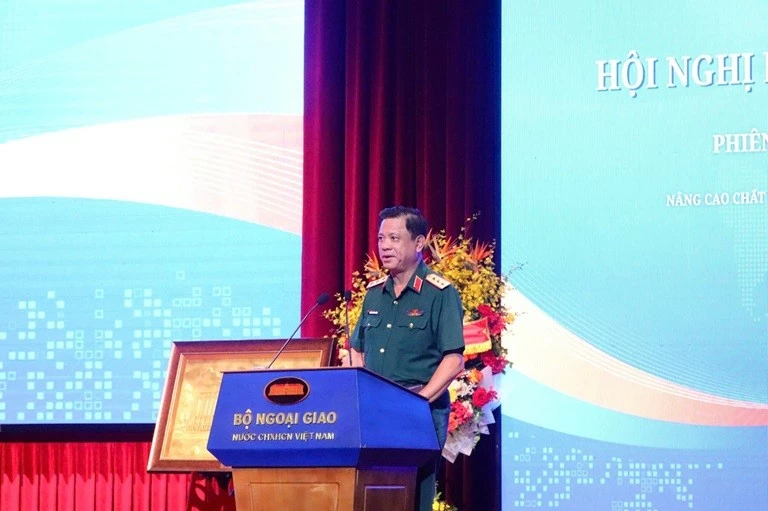 |
| Senior Lieutenant General Nguyen Truong Thang, Party Central Committee Member, Deputy Minister of National Defence presents a discussion at the session. (Photo: Anh Tuan) |
Also at the session, Senior Lieutenant General Nguyen Truong Thang, Party Central Committee Member, Deputy Minister of National Defence, affirmed that Vietnamese Representative Missions abroad play an important role in implementing foreign policy, international integration, contributing to safeguarding a peaceful, stable environment and creating favorable conditions for national development.
Praising the close coordination between the Ministry of Foreign Affairs, Vietnamese Representative Missions abroad, and the Ministry of National Defence in recent times, Deputy Minister Nguyen Truong Thang stated that the effective support of Vietnamese representative missions has contributed to promoting defence diplomacy in many fields, thereby enhancing trust, expanding cooperation with partners, and raising the position and prestige of the Vietnam People's Army on the international stage.
According to the Deputy Minister of National Defence, in the context of the rapidly changing and complex global situation, the coordination between representative missions and the defense force needs to be further strengthened, especially in strategic research and forecasting, promoting international cooperation, economic diplomacy, science and technology, external information, and effectively implementing existing cooperation mechanisms, thereby making practical contributions to the implementation of the Party's foreign policy and national development goals in the new phase.
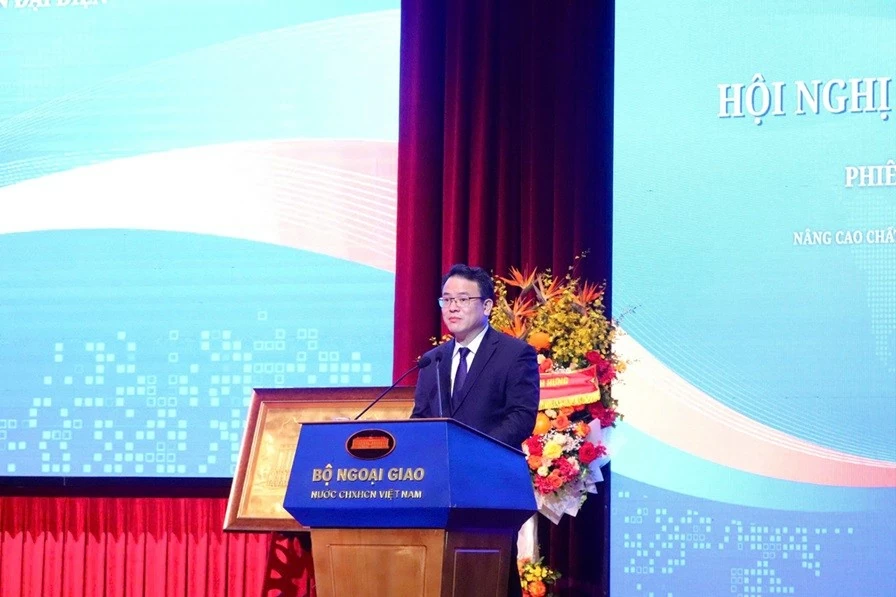 |
| Deputy Minister of Finance Tran Quoc Phuong delivers a discussion at the session. (Photo: Anh Tuan) |
At the session, Deputy Minister of Finance Tran Quoc Phuong emphasised that the positive results in macroeconomic stability, foreign investment attraction, and import-export of Vietnam in recent times have all had significant contributions from representative missions abroad. Vietnamese Representative missions are not only a diplomatic bridge but also a pioneering force in economic diplomacy, contributing to promoting the national image, providing strategic information, supporting businesses, and building trust with the international investment community.
In this spirit, the Ministry of Finance always considers strengthening coordination with the Ministry of Foreign Affairs and Vietnamese Representative Missions abroad as one of the important conditions for effectively implementing the task of socio-economic development, mobilizing international resources, and enhancing Vietnam's position and reputation on the international stage in the new phase.
According to Mr. Tran Quoc Phuong, to continue promoting the role of economic diplomacy in the new development phase, the Ministry of Finance has closely coordinated with the Ministry of Foreign Affairs in three aspects: Completing the institutional framework, ensuring resources, and enhancing the effectiveness of coordination in foreign economic affairs.
Currently, the Ministry of Finance has deployed a team of officials for investment promotion at some Vietnamese Representative Missions abroad. This is the core force and a component of Vietnam's economic diplomacy system, operating under the unified leadership of the head of the representative mission and closely coordinating with economic, trade, and related agencies in the field.
Particularly, in the context of the world shifting towards fields such as high technology, semiconductors, artificial intelligence, digital transformation, green transformation, circular economy, and sustainable finance, according to Deputy Minister Tran Quoc Phuong, the role of Vietnamese Representative Missions abroad is increasingly important. They are not only a bridge between Vietnam and economic partners but also a focal point for receiving strategic information, helping to identify early development trends, connecting partners with Vietnam, thereby supporting ministries, sectors, and localities in building appropriate policies and seizing new values and development opportunities of the world.
On this basis, the Deputy Minister of Finance proposed several solutions: Firstly, continue to improve the quality of research, forecasting, and information sharing to serve policy management and investment promotion; secondly, innovate investment promotion methods towards focus and priority, with quality, efficiency, and added value as goals; thirdly, build increasingly tight, substantive, and effective coordination mechanisms between the Ministry of Finance and the Ministry of Foreign Affairs as well as Vietnamese Representative Missions abroad.
In addition, the Ministry of Finance wishes to continue receiving coordination from the Ministry of Foreign Affairs in the process of researching and completing policies related to foreign affairs and foreign financial management, ensuring both meeting the increasingly deep international integration requirements and enhancing the efficiency of managing and using state resources.
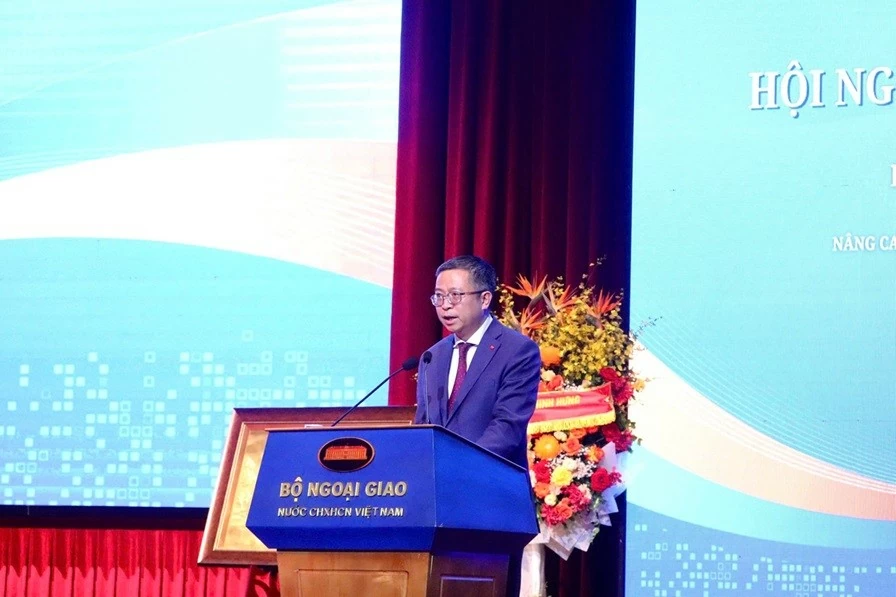 |
| Vietnamese Ambassador to China Pham Thanh Binh delivers a discussion at the session. (Photo: Anh Tuan) |
Speaking at the session, Vietnamese Ambassador to China Pham Thanh Binh stressed that in the context of strategic competition and global economic fluctuations, Vietnamese representative missions need to continue enhancing research, forecasting, and strategic advisory capabilities, while promoting the pioneering role of economic diplomacy in serving national development. According to the Ambassador, the activities of representative missions need to shift strongly from reflecting the situation to forecasting trends, creating policies, and proactively opening up new cooperation opportunities.
To realize this goal, Ambassador Pham Thanh Binh proposed transforming the advisory method towards forecasting and policy creation; innovating research work with an interdisciplinary approach, linked to development requirements; building a data-sharing mechanism and connecting the advisory network across the sector.
Regarding economic diplomacy, Ambassador Pham Thanh Binh suggested proactively anticipating investment and supply chain shifts; enhancing business support through dialogue mechanisms and early warnings; establishing inter-sectoral coordination mechanisms in implementing cooperation projects; building a team of economic diplomacy officials with interdisciplinary thinking and practical capabilities; and effectively utilizing the resources of Vietnamese entrepreneurs, experts, and intellectuals abroad to serve national development.
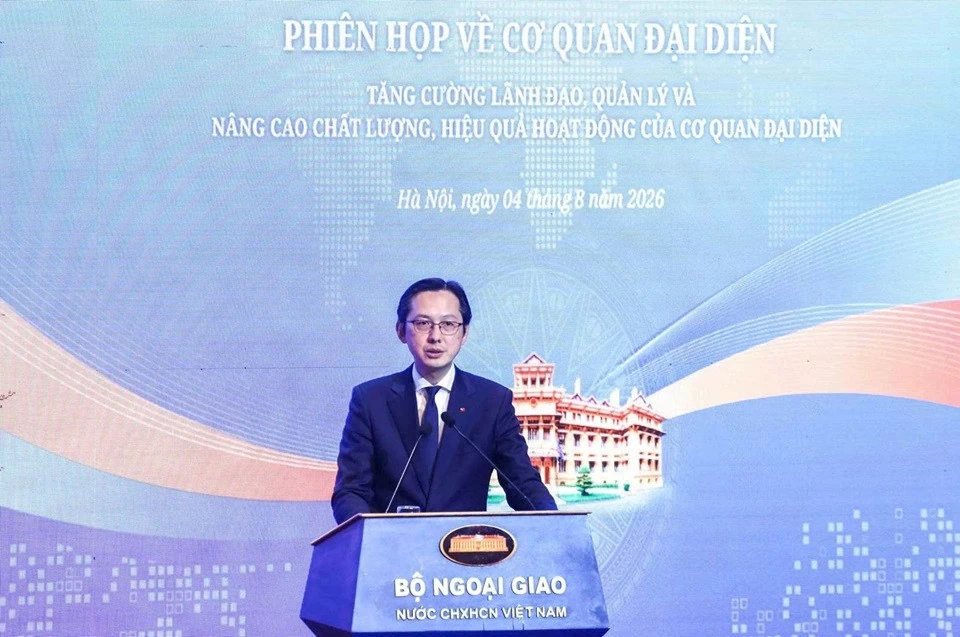 |
| Ambassador, Head of the Permanent Mission of Vietnam to the United Nations Do Hung Viet delivers a speech at the discussion. (Photo: Anh Tuan) |
Addressing multilateral diplomacy in the new phase, Ambassador, Head of the Permanent Mission of Vietnam to the United Nations Do Hung Viet noted that the global political and security context continues to change rapidly, with multilateral institutions under pressure from competition among major countries. However, new trends in science and technology, innovation, digital transformation, and processes for building governance mechanisms for artificial intelligence, digital space, seas and oceans, reforming international financial institutions, the United Nations, and post-2030 development frameworks also open opportunities for developing countries, including Vietnam, to participate more deeply in global governance.
Accordingly, multilateral diplomacy needs to shift strongly from participation to proactive contribution, from protecting development space to contributing to creating development capacity, from following to participating in shaping the rules and gradually taking on leadership roles when conditions permit. This requires innovation in thinking, coordination mechanisms, resource mobilization methods, and building a team of officials meeting new requirements.
Regarding personnel work, Ambassador Do Hung Viet stated that multilateral diplomacy officials need to have strong political courage, strategic thinking, research, forecasting, and advisory capabilities; proactively participate early in the formation of international mechanisms and rules; while having deep expertise in each field and the ability to handle interdisciplinary issues. Additionally, the team needs to be proficient in foreign languages, negotiation skills, international coordination, advocacy, and building cooperation networks...
Ambassador Do Hung Viet also suggested reforming the organizational and personnel evaluation mechanism to suit the characteristics of multilateral work, building an evaluation criteria system that fully reflects long-term, hard-to-quantify results such as Vietnam's position, prestige, and voice at international forums. At the same time, attention should be paid to allocating resources to enhance the effectiveness of multilateral diplomacy, supporting the proposal of initiatives, candidacy for international positions, strengthening research, forecasting, building databases, and training and fostering the team of officials.
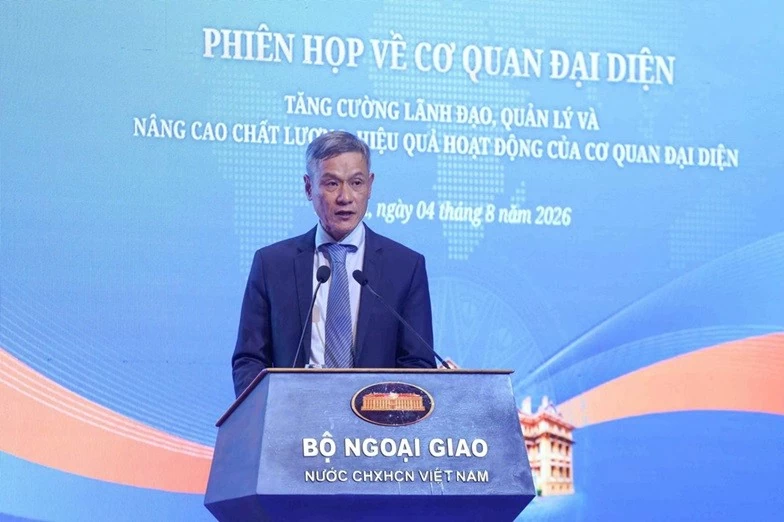 |
| Vietnamese Ambassador to Cambodia Nguyen Minh Vu. (Photo: Anh Tuan) |
Speaking at the session, Vietnamese Ambassador to Cambodia Nguyen Minh Vu stated that in the context of good neighborly relations, traditional friendship, and comprehensive cooperation between Vietnam and Cambodia continuing to develop positively in many fields, Vietnamese Representative Missions in Cambodia need to continue to play their role as an important bridge, contributing to strengthening political trust, promoting substantive cooperation, and enhancing the connection between the two countries.
The Ambassador emphasized the need to continue improving the coordination mechanism within the representative mission as well as between representative missions and ministries, sectors, localities, and domestic businesses to create a comprehensive strength in implementing foreign affairs; while enhancing the quality of research, strategic advisory, situation forecasting, innovating economic diplomacy, strengthening citizen protection, supporting the Vietnamese community in Cambodia, and promoting external information work.
In addition, Ambassador Nguyen Minh Vu stated that attention should be paid to building a team of diplomatic officials with political courage, professional qualifications, foreign languages, and professional demeanor, meeting the task requirements in the new phase, thereby continuing to contribute to fostering good neighborly relations, traditional friendship, comprehensive, long-term sustainable cooperation between Vietnam and Cambodia.
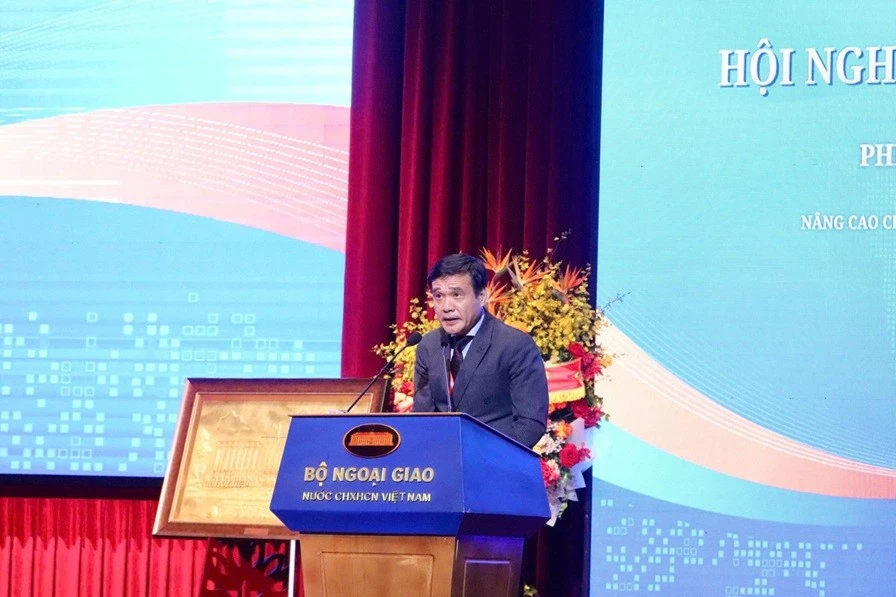 |
| Mr. Nguyen Trong Hoa, Deputy Director General of the Department of Scientific Research on Organization and Personnel, Party Central Committee's Organization Commission delivers a speech at the discussion. (Photo: Anh Tuan) |
Speaking at the session, Mr. Nguyen Trong Hoa, Deputy Director General of the Department of Scientific Research on Organization and Personnel, Party Central Committee's Organization Commission, stated that the policy of "rearranging the territory," implementing a two-tier local administrative model from July 2025, is a strategic decision of historical significance. This policy has a profound and comprehensive impact on the political system and all aspects of the country's activities, including the Foreign Affairs sector and foreign affairs work, posing many new and unprecedented practical issues.
More deeply, this is a process of redesigning the organizational model and operating method of the political system; transitioning to a streamlined, connected, clear-person, clear-task, clear-responsibility apparatus; shifting from tiered administrative management according to processes to development management based on data, goals, and results; from the mindset of "each agency doing its own work" to the principle of "one agency doing multiple tasks, one task assigned to one agency to lead and take primary responsibility"; from passive government to creative government, creative ministries, sectors, accompanying and best serving the people and businesses.
According to Mr. Nguyen Trong Hoa, accompanying this process, the Party Central Committee's Organization Commission has proactively and actively advised the Party Central Committee to issue many policies and solutions to implement the reorganization of the political system's apparatus according to the new model; while leading and coordinating with relevant agencies, including the Ministry of Foreign Affairs, regularly monitoring, summarizing, and reporting on implementation progress. He also highly appreciated the coordination of the Foreign Affairs sector in sharing international experience, considering Vietnamese Representative Missions abroad as an important strategic advisory force for personnel organization work.
The Deputy Director General of the Department of Scientific Research on Organization and Personnel also stated that the 14th Party Congress Document for the first time set a target of an average GDP growth of 10% or more for the 2026-2030 period, while identifying foreign affairs and international integration as crucial, regular tasks of the entire Party, army, and people. According to him, the double-digit growth target requires the synchronized movement of the entire political system.
From the perspective of personnel organization work, Mr. Nguyen Trong Hoa suggested continuing to innovate leadership methods, perfect the institutional framework, refine the organizational apparatus model, improve the quality of the personnel team, innovate inspection and supervision work, and promote digital transformation, considering data as a breakthrough driving force to enhance operational efficiency. Specifically for the Foreign Affairs sector, he proposed continuing to perfect the organizational model, improve the effectiveness of Vietnamese Representative Missions abroad, and promote the pioneering role in turning international commitments and opportunities into specific development results for the country and localities.
 |
| Deputy General Director of the Military Industry and Telecommunications Group (Viettel) Dao Xuan Vu delivers a discussion at the session. (Photo: Anh Tuan) |
Speaking at the Conference, Deputy General Director of the Military Industry and Telecommunications Group (Viettel) Dao Xuan Vu stated that in the context of implementing new Party resolutions on international integration and national development, high-quality human resources are the decisive factor in turning integration opportunities into development momentum. According to him, institutions pave the way and integration creates opportunities, but people are the direct factor creating success.
Sharing from over 20 years of investing abroad, present in 17 countries, Viettel stressed that the process of expanding international operations not only creates growth momentum but also provides an environment for training a team of officials with courage, adaptability, and the ability to work in a global environment. From this practice, Viettel identifies that developing high-quality human resources must be built on a synchronized ecosystem, including nurturing the ideal of dedication, building trust in the organization, assigning a sufficiently large mission, creating development opportunities, and having a corresponding reward mechanism to attract and retain talent.
To enhance integration capacity and support Vietnamese businesses in developing in the international market, Viettel proposed that Vietnamese Representative Missions abroad further promote their role as a bridge for market development, proactively connecting partners, supporting investment promotion, resolving difficulties, and protecting the legitimate rights and interests of businesses.
At the same time, Viettel suggested building a global Vietnamese knowledge network linked to the country's and businesses' development needs; strengthening the connection of experts, scientists, engineers, and overseas Vietnamese to participate in cooperation programs, research, and technology transfer. Besides, a unified talent attraction ecosystem should be formed between the State and businesses, where the State completes the institutional framework, and businesses proactively use and effectively promote high-quality human resources, contributing to bringing Vietnamese technology, products, and intelligence to the world.
***
In his directive speech at the session, Politburo Member, Party Secretary of the Ministry, Minister of Foreign Affairs Le Hoai Trung emphasised the particularly important role of the system of Vietnamese Representative Missions abroad; affirming that this is the core force of Vietnam's diplomacy, playing a decisive role in the effective implementation of the Party and State's foreign policy as the country enters a new phase of development.
According to Foreign Minister Le Hoai Trung, along with the growing position and potential of the country, the system of representative missions is increasingly expanding, reflecting the development of foreign relations as well as the increasing ability to contribute to development and international integration goals. Therefore, improving the quality of the activities of representative missions is one of the key contents in the process of advising on the completion of foreign policy orientations in the new term.
In particular, foreign affairs are facing three new requirements. Firstly, foreign activities must correspond to the historical, cultural stature, and increasingly high position of Vietnam. Secondly, Vietnam needs to be more proactive, positive, and responsible in participating in solving common issues of the international community. Thirdly, foreign affairs should not only stop at participating in international cooperation mechanisms but must gradually participate in shaping the rules, initiatives, and regional and international structures. This requires foreign affairs to go beyond traditional tasks such as promoting bilateral relations, safeguarding sovereignty, or resolving border and territorial issues to directly serve the country's new development model, in which economic diplomacy plays a particularly important role.
Assessing the team of officials, the Minister stated that about 81% of the Ministry of Foreign Affairs' staff are currently aged 30 to 50 - the prime stage in terms of physical, experience, and dedication capacity. This is a great advantage, but it also requires continuing to improve the quality of the team, as this force will play the main role in the sector in the next 5-10 years. Meanwhile, the number of young officials under 30 is still quite modest, posing the requirement to have a strategy for long-term training, fostering, and developing human resources.
Addressing the requirement to improve the quality of Party building work in the Foreign Affairs sector, the Minister emphasized the need to continue perfecting the leadership method of the Party organization, enhancing the quality of ideological, organizational, inspection, supervision work, and building a team of officials to meet the new situation's requirements.
In addition, Foreign Minister Le Hoai Trung also acknowledged and highly appreciated the efforts and contributions of the heads of representative missions and diplomatic officials under challenging and difficult working conditions. Through this, the head of the Foreign Affairs sector expressed confidence that Vietnamese Representative Missions abroad will continue to play a pioneering role, enhance the quality of strategic advisory, effectively implement the Party and State's foreign policy, and make positive contributions to the development and integration of the country in the new phase.