





Vietnam’s top 50 teams revealed in Samsung Solve for Tomorrow 2025 Competition
WVR - Out of 2,625 entries, the top 50 most outstanding submissions have been selected by Samsung to advance to the Product Development Round of Samsung Solve for Tomorrow 2025.
Latest
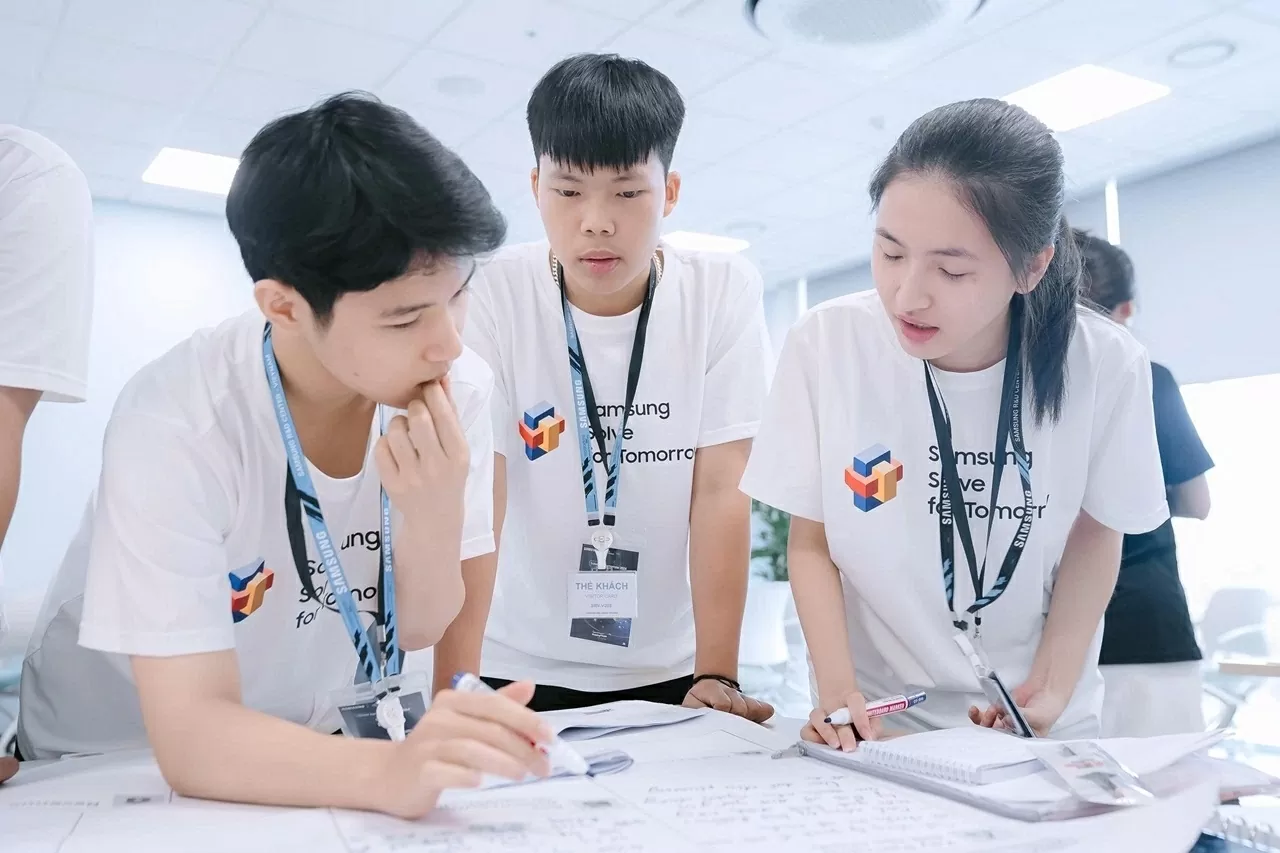 |
| The Top 50 teams will have the opportunity to participate in many useful training programs during the model development phase. (Source: Samsung Solve for Tomorrow 2025) |
Officially launched in March 2025, after more than three months of implementation, the Preliminary Round of the Samsung Solve for Tomorrow 2025 competition has concluded with 2,625 entries submitted by middle and high school students from provinces and cities across Vietnam — marking the year with the highest number of entries in the competition’s history.
Among them, the 50 best technology solutions were selected to move on to the next stage – the Product Development Round. The selected teams come from across the country, including 15 from the North, 15 from the Central region, and 20 from the South.
The selected project topics are diverse, ranging from devices that improve everyday life and environmental protection solutions, to innovations that enhance healthcare and educational experiences, support disadvantaged groups, and aid local production activities. Many ideas also focus on personalizing physical activities, improving performance, and ensuring safety — all contributing to building a healthier community.
Notably, 21 out of the 50 projects that advanced to Round 2 were developed with the goal of addressing social issues, demonstrating the younger generation's deep concern for society.
"This year’s submissions show a significant improvement in quality compared to last year, especially in Category B – High School level," said Dr. Phung Cong Phi Khanh, Head of the Department of Electrical and Electronic Technology at the Faculty of Technical Education, Hanoi National University of Education, and a representative of the judging panel.
"Many teams presented ideas that are not only highly practical and feasible but also incorporate complex technological and technical tools in their solutions."
He added: "Another major highlight this year is the academic depth of the submissions. The structure, explanation, and approach of the projects align with the standards of a proper research project in science and engineering. These elements show noticeable improvement compared to last year. Remarkably, the gap in technical skill levels between different regions has narrowed considerably, and many new faces with high-quality ideas and solutions have emerged."
Also praising the quality of the entries, Mr. Dang Ngoc Truong, M.A., from the Faculty of Technical Education at Hanoi National University of Education and another judge, commented:
"The entries were highly applicable, with many drawing inspiration from real-life situations, communities, and production environments. They were persuasive and could be further developed with time and investment."
The Top 50 teams of Samsung Solve for Tomorrow 2025 will continue to develop their ideas from paper into physical product models under the guidance of technology experts. The functionality of the models may be adjusted according to real-world conditions but must remain aligned with the original solution submitted and scored during the preliminary round. This stage offers the teams a chance to showcase their talents while reassessing the feasibility and effectiveness of their proposed solutions and making appropriate adjustments.
After this round, 16 teams will be selected to compete in the Final Round, expected to take place in late October 2025.
“Samsung Solve for Tomorrow opens a space for teenagers — those who dream of a brighter future — to present their ideas and solve problems through STEM education. I hope that students across Vietnam will grow into key talents for the nation, equipped with both STEM capabilities and excellent problem-solving skills,” said Mr. Na Ki Hong, General Director of Samsung Vietnam.
Annual competion Samsung Solve for Tomorrow was first launched globally in 2010 in the United States, aiming to give students the opportunity to apply their STEM (Science, Technology, Engineering, and Mathematics) knowledge to develop technological solutions that address local and societal issues.
In Vietnam, the competition was first held in 2019, and has since become an annual platform for creative thinking for middle and high school students aged 12 to 18.
As of the end of 2024, the program has attracted over 475,000 students and teachers and received nearly 7,500 entries.


