





Vietnam, Timor-Leste strengthen cooperation in legal and judicial sectors
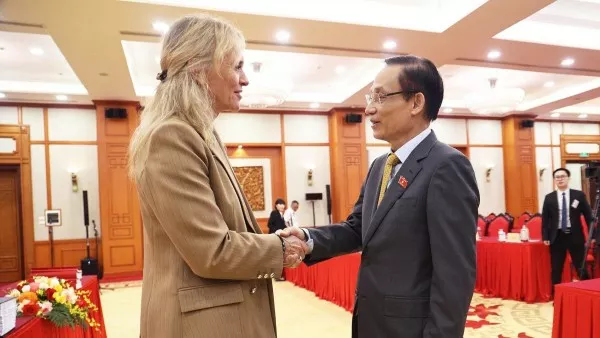
WVR - On July 2, in the capital city of Dili, Vietnamese Chargé d'affaires in Timor-Leste Pham Binh Dam held a working session with Timor-Leste's Minister of Justice Sérgio de Jesus Fernandes da Costa Hornai.
Latest
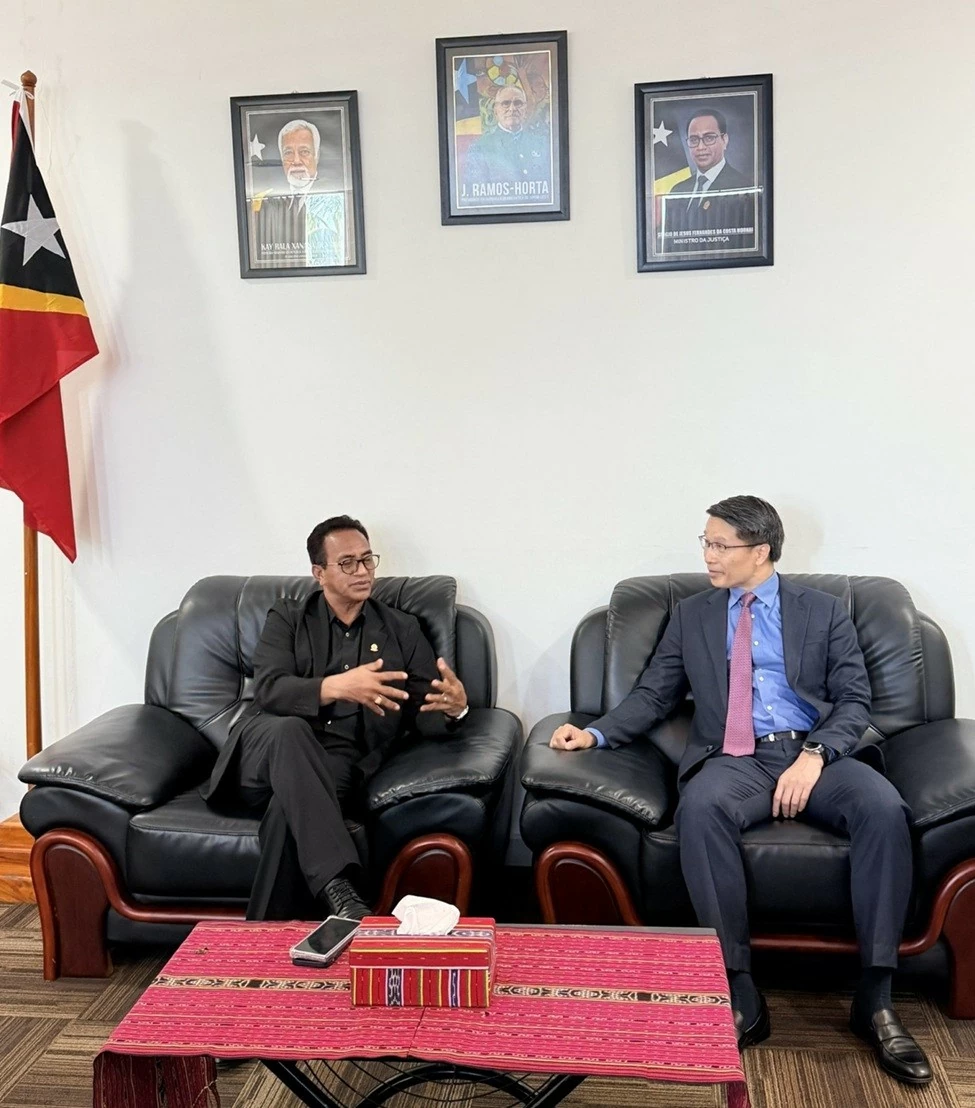 |
| Vietnamese Chargé d'affaires in Timor-Leste Pham Binh Dam (right) and Timor-Leste's Minister of Justice Sérgio de Jesus Fernandes da Costa Hornai. (Source: Vietnamese Embassy in Timor-Leste) |
The two parties discussed directions to promote cooperation in legal and judicial sectors, digital transformation, and facilitating investment and business activities of Vietnamese enterprises in Timor-Leste.
During the meeting, Chargé d'affaires Pham Binh Dam expressed his impression with the positive changes in judicial reform, legal system improvement, and enhancement of state governance efficiency in Timor-Leste.
The Chargé d'affaires affirmed that Vietnam is ready to share experiences with Timor-Leste both bilaterally and within ASEAN's legal and judicial cooperation mechanisms.
Sharing nearly four decades of experience in building and perfecting the legal system associated with the Doi Moi process, Chargé d'affaires Pham Binh Dam suggested that Vietnam's reform process, from establishing a legal framework for a market economy and international integration to innovating legal construction and enforcement linked with digital transformation, could offer practical lessons for Timor-Leste.
According to the Chargé d'affaires, Timor-Leste could selectively study and adopt suitable experiences, “not necessarily retracing every step; in some stages, they can leapfrog,” thereby shortening the process of institutional perfection and enhancing national competitiveness.
To lay the foundation for a developing nation, Chargé d'affaires Pham Binh Dam emphasized that alongside "hard infrastructure" like roads, airports, and ports, special attention should be given to "soft infrastructure" including laws, institutions, and administrative procedures. A transparent, stable legal system with clear, convenient procedures is essential to build trust, attract investment, and promote production and business activities.
For his part, Minister Sérgio Hornai noted that the legal systems of Vietnam and Timor-Leste share many similarities, with both countries having to address complex historical issues such as land disputes.
Based on Vietnam's decades of accumulated experience, the Minister proposed that the two Ministries of Justice implement a comparative legal study program between Vietnam and Timor-Leste to clarify similarities and differences and identify suitable experiences for Timor-Leste to reference in perfecting its legal system and dispute resolution mechanisms.
In the context of Timor-Leste accelerating ASEAN integration, the Minister emphasized that gradually harmonizing laws with regional and international standards is a crucial requirement. He expressed a desire for Vietnam to support training and capacity building for Timor-Leste's Ministry of Justice staff; share experiences on coordination mechanisms between courts, prosecution agencies, and the legal profession, as well as in dispute resolution, arbitration, extradition, and combating transnational crime.
The two sides also delved into the role of digital infrastructure in judicial reform and public administration modernization. Chargé d'affaires Pham Binh Dam shared Vietnam's experience in building an e-Government, developing a national database on population, electronic identification systems, and data connectivity across civil status, land, tax, insurance, and public services sectors.
According to the Chargé d'affaires, digital identification and shared databases not only simplify administrative procedures and enhance transparency but also lay the foundation for developing digital services for citizens and businesses. However, these systems can only operate effectively when supported by stable, widely-covered, and reasonably priced telecommunications infrastructure.
In this spirit, the Chargé d'affaires urged the Timor-Leste Government to continue addressing visa and administrative procedure obstacles, improving the investment environment, and creating favorable conditions for Vietnamese enterprises to maintain operations and expand investments in Timor-Leste.
Regarding Telemor, a Vietnamese enterprise operating in the telecommunications sector in Timor-Leste, the Chargé d'affaires suggested that Timor-Leste consider appropriate mechanisms and incentive policies to enable the company to continue expanding its network, increasing service coverage, developing subscriptions, enhancing connectivity, and gradually reducing telecommunications access costs for the public.
Chargé d'affaires Pham Binh Dam stated that Vietnam has accumulated extensive experience in developing telecommunications infrastructure, popularizing services to rural, remote, and isolated areas, and forming technology enterprises with international competitiveness. Vietnam is ready to share these lessons to support Timor-Leste in developing digital infrastructure and accelerating national digital transformation.
Minister Sérgio Hornai acknowledged Vietnam's proposals and affirmed that Timor-Leste will continue to address difficulties and create favorable conditions for Vietnamese enterprises to operate and invest, especially in digital infrastructure and telecommunications sectors.
The Minister also committed to coordinating efforts to expedite procedures related to the completion of the Vietnamese Embassy headquarters in Dili in the spirit of reciprocity, mutual respect, and for the common interests of both countries.
The meeting took place in the context of the Vietnamese Embassy in Timor-Leste officially commencing operations, as both countries actively implement the outcomes of Timor-Leste Prime Minister Kay Rala Xanana Gusmão's official visit to Vietnam in June 2026, and prepare for the first session of the Vietnam - Timor-Leste Joint Committee and upcoming high-level visits and exchanges.
At the conclusion of the meeting, both sides agreed to review and identify specific areas and cooperation needs; promptly develop a list of documents and cooperation programs for discussion, agreement, and implementation under appropriate bilateral mechanisms.