





Vietnam's Engineering Unit No. 4: Clay road and the journey to build trust in Abyei
WVR - After 85 days of construction under harsh weather conditions, Vietnam's Engineering Unit No. 4 restored the 37 km Abyei - Agok road, completing it 35 days ahead of schedule.
Latest
Not only did they reconnect a vital traffic artery, but the Vietnamese blue-helmet soldiers also left a mark through community support activities, contributing to building trust among the people of Abyei and spreading the image of a responsible and humane Vietnam in United Nations peacekeeping operations.
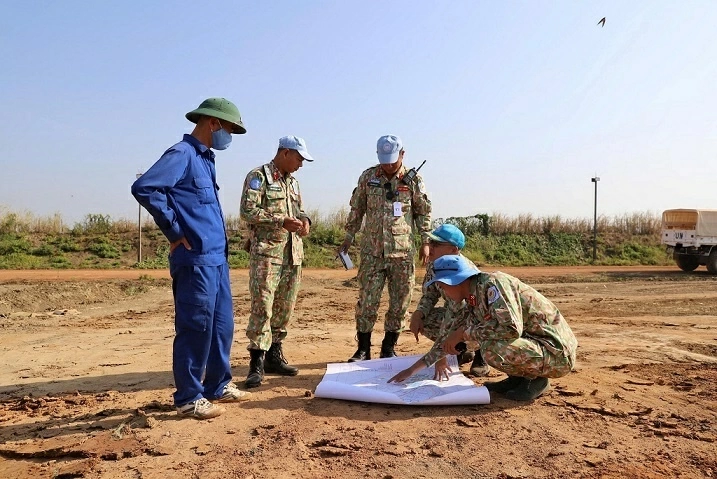 |
| Vietnam's Engineering Unit No. 4 surveys the Abyei - Agok road. (Source: Vietnam's Engineering Unit No. 4) |
Conquering a harsh land
Abyei, located between Sudan and South Sudan, holds a special geographical and political position. After years of conflict, the area is still maintained by the United Nations peacekeeping forces to ensure security, facilitate humanitarian activities, and promote stability.
In such conditions, a road is not merely a transportation project. For local residents, accessible roads mean the ability to reach schools, hospitals, markets, and supplies of food and essentials.
For the United Nations Interim Security Force for Abyei (UNISFA), convenient transportation is crucial for maintaining patrols, logistical transport, deploying humanitarian activities, and accessing areas in need of support.
The nature of Abyei presents unique challenges. During the dry season, temperatures can soar to nearly 50 degrees Celsius, with scorching heat and red dust covering the ground, camps, and vehicles. When the rainy season arrives, the area's characteristic black clay quickly absorbs water, becoming mushy and forming deep mud pits, causing many vehicles to risk getting stuck and cutting off traffic.
The 37 km Abyei - Agok road had severely deteriorated after years of use and weather impact. The road surface was riddled with potholes; the roadbed sank, drainage systems were damaged, and many sections were eroded. Each rain worsened the degradation, affecting UNISFA operations and the lives and livelihoods of the locals.
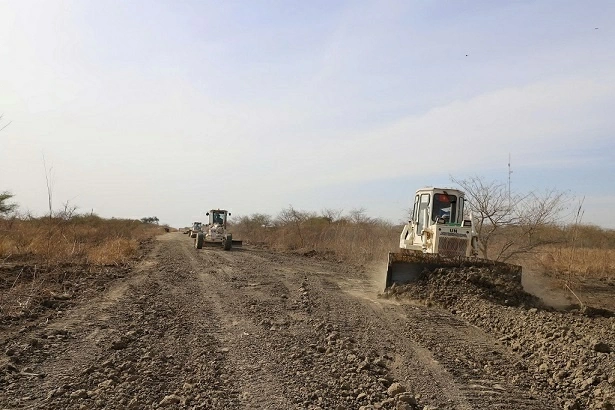 |
| The 37 km Abyei - Agok road had severely deteriorated after years of use and weather impact. (Source: Vietnam's Engineering Unit No. 4) |
Recognizing the special significance of this transportation route and appreciating the expertise of Vietnam's Engineering Unit No. 4, UNISFA assigned the unit the task of upgrading and repairing it. The requirements were not only to ensure the quality of the project but also to complete it before the rainy season returned.
For the Vietnamese engineers, it was truly a race against time and weather. From the outset, Engineering Unit No. 4 devised a construction plan consisting of three phases: grading and restoring damaged road sections; raising the roadbed by about 50 cm with 150,000 m³ of soil and sand; and finally, spreading a 20-30 cm layer of murram material to create a “shield” protecting the road surface.
The construction phases were carried out continuously, with reinforcement and compaction done as they progressed to increase load-bearing capacity and reduce the risk of landslides and damage during heavy rains. With the spirit of “overcoming the sun, defeating the rain”, the engineering force organized construction from early morning, maximizing favourable weather conditions.
On the construction site, excavators, bulldozers, dump trucks, and rollers worked in succession. Dust covered uniforms and machinery; the heat from the road surface and engines made working conditions even harsher. Meals were taken hastily by the roadside, under the scarce shade. There was no concept of “office hours” as progress was always pressured by the approaching rainy season.
Besides technical requirements, ensuring security and safety was also a top priority. Engineering Unit No. 4 closely coordinated with the mission, military police, and local authorities to stay informed and proactively address risks during construction.
After 85 days, the 37 km Abyei - Agok road was restored, with a reinforced and compacted roadbed, improved embankments, and drainage ditches. Notably, the project was completed 35 days ahead of the mission's schedule.
Major General Ganesh Kumar Shrestha assessed this as a significant and impactful project for the Abyei community since the mission was established in 2011, acknowledging the efforts and capabilities of Vietnam's Engineering Unit No. 4.
For local residents, the restored 37 km road is not just a number. It shortens the distance between villages and hospitals, between residential areas and markets, schools, and humanitarian aid sources. For UNISFA, it is a transportation route that enhances mobility and mission effectiveness.
But for the Vietnamese soldiers, when the project was completed, another journey began: the journey of building trust.
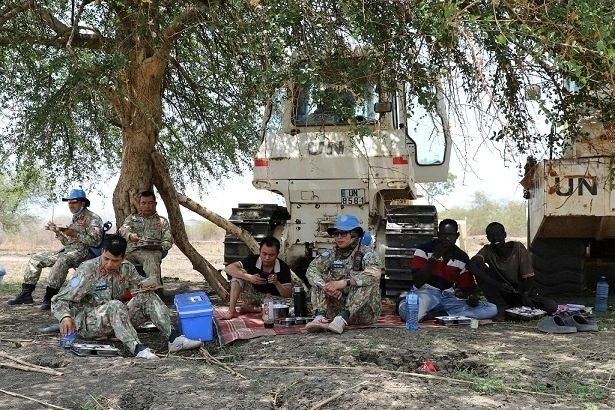 |
| Engineers restore the road under harsh weather conditions. (Source: Vietnam's Engineering Unit No. 4) |
When the road becomes a bridge of trust
If a project is measured by meters of road, volumes of earth and stone, and construction progress, trust is formed from simpler things.
During their mission in Abyei, Engineering Unit No. 4 not only focused on assigned projects but also actively participated in community support activities. The Vietnamese soldiers helped locals with stuck vehicles, repaired eroded road sections, and improved roads leading to residential areas, churches, and hospitals.
During times when the community faced difficulties due to diseases like Ebola and malaria, Vietnamese military medical personnel provided medical supplies and disseminated disease prevention knowledge through accessible and understandable methods. Activities such as teaching the “no-touch” rule, practicing the six-step handwashing technique according to medical standards, or organizing the “handwashing dance” brought health messages closer to the people, especially children.
Engineering Unit No. 4 also repaired damaged schools, leveled schoolyards, and made new desks and chairs for students. Notably, the unit's carpentry workshop became a place to teach over 100 local students vocational skills. The students learned to use tools, measure, prepare materials, and practice basic carpentry skills. Under the guidance of the Vietnamese soldiers, they were able to assemble desks and chairs for their own school for the first time.
Mr. Karbino Dut, Minister of Education for the Abyei area, noted that the Vietnamese soldiers not only repaired roads but also inspired learning and labour in the younger generation, thereby demonstrating the humanitarian values that the international community aims for.
In a letter to Engineering Unit No. 4, the Abyei Special Administrative Area authorities acknowledged not only the quality of the road but also appreciated the unit's practical contributions to the local community.
Such recognition is built from many specific actions. People do not evaluate a peacekeeping force by technical reports. They remember through what they see and experience: a vehicle being helped out of the mud, a road being repaired, a school being restored, or a child being taught how to use tools safely.
Mr. Deng, the village chief of Banton, shared that whenever they see a vehicle with the red flag and yellow star of Vietnam, children in the village run out to greet it. The locals know that the Vietnamese soldiers have provided drinking water, repaired roads for ambulances to pass, and have a fondness and trust for them.
Lieutenant Colonel Trinh Van Cuong, Commander of Engineering Unit No. 4, affirmed that the unit not only strives to complete its mission but also aims to bring good values to the local community. For the Vietnamese soldiers, helping people is a “command from the heart”.
From these simple actions, the gap between the peacekeeping force and the local community gradually narrows. Trust does not form in a day but is built from presence, responsibility, and consistency in every action.
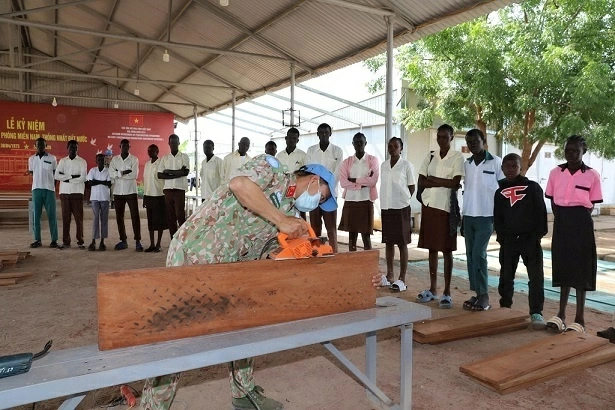 |
| The unit's carpentry workshop became a place to teach over 100 local students vocational skills. (Source: Vietnam's Engineering Unit No. 4) |
Vietnam's mark on the peacekeeping journey
Mr. Justice Charles Jok, Head of the Abyei Special Administrative Area, stated that what the Vietnamese Engineering Unit has done is not just about roads but also brings hope for a better future for the people here.
From a peacekeeping perspective, every project undertaken by Engineering Unit No. 4 has value beyond technical scope. A restored road helps UNISFA forces reach areas faster; a repaired school creates better learning conditions for children; a medical support activity contributes to community health protection. More importantly, each specific action helps build a trusting relationship between the peacekeeping force and the people.
This is also how Vietnam's image is built on the international stage: not through introductions, but through competence, discipline, responsibility, and humanity.
From a country that once experienced war, Vietnam today sends its soldiers to unstable regions to contribute to peacekeeping. The blue-helmet soldiers bring their expertise, cooperative spirit, and the nation's humanitarian tradition to share responsibility with the international community.
Evening falls quickly in Abyei. The last rays of sunlight stretch over the road connecting Abyei to Agok. Vehicles continue to roll, people pass by, and children go to school. Normal life gradually returns on the road once divided by mud.
Thirty-seven kilometers of road can be measured on a map, but the journey that the Vietnamese soldiers have traveled in Abyei can only be measured by another value: trust.
Lieutenant Colonel Trinh Van Cuong shared that for the Vietnamese blue-helmet soldiers, the greatest reward does not lie in certificates of merit but in contributing a small part to ensuring the people of Abyei live more safely, children go to school, patients have roads to hospitals, and each family has more hope for a better tomorrow.
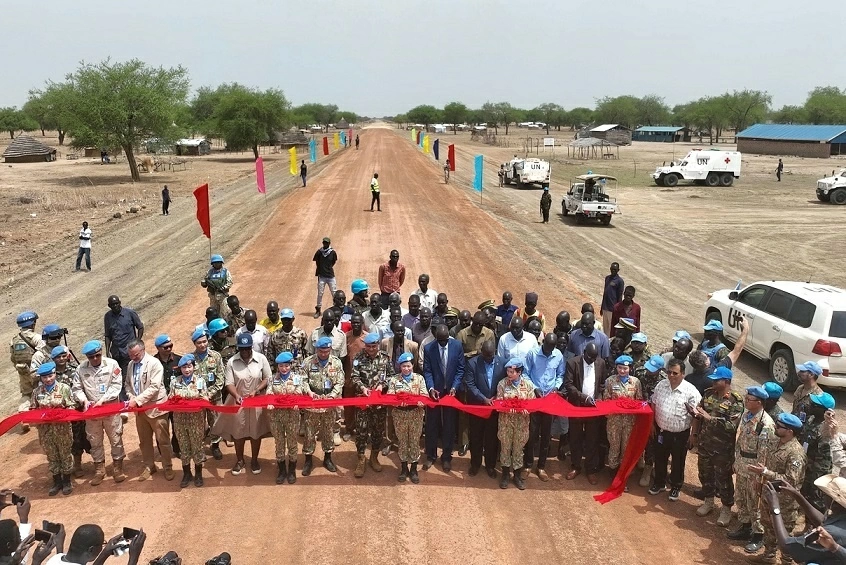 |
| The newly restored road in Abyei. (Source: Vietnam's Engineering Unit No. 4) |
The Abyei - Agok road will continue to face the challenges of new rainy seasons. But the marks left by Vietnam's Engineering Unit No. 4 on this land are not just in layers of soil, stone, or drainage systems. They are also memories of soldiers from a distant country who have been present with sincerity, responsibility, and sharing.
From the clay road, they found a path to the hearts of Abyei's people. And on that journey, Vietnam's image emerges simply yet profoundly: A Vietnam ready to share responsibility, contribute to peace, and accompany the international community through concrete actions.