


Prime Minister Pham Minh Chinh welcomes European Council President António Costa, seeks to deepen cooperation with the EU
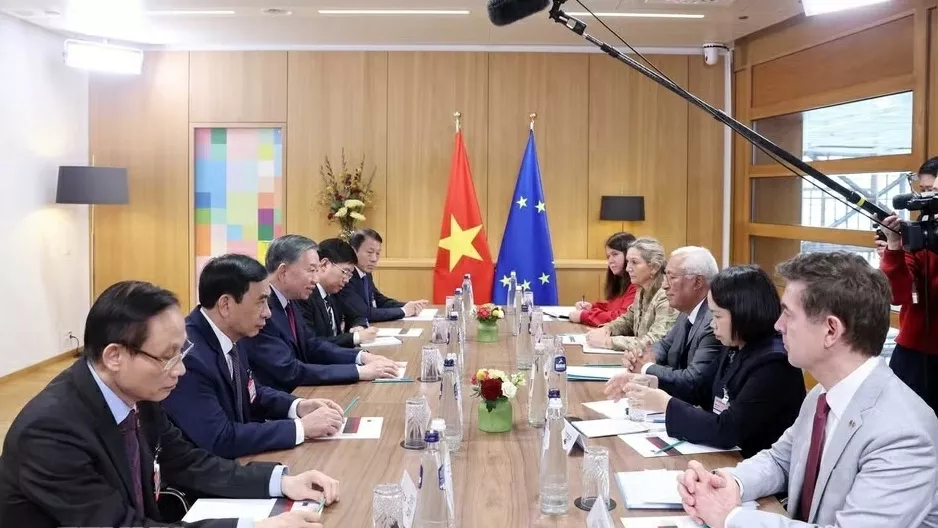
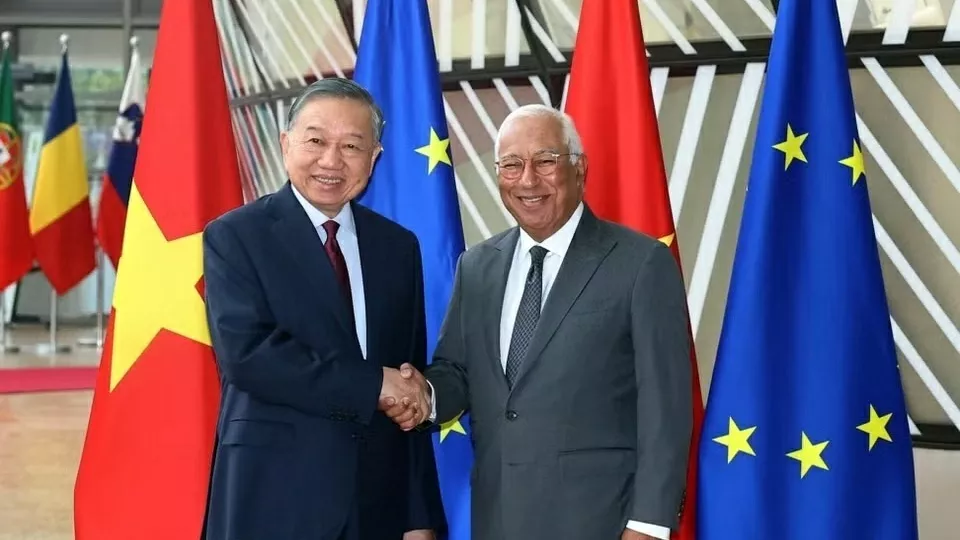
WVR - On January 29, at the Government Headquarters, Prime Minister Pham Minh Chinh had a meeting with visiting President of the European Council (EC) António Costa, during which he expressed his hope for stronger cooperation between Vietnam and the European Union (EU).
Latest
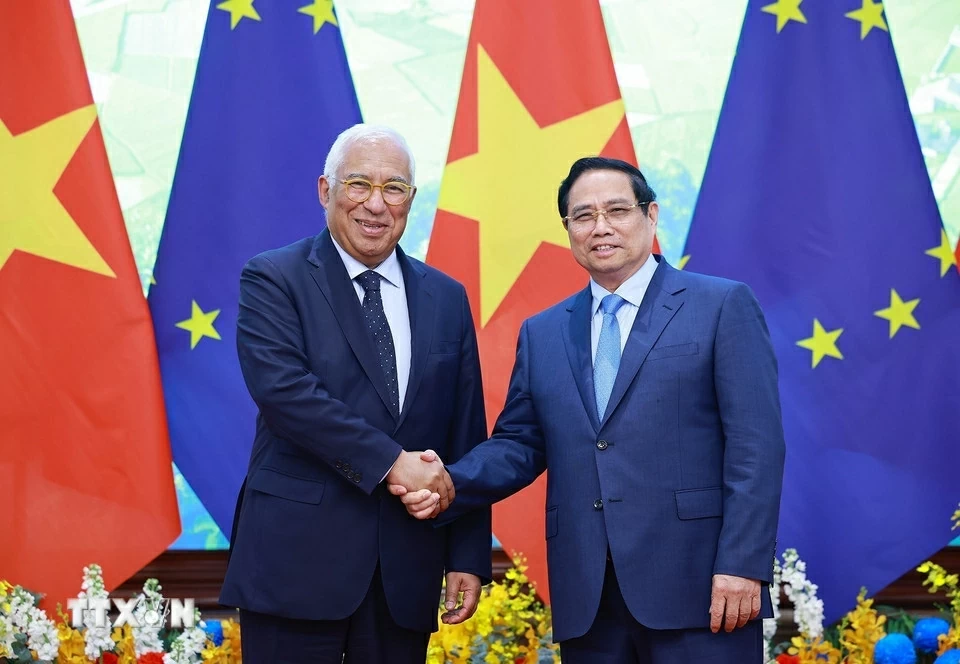 |
| Prime Minister Pham Minh Chinh meets with European Council President Antonio Costa. (Source: VNA) |
Welcoming EC President Costa, Prime Minister Chinh said the visit is of particular significance as Vietnam and the EU have just elevated their relations to a Comprehensive Strategic Partnership. He described the upgrade as a historic milestone reflecting a new stage of development in the bilateral ties and conveying a strong message in support of cooperation at the regional and global levels.
The Government leader affirmed that Vietnam highly evaluated the EU’s global role and standing and wished to further strengthen relations with the bloc, one of Vietnam’s leading partners in economy, trade and investment, as well as a pioneer in promoting sustainable development, green growth, circular economy, digital transformation, clean energy and free trade.
Briefing his guest on Vietnam’s socio-economic development, Prime Minister Chinh noted that after 40 years of Doi moi (Renewal), Vietnam has risen from a war-ravaged, underdeveloped country to a developing economy with a GDP of around 510 billion USD, ranking 32nd globally. Vietnam’s exports have reached nearly 500 billion USD, supported by 17 free trade agreements with international partners, placing the country among the world’s top 20 economies in terms of trade scale and investment attraction.
In 2025 alone, Vietnam’s GDP growth exceeded 8.02%, among the highest in the region and the world, while macroeconomic stability was maintained, inflation kept under control and major balances ensured. GDP per capita reached 5,026 USD, officially placing Vietnam in the group of upper-middle-income countries, while the national happiness index rose by 37 places over five years.
The Prime Minister underlined that following the 14th National Party Congress, Vietnam has entered a period of acceleration and breakthrough in socio-economic development, focusing on transforming its growth model, building a socialist rule-of-law State, and steadfastly pursuing a foreign policy of independence, self-reliance, self-strengthening, peace, cooperation and development, multilateralisation and diversification of external relations, together with the “four no’s” defence policy.
Regarding the implementation of the Vietnam-EU Comprehensive Strategic Partnership, Prime Minister Chinh proposed both sides increase high-level exchanges and dialogue, make full use of existing cooperation mechanisms, and swiftly implement the Joint Statement to ensure the partnership develops in a substantive, effective and in-depth manner. He reaffirmed Vietnam’s commitment to further improving the investment climate to facilitate foreign investors, including EU businesses, to operate in the country.
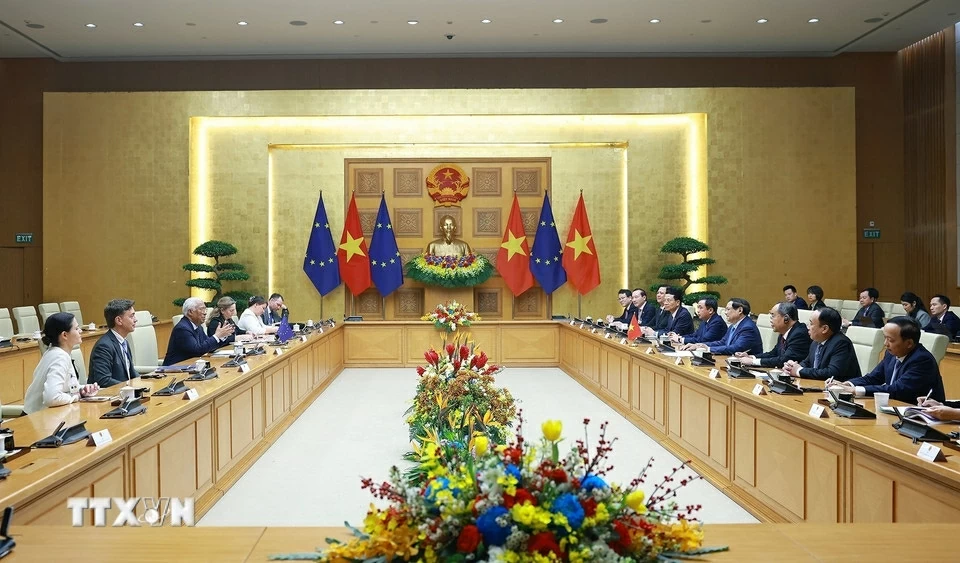 |
| Overview of the meeting between Prime Minister Pham Minh Chinh and European Council President Antonio Costa. (Source: VNA) |
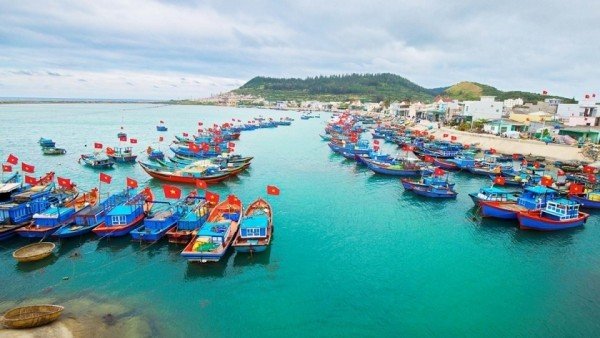
Expressing gratitude for the EU's support in sustainable fisheries development, the Prime Minister urged the EU to soon dispatch an inspection delegation to Vietnam to conduct an objective assessment of Vietnam’s serious and effective efforts against illegal, unreported and unregulated (IUU) fishing, taking into account the newly upgraded Comprehensive Strategic Partnership, with a view to promptly lifting the “yellow card” imposed on Vietnamese seafood.
The Prime Minister also called on the EU to continue supporting Vietnam in modernising and sustainably restructuring its fisheries sector, while creating favourable conditions for the Vietnamese community in Europe to contribute to host societies and promote ties between Vietnam and EU member states.
Congratulating the success of the 14th Party Congress, European Council President Costa expressed his strong impression for Vietnam's comprehensive socio-economic achievements, especially in the context of global and regional economic difficulties and instability. He also praised Vietnam's long-term development goals and strategies.
He affirmed that Vietnam is an important partner for the EU in the Indo-Pacific region and within ASEAN, emphasizing that the EU is a reliable partner eager to deepen cooperation with Vietnam across all fields. He committed to continuing to support Vietnam in its socio-economic development journey and suggested both sides maximize the upgrade to a Comprehensive Strategic Partnership to implement substantive and effective cooperation.
The European Council President highlighted that the established Comprehensive Strategic Partnership presents a significant opportunity for both sides to boost trade, diversify markets and supply chains, develop the marine economy, and promote essential infrastructure construction. These are the foundations for both sides to work together in building a shared future and strengthening bilateral cooperation.
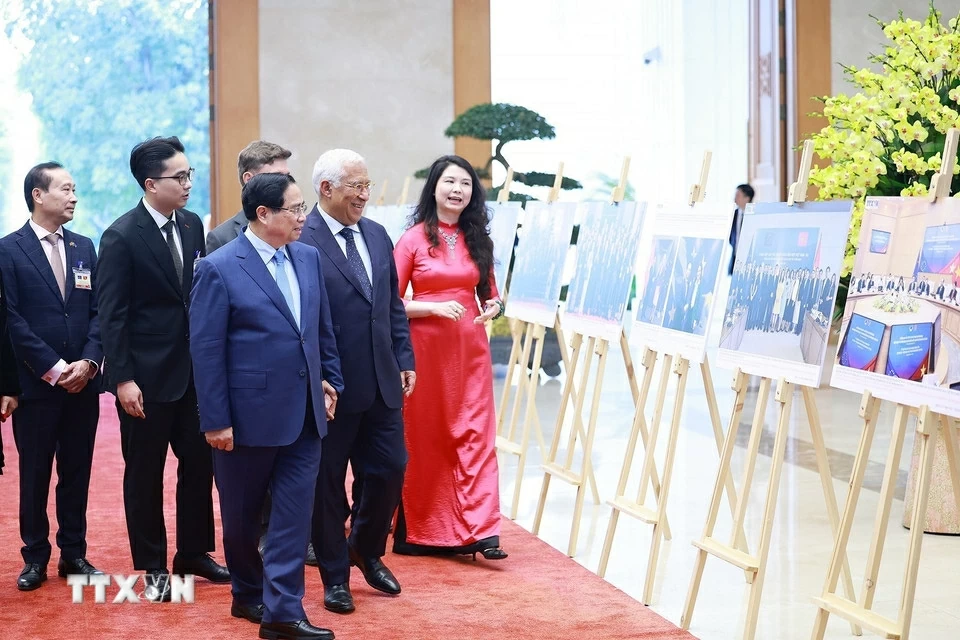 |
| Prime Minister Pham Minh Chinh and European Council President António Costa visit a photo exhibition on the cooperation between Vietnam and the European Union. (Source: VNA) |
The two leaders agreed to closely coordinate in effectively implementing the Vietnam-EU Free Trade Agreement (EVFTA) and promptly complete the ratification of the Investment Protection Agreement (EVIPA). They also aim to promote cooperation in investment, trade, science and technology, green transition, digital transformation, marine economy, clean energy, and high-quality human resource training.
Both sides also affirmed their encouragement and support for research institutes, universities, and businesses from Vietnam and Europe to connect and cooperate, developing an innovation ecosystem and enhancing the capacity of Vietnamese enterprises to participate more deeply in the EU's technology value chain.
Within the ASEAN-EU cooperation framework, the two leaders agreed to enhance coordination to promote the construction of an ASEAN-EU Free Trade Agreement. They also aim to effectively exploit new development drivers with a balanced and harmonious approach that meets the cooperation priorities of countries in the region.
Exchanging views on international and regional issues, the two sides shared a common vision of striving for a peaceful and stable environment conducive to sustainable development and shared prosperity.
They reaffirmed their commitments to multilateralism, respect for international law and the peaceful settlement of disputes in accordance with the UN Charter, while underscoring the importance of maintaining peace, stability, freedom of navigation and overflight, and the rule of law in the East Sea as well as the Indo-Pacific region.