




Prime Minister calls on Phenikaa University to be model for new-generation private universities
On July 22, Prime Minister Pham Minh Chinh has called on Phenikaa University to become a model for new-generation private universities focused on innovation, while visiting the institution and handing over the Government’s decision allowing it to expand from a multi-disciplinary institution into a university with multiple member schools across various fields.
Latest
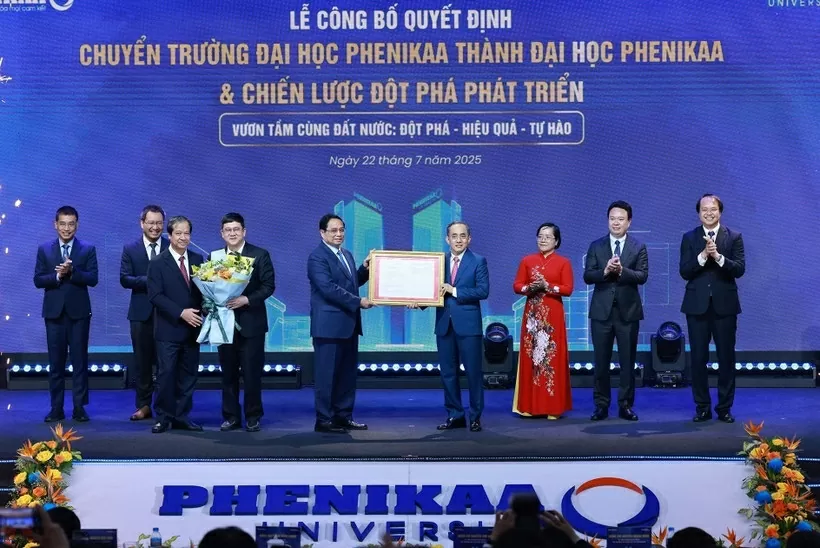 |
| Prime Minister Pham Minh Chinh (fifth, right) hands over the Government’s decision allowing Phenikaa University to expand from a multi-disciplinary institution into a university with multiple member schools across various fields. (Source: VNA) |
Established in 2007, Phenikaa University now trains nearly 25,000 students in over 100 programmes, including 64 undergraduate majors, 10 international joint programmes, 16 master’s and 11 doctoral programmes. The university has established five schools in engineering, economics, medicine-pharmacy, IT, and foreign languages-social sciences.
On April 15 this year, the Prime Minister signed the decision, which officially recognises Phenikaa as the first private university in northern Vietnam to operate under the multi-school model.
Speaking at the event, Prime Minister Chinh urged the university to build its own cultural identity and brand based on the philosophy that students are the centre, the university is the foundation, and teachers are the driving force. Phenikaa’s culture is inseparable from the national culture, he noted.
He emphasised that in Vietnam's era of national development towards prosperity and modernity, science and technology, innovation, digital transformation, and high-quality human resources training are of strategic importance to achieve the country's two centennial development goals.
Commending Phenikaa University for its initial achievements in education, research, and innovation, the Government leader said that the university should grow into a hub for research, training, and innovation, playing a leading and inspirational role within Vietnam’s higher education system
He urged the university to enhance scientific research, innovation, and systematic technology transfer to help solve real-world problems facing businesses, the market, and the economy in line with contemporary development trends.
He also directed Phenikaa to expand practical and interdisciplinary training programmes aligned with Vietnam’s national technology priorities, and to deepen international cooperation to foster academic exchanges and strengthen its participation in global value chains.
(Source: VNA)