



Prime Minister attends SCO 2025 and works in China: Transforming shared perceptions into practical, long-term cooperative products
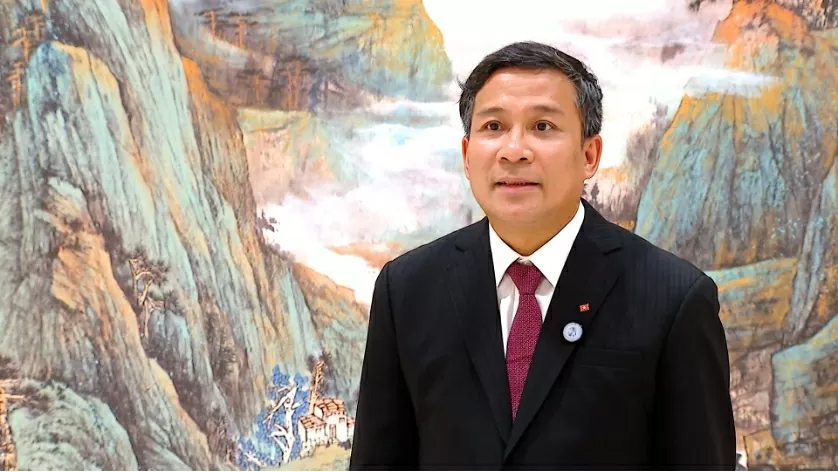
WVR - In an interview with the press regarding the outcomes of Prime Minister Pham Minh Chinh's visit to attend the Shanghai Cooperation Organization (SCO) 2025 Summit and work in China (from August 31 to September 1), Permanent Deputy Minister of Foreign Affairs Nguyen Minh Vu stated that the results achieved hold significant importance not only for the relations between the two Parties and countries but also contribute to transforming the highest leadership's shared perceptions into specific, practical cooperative projects and products with long-term value.
Latest
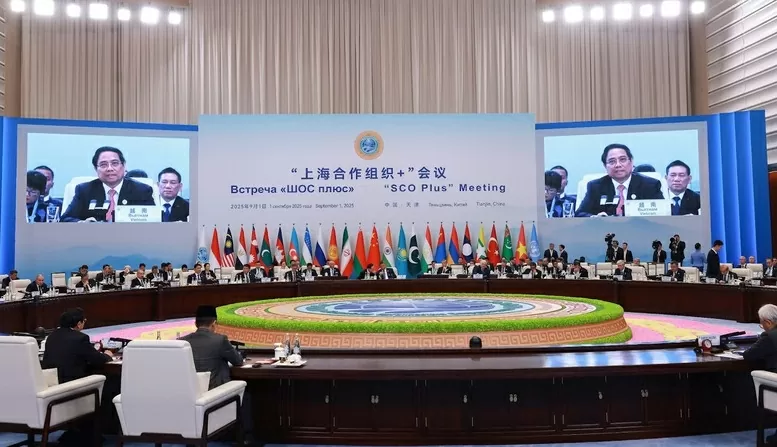 |
| On September 1, Prime Minister Pham Minh Chinh delivered an important speech at the expanded SCO Summit. (Source: VNA) |
Could you share the notable outcomes of Prime Minister Pham Minh Chinh and the high-level Vietnamese delegation attending the Shanghai Cooperation Organization (SCO) 2025 Summit in Tianjin, China?
This SCO Summit took place amidst global and regional instability. The theme and content of the Summit were highly topical, balancing security and development, aligning with the common interests of the participating countries. This attracted widespread attendance, making it the largest Summit in the 25-year history of the Shanghai Cooperation Organization.
|
With a variety of rich and diverse activities on both bilateral and multilateral levels by Prime Minister Pham Minh Chinh, the visit to attend the SCO Summit was a great success, evidenced by two standout results:
Firstly, as a guest of the host country, Prime Minister Pham Minh Chinh delivered an important speech at the Summit. He emphasized Vietnam's stance of supporting, respecting, and upholding the fundamental principles of the United Nations Charter and international law, while reaffirming our Party and State's consistent foreign policy and Vietnam's positive contributions to peace, cooperation, and development in the region and the world.
Notably, the Prime Minister presented three proposals from Vietnam: Firstly, promoting multilateralism, solidarity, and international cooperation in addressing both traditional and non-traditional security challenges. Secondly, enhancing resource mobilization for development and improving global governance capacity. The Prime Minister stressed that all countries, especially major ones, should lead by example, take responsibility, and work closely with the United Nations to successfully achieve the Sustainable Development Goals. Thirdly, strengthening mutual trust, understanding, and mutually beneficial cooperation, starting with neighboring countries, to enhance comprehensive connectivity among countries in the region and globally. Additionally, the Prime Minister called for increased cooperation between the Shanghai Cooperation Organization, the United Nations, and ASEAN to strengthen the UN-centered international system.
Secondly, during the Summit, the Prime Minister and the high-level Vietnamese delegation held sincere, open, and effective bilateral meetings with leaders from various regions, from Southeast Asia to Central Asia, South Asia, and Southeast Europe, as well as leaders of many international organizations. Through these meetings, we have capitalized on opportunities to consolidate and deepen our bilateral relations with partners in priority development areas, especially in strategic infrastructure, agriculture, energy, nuclear power, digital transformation, and green transition. During meetings with our Prime Minister, leaders of other countries and organizations expressed their admiration for Vietnam's past struggle for national liberation and its current achievements in national development.
Partners affirmed their appreciation of Vietnam's role and position and expressed a desire to continue strengthening cooperation with Vietnam in various fields. They also agreed on measures to develop bilateral relations with Vietnam in a deeper, more substantive manner.
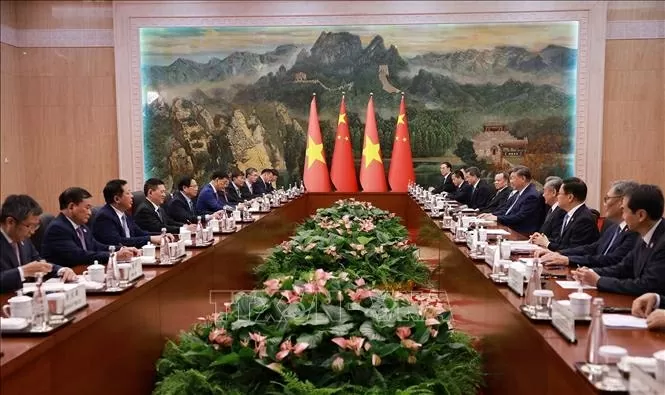 |
| Prime Minister Pham Minh Chinh meets with General Secretary and President of China Xi Jinping in Tianjin (China), during the program to attend the Shanghai Cooperation Organization (SCO) 2025 Summit and work in China, on August 31. (Source: VNA) |
Prime Minister Pham Minh Chinh held meetings with senior Chinese leaders. Could you share the important outcomes of these meetings?
Throughout the visit, China extended a warm and respectful welcome to the Prime Minister and the high-level Vietnamese delegation, reflecting the host country's special regard for Vietnam. During meetings with General Secretary and President of China Xi Jinping and attending a banquet hosted by Chairman of the National Committee of the Chinese People's Political Consultative Conference Wang Huning, both sides agreed on major measures to promote bilateral relations under the six-point orientation, focusing on three major areas: (i) effectively implementing the Joint Statements; (ii) enhancing strategic exchanges and promoting the defense-security cooperation pillar; (iii) maintaining close multilateral coordination to address common regional and global challenges.
Regarding practical cooperation, both sides agreed to comprehensively connect the two economies, especially in railways and energy connectivity, and to boost cooperation in science and technology, and innovation. China agreed to firmly advance the feasibility study report on the construction of the Lao Cai - Hanoi - Hai Phong railway line, actively exploring cooperation in capital mobilization, lending, human resource training, and railway industry development; expand imports of Vietnamese agricultural products, and accelerate the construction of smart border gates. These are all very practical areas serving the breakthrough development needs of both countries in the next phase. The Prime Minister also met with some of China's leading enterprises in various fields to immediately implement specific cooperation.
Both sides also agreed to continue connecting the two cultures, enhancing people-to-people exchanges, and jointly organizing activities within the framework of the Vietnam-China Year of People-to-People Exchange, commemorating the 75th anniversary of diplomatic relations and the "Red Journey" for youth research and study, practically consolidating the "people's foundation" for bilateral relations.
On maritime issues, both sides agreed to continue seriously implementing high-level common perceptions on better managing and resolving disagreements; respecting each other's legitimate interests in accordance with international law, especially UNCLOS 1982; and working with ASEAN countries to promote substantive, effective, and efficient negotiations on the Code of Conduct in the South China Sea (COC), in line with international law, UNCLOS 1982, to build a peaceful, stable, and favorable environment for the development of each country and the region.
In summary, the very important results of this visit will continue to concretize the perceptions of the highest leaders of the two Parties and countries into specific, practical cooperative projects, works, and products, bringing tangible benefits to the people and businesses of both countries, and guiding the Vietnam-China relations towards stable, healthy, and substantive development, contributing to peace, cooperation, and development in the region and the world.