





Nghe An: From paving the way to creating new drivers of growth
In the first ten months of 2026, Nghe An attracted approximately USD 2.49 billion in foreign direct investment (FDI), accounting for around 4.5% of Vietnam’s total registered FDI during the same period.
Latest
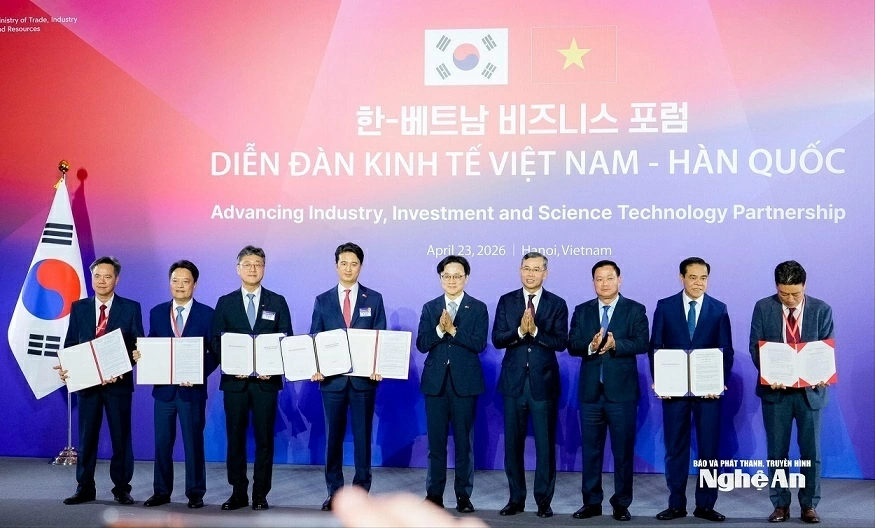 |
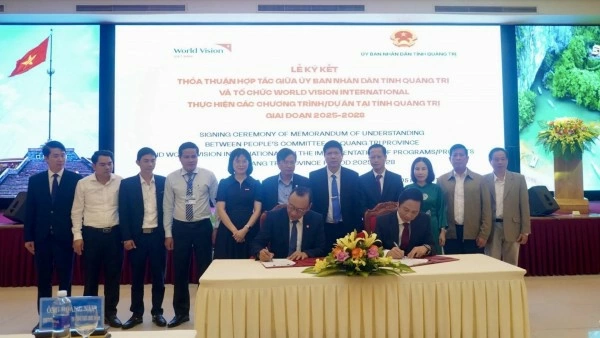
| Nghe An provincial leaders sign cooperation agreements with South Korean partners at the Vietnam–South Korea Economic Forum in April 2026. (Source: Nghe An Newspaper and Radio -Television) |
New opportunities and strategic choices
International flows of investment, technology, trade and human resources are shifting amid a rapidly changing and increasingly unpredictable world. Geopolitical competition, the restructuring of supply chains, digital transformation, green transition, and increasingly stringent requirements relating to energy security, the environment and labour are reshaping the criteria for selecting investment destinations. Investors are no longer looking solely for low costs or short-term incentives. They need an ecosystem capable of ensuring stable operations, facilitating connectivity, providing a suitable workforce, maintaining transparent institutions and offering a government with the capacity to work alongside them.
This is also Nghe An’s strategic choice. Economic diplomacy must become a means of mobilizing external resources and connecting them with the province’s internal development needs. It must help the province gain access to markets, technology, knowledge, capital, management practices and partner networks, create more quality employment opportunities for people in their home province and expand development opportunities for businesses and local residents.
This strategic choice is consistent with Directive No. 15-CT/TW of the Party Central Committee’s Secretariat and the Government’s Resolution No. 21/NQ-CP on economic diplomacy in service of national development, and is further elevated by the Politburo’s Resolution No. 59-NQ/TW, which calls for proactive, comprehensive, extensive and effective international integration. For Nghe An, Resolution No. 39-NQ/TW on the construction and development of the province through 2030, with a vision to 2045, provides the strategic direction. These policies converge on one requirement: the province must do a better job of translating its international standing and external relations into resources, capabilities and tangible development outcomes.
The 14th National Party Congress also identifies foreign affairs and international integration as a “key and regular” task. The Ministry of Foreign Affairs has emphasized that localities can no longer remain the “rear” but must become the “front line”. At a working session with the Standing Board of the Nghe An Provincial Party Committee on May 15, 2025, General Secretary To Lam urged Nghe An to become a model of modern development in Central Vietnam in the new era.
From opening doors to supporting businesses
Looking back on the journey so far, a key shift in Nghe An’s external relations has been the increasingly close alignment of the three pillars of external affairs – Party diplomacy, State diplomacy, and people-to-people diplomacy - with the province’s socio-economic development objectives. Traditional bonds of friendship, particularly with localities in Laos, have continued to be strengthened. At the same time, the province has proactively expanded its engagement and cooperation with partners in Northeast Asia, Southeast Asia, several European countries, the United States, and promising economic and technological hubs.
The goal should not be to expand relations in breadth alone, but to select the right partners and clearly define the benefits of cooperation. Each framework for cooperation should be linked to a number of areas with clear implementation potential, while every engagement should lead to designated focal points with clear responsibilities, a work roadmap and tangible deliverables.
Economic diplomacy should also not be measured solely by FDI. ODA projects, non-refundable aid and international cooperation programmes in agriculture, healthcare, transport, urban infrastructure, vocational training and support for disadvantaged groups all contribute to improving people's quality of life and strengthening the local capacity for development.
The fact that Nghe An is currently implementing seven ODA projects with a combined investment of more than VND 7.1 trillion demonstrates how international resources can be channelled into essential sectors, delivering tangible benefits to local communities and disadvantaged areas. At the same time, Nghe An’s products have reached around 170 countries and territories, with export turnover in the first ten months of 2026 reaching USD 5.77 billion, up 52.7% year-on-year. These figures represent not merely trade performance, but also reflect the increasingly deep integration of local production into international markets.
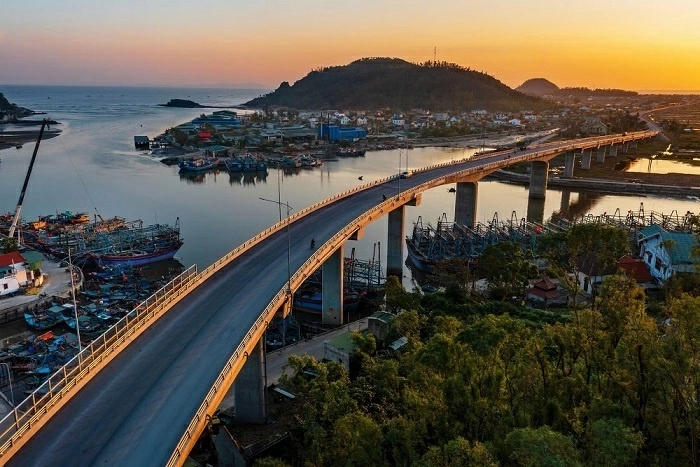 |
| The coastal road project connecting Nghi Son in Thanh Hoa Province with Cua Lo in Nghe An Province is seen as a driving force for regional connectivity in the North Central region. (Photo: Nhan Dan Newspaper) |
From attracting investment projects to building a development ecosystem
The growing inflow of FDI marks an important milestone. In the first ten months of 2026, the total value of newly registered and adjusted investment capital in Nghe An exceeded VND 108.272 trillion, 2.92 times higher than the same period last year, while FDI reached approximately USD 2.49 billion. The Industrial Production Index (IIP) rose by 21.18%, and export turnover reached USD 5.77 billion. These figures indicate that industry is becoming an increasingly prominent driver of the province’s economic structure, while Nghe An has crossed an important threshold in establishing itself as a destination attracting the attention of international investors.
However, what matters more is how the province translates this investor interest into productive capacity. For investors, time is a cost, and consistency on the part of local authorities is an important factor in investment decisions. The establishment of task forces to address bottlenecks facing key projects, accelerate the development of industrial parks, resolve issues concerning delayed projects, and streamline administrative procedures are concrete measures to turn commitments to accompany businesses into tangible experiences for investors.
The province is gradually implementing its “Five Readinesses” approach: readiness in planning, infrastructure connectivity, cleared land, human resources, and administrative procedure support. However, the “Five Readinesses” must not remain merely a slogan; they must translate into tangible capabilities that can be independently verified.
In other words, Nghe An needs to move beyond competing on the basis of input advantages and towards competing on the strength of the quality of its entire investment ecosystem. This shift is in line with the spirit of Politburo Resolution No. 10-NQ/TW dated 8 June 2026 on the development of the foreign-invested economy.
Not just about investment inflows, but the true value
We are fully aware that these impressive growth figures are not an end in themselves. Registered investment capital does not necessarily translate into disbursed capital; a licensed project does not automatically create productive capacity; and high export turnover does not necessarily mean that greater added value is retained locally.
Accordingly, the success of economic diplomacy in the coming period must be measured by broader criteria than the amount of investment attracted. These include the proportion of registered capital implemented on schedule; the number of quality jobs offering better incomes; the capacity of local businesses to participate in supply chains; the extent of technology transfer and workforce training; and the value added and contributions to the state budget, among other factors.
With this in mind, Nghe An has identified three decisive shifts. For the 2026–2030 period, the province aims to attract approximately USD 6–8 billion in registered FDI, while striving to achieve USD 5–6.5 billion in realised FDI, averaging USD 1–1.3 billion annually. Setting these two targets alongside each other clearly reflects the requirement not only to expand the scale of investment attraction, but also to strengthen the capacity to implement projects and absorb investment capital.
The orientation towards attracting investment in high-tech industries, semiconductors, artificial intelligence, supporting industries, clean energy and modern logistics must therefore be accompanied by substantive preparations in infrastructure, human resources, environmental standards and supply capacity. A project does not automatically become suitable simply because it is labelled as high-tech. What Nghe An needs are projects capable of building additional capacity, upgrading local businesses, expanding market access and making sustainable contributions to the economy.
Today, competition for investment takes place not only among countries, but also among localities within the same country. Investors have multiple options and are increasingly able to compare the quality of governance. Therefore, Nghe An’s long-term advantages cannot rest solely on its geographical location, land availability or labour costs. They must be built on a proactive, integrity-driven and action-oriented government; a transparent and stable investment environment; an interconnected infrastructure system; and a workforce equipped with the skills required by the industries of the future.
From the homeland of President Ho Chi Minh, Nghe An is entering a new phase of development with stronger aspirations to advance, while maintaining a clear-eyed understanding that opportunities can only become reality when there is sufficient capacity to seize and translate them into concrete outcomes. Nghe An aspires not merely to be recognised as an emerging investment destination, but to become a trusted partner and a value-adding link in regional and global value chains, making a worthy contribution to the development of the country.