




Minister of Health Dao Hong Lan: Putting people at the center, providing comprehensive health care from early, remote, and grassroots levels
WVR - Central Party Committee Member, Minister of Health Dao Hong Lan shares insights on the implementation of Resolution 72-NQ/TW dated September 9, 2025, by the Politburo, along with key solutions to address longstanding bottlenecks in the health sector, shifting from a "treatment" mindset to comprehensive health care throughout the life cycle, with people at the center.
Latest
 |
| Member of the Central Party Committee, Minister of Health Dao Hong Lan. |
Minister, how is Resolution 72-NQ/TW shifting the focus from medical examination and treatment to comprehensive health care being implemented?
In recent times, the Party and the State have issued numerous important guidelines, mechanisms, and policies to promote the development of the health sector. Among them, Resolution 72-NQ/TW issued by the Politburo is a breakthrough directive, laying the foundation for the mission of caring for, protecting, and enhancing public health.
Resolution 72-NQ/TW is approached with the perspective that public health is the most valuable asset and the central focus for service, implementing tasks, and solutions in the health sector. Additionally, the Resolution clearly reflects the spirit of addressing the "bottlenecks" in the health sector that have not been fundamentally resolved for a long time.
Resolution 72-NQ/TW addresses the transformation in healthcare work, shifting from primarily focusing on medical examination and treatment to comprehensive health care; enhancing the role and importance of disease prevention; and providing early and remote health care for the public.
The work of caring for, protecting, and enhancing public health will be closely linked with managing and providing comprehensive health care throughout the life cycle. This is a significant directional change in the implementation of the health sector's tasks in the coming time.
With an approach focused on resolving "bottlenecks", the Ministry of Health has reported and proposed for the Government to issue Resolution 282/NQ-CP on the Government's action program to implement Resolution 72-NQ/TW by the Politburo on some breakthrough solutions to enhance the protection, care, and improvement of public health, with a clear and specific implementation plan.
It can be affirmed that after three months of implementing Resolution 72-NQ/TW, under the decisive direction and management of the Government and the close coordination of ministries and sectors, the organization of implementation has been strongly promoted, creating initial changes.
Notably, localities have shown clear movements in building resolutions, programs, and plans to concretize the spirit of Resolution 72-NQ/TW by the Politburo; thereby forming practical, suitable projects, solutions, and policies with the actual conditions of each locality.
One of the identified "bottlenecks" is the institutional framework. How will the Ministry of Health focus on resolving this issue, Minister?
Resolution 72-NQ/TW sets the requirement to focus on resolving the second "bottleneck" which is the institutional framework. Practical experience over time has shown that institutional inadequacies have created many bottlenecks in the organization of the health sector's tasks.
Therefore, unresolved issues, as well as the development direction of the health sector in the upcoming period, will be focused on resolving through the completion of the institutional framework, policies, and mechanisms for mobilizing and allocating resources. The consistent spirit is that when issuing policies, there must be ensured participation and close coordination between the State and related entities; simultaneously effectively combining public and private resources, promoting the role of the public in organizing the tasks of caring for, protecting, and enhancing public health. This approach aims to clearly establish the responsibility of the political system and the whole society towards health care work, while creating conditions for policies to be implemented practically and effectively.
For the Ministry of Health, in the coming time, we will continue to review and complete regulations and mechanisms to resolve "bottlenecks", ensuring the synchronized implementation of solutions outlined in Resolution 72-NQ/TW. The Ministry of Health has registered a program to build laws for the next five years and subsequent years; in which, improving the quality of institutional building is identified as a key task, contributing to resolving bottlenecks and addressing gaps in the organization of health care tasks.
Along with completing the institutional framework, the requirement is to ensure suitability, feasibility, and effective implementation. Accordingly, policy development and issuance need to be closely linked with the implementation mechanism and the participation of related entities; ensuring clarity and transparency in practice; mobilizing the participation of all levels, sectors, and the whole society in caring for, protecting, and enhancing public health. This is also the basis for the health sector to implement tasks and solutions synchronously in the coming time, in the spirit of Resolution 72-NQ/TW.
In mobilizing resources, combining state resources, health insurance funds, the private sector, and public participation, what will be the focus of implementation?
Resolution 72-NQ/TW has proposed breakthrough solutions for resource mobilization, including both public and private resources; simultaneously emphasizing the role, responsibility, and participation of the public in organizing health care solutions.
Accordingly, to effectively utilize resources for the health sector, alongside state resources, the focus is on implementing the National Target Program over the next ten years with specific solutions, ensuring the highest effectiveness. Along with that, it is necessary to mobilize and effectively use other resources, including managing and using the health insurance fund associated with the goal of universal health insurance; promoting the role of the health workforce in the private sector; and enhancing public participation in self-care and health protection.
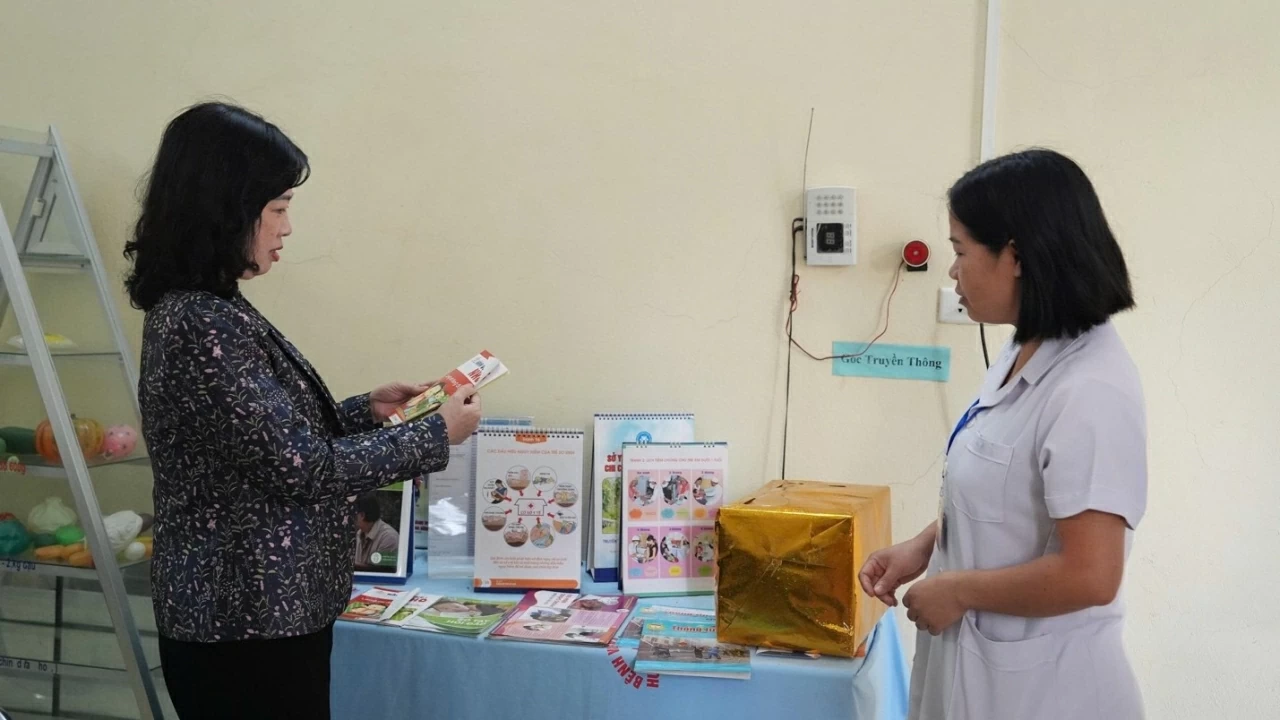 |
| Member of the Central Party Committee, Minister of Health Dao Hong Lan inspects health education communication work at Sam Mứn Commune Health Station – Dien Bien Province. |
The renewal of mechanisms and ensuring resources for public health care in the coming time requires specific solutions to mobilize all resources comprehensively. The consistent approach is to strengthen coordination, promote the participation of all levels, sectors, and related entities; simultaneously institutionalize with clear and transparent policies, creating a basis for effective implementation in practice.
How is the institutionalization of the Resolution 72-NQ/TW directive being implemented, especially through documents presented at the 10th session of the National Assembly, Minister?
To implement Resolution 72-NQ/TW, in recent times, alongside actively presenting to the Government and the Government issuing very specific action programs and implementation plans as I mentioned above, the Ministry of Health has advised in the 14th session of the National Assembly many very important documents to concretize these contents.
First, building a Resolution of the National Assembly on specific, breakthrough solutions in the field of public health care and protection;
Second, presenting to the National Assembly the Law on Disease Prevention and the Law on Population; in which the Law on Disease Prevention has mechanisms and policies to institutionalize the contents that the public is very concerned about in Resolution 72-NQ/TW, such as life cycle health care; disease prevention is focused as the initial solution in public health care, protection, and enhancement with specific policies. This is an important basis for the Ministry of Health to coordinate with ministries, boards, and sectors to build specific implementation plans in the coming time.
Third, the Ministry of Health has advised on presenting the National Target Program on Health Development and Population Policy for the next ten years, ensuring resources to implement the directives; when the institutional framework and policies are issued, there are resources to implement them.
We believe this is a great effort, and the public is also eagerly awaiting specific solutions to be implemented in the coming time. This will contribute to comprehensive public health care for a healthy Vietnam.
Simultaneously, with three approaches from changing mindset and awareness, from resolution solutions and specific policies to ensuring resource allocation for implementation, the execution has been and is being implemented synchronously from the Central to local levels.
With human resources and digital transformation, what is your focus to meet the requirements of comprehensive public health care from early, remote, and grassroots levels?
A "bottleneck" clearly stated in Resolution 72-NQ/TW is resolving difficulties in human resources to ensure the implementation of health mechanisms and policies.
We must focus on training the health sector's workforce; considering health workforce training as a specialized profession. Therefore, issues of resolving mechanisms and policies for specialized training in the health sector have been clearly reflected in the Politburo's Resolution.
Simultaneously, caring for the health sector's workforce, especially at the grassroots health level, preventive health, and areas needing support for development, is also addressed in Resolution 72-NQ/TW with directives to concretize into legal documents and practical implementation solutions in the coming time.
Another important task is creating a mechanism for the grassroots health system to develop. To implement the goal of providing public health care from early, remote, and grassroots levels, the Ministry of Health has recently completed tasks related to providing health care for the public at the grassroots level. Through the implementation process, there has been significant consensus and support, including changes in form and strengthening the functions and tasks of grassroots health.
Localities also support and implement with many solutions. For example, Hanoi, Quảng Ninh, Ho Chi Minh City, and many other provinces and cities have solutions to implement the tasks stated in Resolution 72-NQ/TW with very specific activities and have received public support.
Along with that, the task of improving the quality of health workforce training is also set. Resolution 72-NQ/TW provides directions, and the Ministry of Health has coordinated with the Ministry of Education and Training in completing the legal system on training, including content related to the development direction of health workforce training.
Additionally, with mechanisms on regimes and policies for health sector staff and employees and policies for using human resources at grassroots levels, there will be many solutions developed and proposed to attract health sector staff and employees in general; focusing on priority areas such as preventive health, staff, and employees working in communes and wards - where direct public health care is provided at the grassroots level.
Another solution is to enhance international cooperation, apply science and technology, and digital transformation in the health sector. This is a strength that the Ministry has focused on implementing in recent times.
Currently, the development and application of electronic medical records, electronic health books; building a database for the health sector; applying artificial intelligence in scientific research; digital transformation in the health sector to be more convenient, suitable, and accessible to science and technology to enhance public health care is being strongly built and implemented by the Ministry of Health with specific solutions.
With that spirit, utilizing domestic resources while absorbing global scientific and technological advancements will create a stronger development step in implementing specific solutions to support public health care and protection.
Thank you very much, Minister!