


General Secretary, President To Lam's visit to India and Sri Lanka: Harmony in ideals, strategic convergence, shared vision
WVR - The visit to India (from May 5-7) and Sri Lanka (from May 7-8) by General Secretary and President To Lam conveys a message about Vietnam's new stature during a historic transition, opening up strategic and substantive cooperation spaces in the promising South Asian region.
Latest
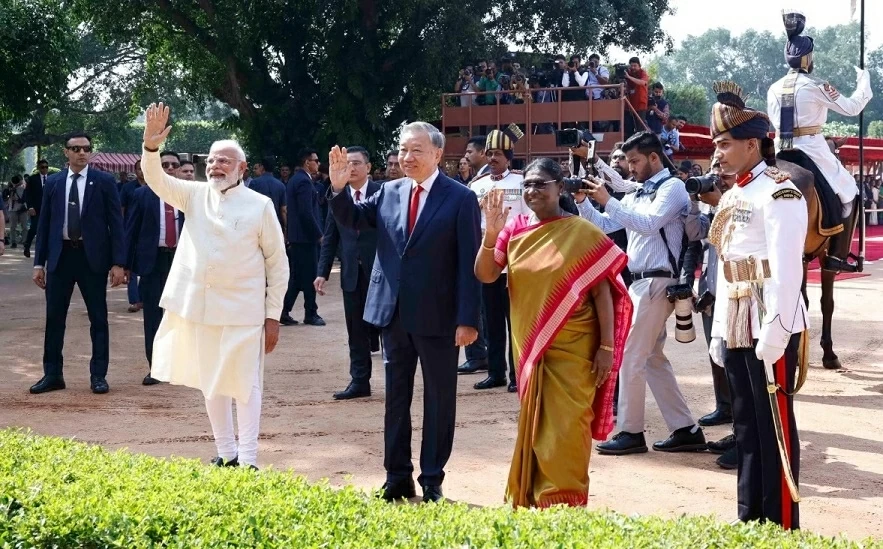 |
| President Droupadi Murmu and Prime Minister Narendra Modi co-chaired the grand welcoming ceremony for General Secretary and President To Lam on his state visit to India on May 6, 2026. (Source: VNA) |
The visit takes place in a special context as Vietnam has just consolidated its key leadership positions following the success of the 14th National Party Congress, with the entire nation entering a new era with renewed vigor; thereby sending a strong message of Vietnam's special regard for traditional friendly nations and strategic partners in the South Asian region.
From strategic harmony to substantive cooperation
In India, the first destination, the visit by General Secretary and President To Lam coincides with the 10th anniversary of the Comprehensive Strategic Partnership between the two countries (2016-2026). Over the past decade, bilateral relations have undergone substantive shifts, deepening in all areas. Both countries share a common aspiration for development: Vietnam aims to become a developed nation by 2045, while India is making strong strides to become a developed country by the centenary of its founding with the slogan "Viksit Bharat 2047".
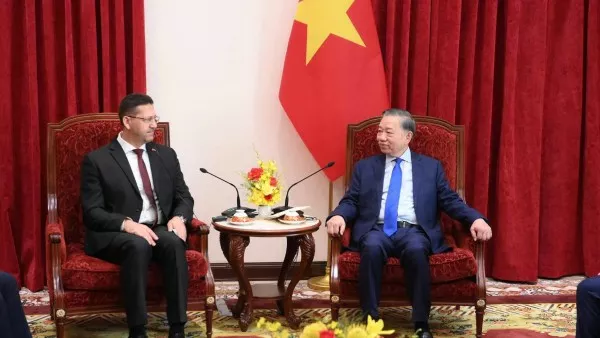
On May 6, amidst the resounding 21-gun salute, the grand welcoming ceremony for General Secretary and State President To Lam at the Indian Presidential Palace marked the beginning of a series of high-level activities, including talks with Prime Minister Narendra Modi and witnessing the signing of cooperation documents; meeting with President Droupadi Murmu. General Secretary and President To Lam delivered a speech at the Indian Council of World Affairs; attended and spoke at the Vietnam-India Innovation Forum; visited Mumbai and held meetings with state leaders, and met with several businesses; attended and spoke at the Vietnam-India Business Forum...
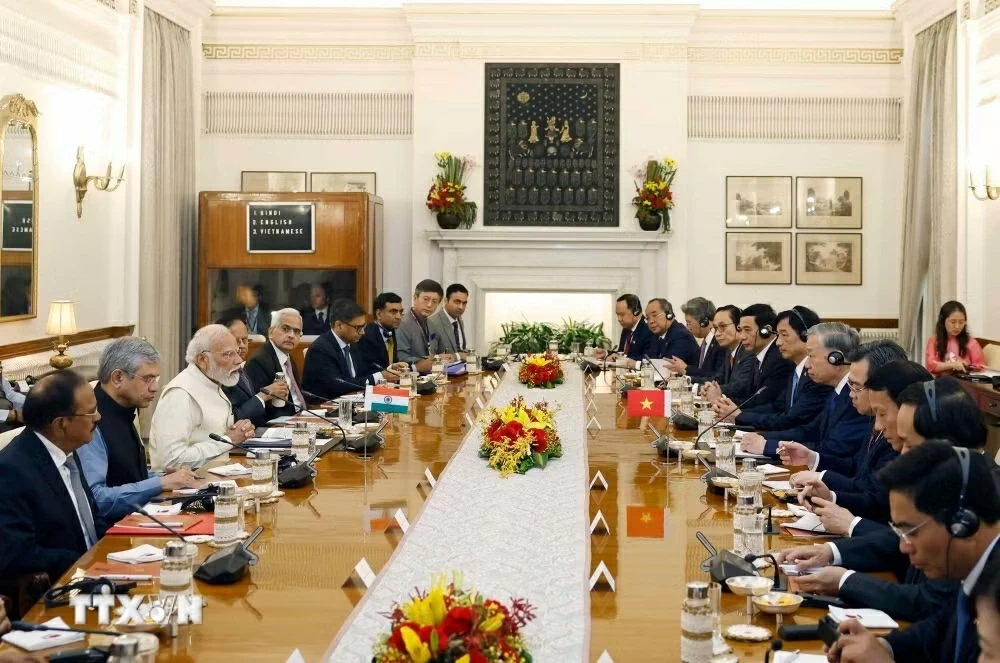 |
| General Secretary and President To Lam held talks with Indian Prime Minister Narendra Modi on May 6. (Source: VNA) |
During the talks on May 6, Prime Minister Narendra Modi emphasized that India always regards Vietnam as one of its foremost partners in the "Act East" policy; he also affirmed that the two countries share common values, visions, and aspirations for independence, autonomy, and building a world order based on international law; this serves as a foundation for the two countries to accompany and support each other, contributing positively to peace, stability, and development in the region and the world.
General Secretary and President To Lam also affirmed that the two countries still possess significant potential and advantages to expand cooperation, bringing practical benefits to the people and businesses of both nations, and suggested that both sides continue to facilitate the business communities of both countries to expand their presence in each other's markets. On this basis, both sides agreed to elevate their relationship to an Enhanced Comprehensive Strategic Partnership under the spirit of "Shared Vision, Strategic Convergence, Substantive Cooperation", marking a new phase of development for bilateral relations.
To concretize the Enhanced Comprehensive Strategic Partnership, the two leaders engaged in sincere exchanges and agreed on strategic directions to further deepen cooperation. Accordingly, both sides affirmed the strong enhancement of political trust based on shared visions, serving as the core foundation and orientation for bilateral relations. Both sides agreed to maintain high-level exchanges and frequent contacts; further enhance the effectiveness of cooperation mechanisms, including the Vietnam-India Joint Commission on Bilateral Cooperation.
Both sides emphasized the important pillar role of defense-security cooperation and affirmed the expansion of cooperation in areas such as defense industry, security industry, maritime security, cyber security, information exchange, and counter-terrorism. India committed to continue supporting Vietnam in training, capacity building, and enhancing defense and security capabilities.
General Secretary and State President To Lam and Prime Minister Narendra Modi also agreed to use science-technology, innovation, and digital transformation as drivers for the new phase of their relationship; strengthen the social foundation of their relationship through enhanced cultural, tourism, and people-to-people exchanges; leverage shared cultural, historical, and religious values; promote aviation connectivity, logistics, and cooperation between localities, economic centers, and technology hubs of the two countries...
| "The new context and new demands of the new development phase of each country require us to consolidate, innovate, and elevate the Vietnam-India relationship to new heights" – Policy speech by General Secretary and President To Lam at the Indian Council of World Affairs, May 6, 2026. |
Striving for a trade turnover target of 25 billion USD
Economic and trade cooperation continues to be a highlight of Vietnam-India relations. Sharing with The World and Vietnam Report, Indian Ambassador to Vietnam Tshering W. Sherpa stated that bilateral trade turnover reached a record level of approximately 16 billion USD by 2025. India has now risen to be among Vietnam's top eight largest trading partners.
According to Vietnamese Ambassador to India Nguyen Thanh Hai, in terms of investment, by the end of 2025, India had 473 active projects in Vietnam with a total registered capital of approximately 1.1 billion USD. Conversely, Vietnamese businesses have begun to expand their presence in India with large-scale projects, notably an electric vehicle manufacturing project in Tamil Nadu with an investment plan of up to billions of USD.
General Secretary and President To Lam and Indian Prime Minister Narendra Modi agreed to create breakthroughs, enhancing mutual complementarity under the win-win principle, especially in strengthening supply chain linkages and global value chains.
Both sides aim to achieve a trade turnover target of 25 billion USD by 2030 in a balanced and sustainable manner; remove trade barriers to facilitate each other's goods entering their respective markets.
General Secretary and President To Lam affirmed that Vietnam is ready to increase imports from India to diversify production inputs; suggested that India consider gradually removing regulations related to the standards of the Bureau of Indian Standards (BIS) for Vietnamese goods.
Both sides encourage the promotion of two-way investment in a high-quality direction; facilitate large corporations from each country to invest in the other with large-scale, symbolic projects, especially in areas such as infrastructure, renewable energy, pharmaceuticals, and high technology...
| During the talks, Indian Prime Minister Narendra Modi highlighted that annually many Vietnamese visit India for pilgrimages; thereby, he hopes both sides will continue to strengthen tourism cooperation in the future, calling for Vietnamese businesses to expand investment in the tourism sector in India. |
New momentum for Vietnam-Sri Lanka Relations
Following the journey is the visit to Sri Lanka, an island nation with a strategically important location on the Indian Ocean maritime route.
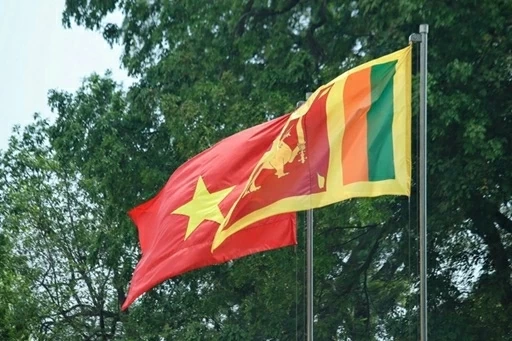
After more than 55 years of diplomatic relations (1970-2025), this is the first time a General Secretary and President of Vietnam has officially visited Sri Lanka, carrying a particularly important diplomatic message, demonstrating Vietnam's regard for Sri Lanka as well as the South Asian region. More importantly, the visit is expected to create new momentum, providing an opportunity for both sides to further consolidate the foundation of political trust and mutual understanding, contributing to transforming commitments into concrete actions, thereby enhancing the effectiveness of cooperation between the two countries in the future.
 |
| After more than 55 years of diplomatic relations (1970-2025), this is the first time a General Secretary and President of Vietnam has officially visited Sri Lanka. (Source: Nguoi lao dong Newspaper) |
According to Vietnamese Ambassador to Sri Lanka Trinh Thi Tam, the visit is expected to focus on three major areas: Elevating the cooperation framework towards a more substantive and effective direction, laying the foundation for the next development phase; promoting economic-trade and investment cooperation, particularly in areas with high complementarity such as agriculture, fisheries, processing industry, logistics, and maritime connectivity; expanding cooperation into new, long-term strategic areas such as digital economy, innovation, renewable energy, and green economy.
Sri Lanka occupies a crucial maritime route in the Indian Ocean and is a potential market with nearly 30 million people. Ambassador Trinh Thi Tam also believes that achieving a trade turnover of 1 billion USD in the medium term is entirely feasible if both sides enhance business connectivity and leverage each other's positions.
Therefore, promoting relations with Sri Lanka will help exploit the potential of this market in particular and South Asia in general, opening up economic cooperation opportunities, increasing Vietnam's exports and investments, and strengthening supply chains in areas where both sides have strengths.
This visit also focuses on addressing logistical and infrastructure bottlenecks; setting higher targets for bilateral trade and investment, aiming for significant investment projects by Vietnamese businesses in Sri Lanka in the near future.
Additionally, Sri Lanka wishes to join the Regional Comprehensive Economic Partnership (RCEP) and Vietnam can play a crucial bridging role to help this island nation access the vast ASEAN market. Conversely, Sri Lanka serves as a gateway for Vietnamese goods to penetrate deeper into South Asia, the Middle East, and Africa.
In summary, the state visit by General Secretary and President To Lam to India and Sri Lanka has created new momentum, transforming commitments into concrete, practical actions.