





General Secretary, President To Lam calls for data standardisation, connectivity across political system
WVR/VNA - On June 25, Party General Secretary and President To Lam called for a comprehensive review, cleansing, standardisation and integration of data across the entire political system, stressing that data must be considered as an important foundation and a strategic national resource.
Latest
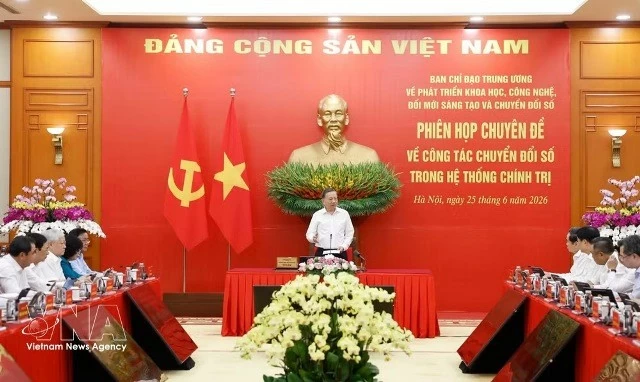 |
| General Secretary, President To Lam calls for data standardisation, connectivity across political system. (Photo: VNA) |
Chairing a thematic meeting on digital transformation within the political system, organised by the Central Steering Committee for Science and Technology Development, Innovation and Digital Transformation, General Secretary and President Lam, who is also head of the committee, said digital transformation has played a crucial role in ensuring the smooth operation of the new organisational apparatus and administrations at all levels.
He commended central agencies and localities for their efforts in implementing the Politburo’s Resolution No. 57 on breakthroughs in science and technology development, innovation and national digital transformation over the past year, noting that significant progress has been achieved. At the same time, he urged authorities to candidly address remaining shortcomings and bottlenecks to accelerate implementation.
According to the leader, the key challenge is no longer awareness, policy direction or resource allocation, as the strategic orientation and institutional framework have largely been established. Instead, the weakest link lies in implementation capacity and the accountability of agencies and their leaders.
Practical experience shows that where leaders directly supervise, inspect and take responsibility, digital transformation delivers results. Where responsibility is delegated entirely to technical units, progress tends to be slow and superficial, he stressed.
Regarding tasks for the coming period, General Secretary and President Lam called for the prompt resolution of overdue tasks, policy backlogs and identified bottlenecks, while accelerating the development of shared databases and digital platforms.
He stressed that data must be created, managed, connected, shared and utilised effectively under the principles of being accurate, complete, clean, up-to-date, unified and shared. Data should generate tangible value for state agencies, businesses and citizens, contribute to the formation of a data market, and support the growth of the digital economy, he noted.
The top leader requested ministries and sectors to complete the establishment and standardisation of specialised databases and urgently connect them with the National Data Centre. He also called for an end to fragmented and incompatible databases, alongside the establishment of strict discipline in data sharing and information-system interoperability throughout the political system.
Emphasising the importance of artificial intelligence (AI), General Secretary and President Lam described it as a powerful tool to enhance productivity and efficiency but stressed that it cannot replace human responsibility, authority and decision-making. AI applications must be developed and deployed responsibly, under effective oversight and with absolute guarantees for national security and data safety, he said.
He also highlighted cybersecurity and data protection as critical priorities, urging all agencies to adhere to the principle that digital systems, databases and digital platforms are designed with security and safety requirements embedded from the outset, rather than having security solutions added after deployment. Ministries, sectors and localities were instructed to classify information systems according to security levels, strengthen access controls and prevent any leakage, misuse or illegal trading of national, corporate or personal data.
Reaffirming the importance of accountability, the leader stressed that tasks should only be considered completed when they produce operational products, verifiable data, real users and measurable outcomes. He called on leaders at all levels to take direct responsibility for digital transformation efforts and ensure that implementation follows the principle of “six clarities” – clear responsibilities, tasks, authority, timelines, accountability and results.