



General Secretary, President To Lam attends Vietnam-Canada business roundtable
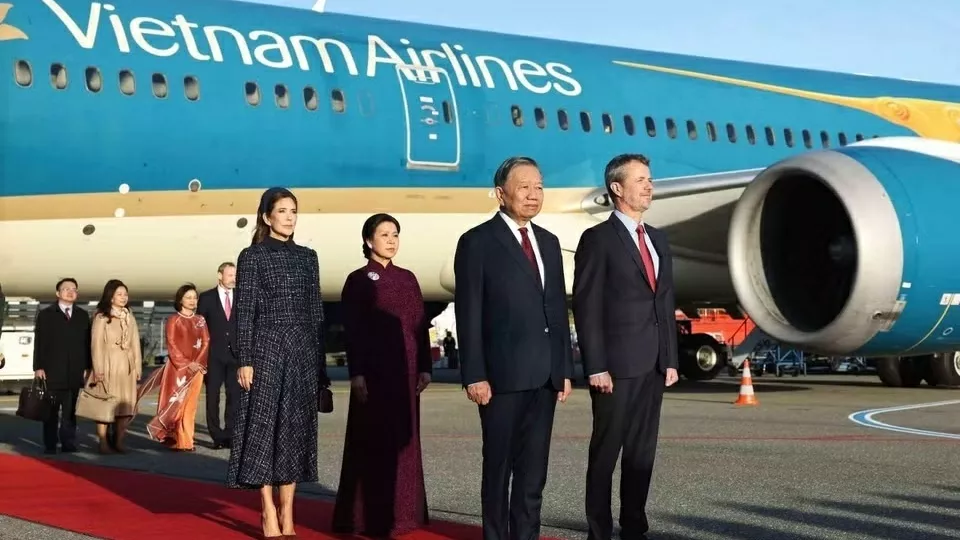
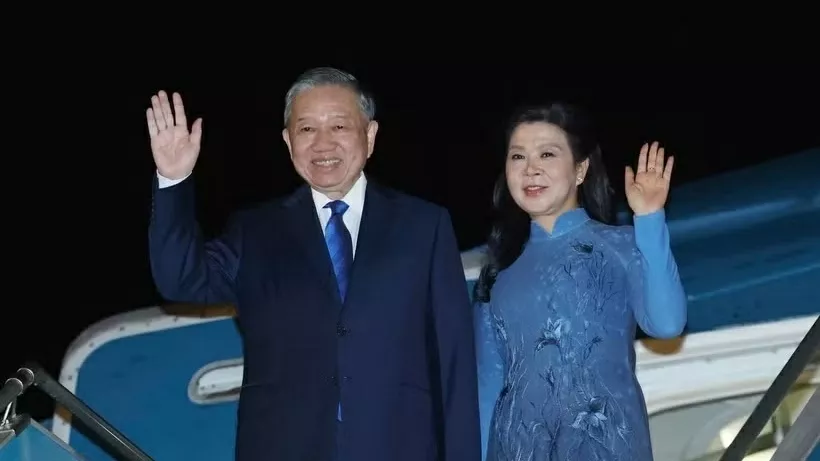
WVR/VNA - On September 25 (local time), General Secretary of the Communist Party of Vietnam Central Committee and President To Lam attended and delivered remarks at a Vietnam-Canada high-level business roundtable in Ottawa , as part of his state visit to the North American country.
Latest
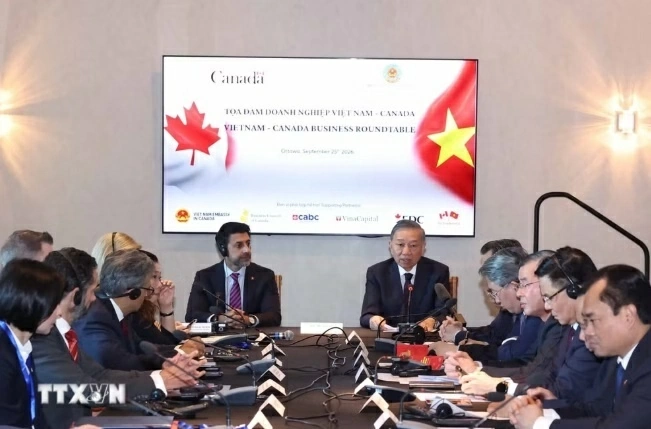 |
| General Secretary of the Communist Party of Vietnam Central Committee and President To Lam (R) speaks at the event. (Photo: VNA) |
The event was jointly organised by the Vietnamese Ministry of Finance and Global Affairs Canada, with the participation of Canadian Minister of International Trade Maninder Sidhu, Vietnamese officials, and businesses from both countries.
In his welcoming remarks, Minister Sidhu said that agreements signed by the two countries and cooperation among their businesses have created a strong foundation for trade and investment ties, opening up new opportunities for bilateral collaboration.
He highlighted Canada’s potential in clean and renewable energy and said Canadian companies have maintained long-standing links with Vietnam. He encouraged more Vietnamese businesses to invest and establish a presence in Canada, noting significant room for mutually beneficial development, particularly through high technology and more efficient production.
Representatives of business associations and companies of the two countries discussed opportunities and proposals in finance, energy, infrastructure, transport and high technology. They agreed that Vietnam-Canada economic ties have a solid foundation but should enter a new phase featuring deeper investment, stronger value-chain linkages and more substantive results.
Addressing the roundtable, General Secretary and President Lam spoke highly of the sound friendship between Vietnam and Canada, built on trust, mutual respect and win-win cooperation. The Comprehensive Partnership established in 2017 has provided a favourable framework for expanding bilateral cooperation across various fields.
He noted that the significance of Vietnam-Canada relations now extends beyond the bilateral framework. Vietnam, with a market of more than 100 million people and extensive free trade agreements, is increasingly connected with ASEAN and the Asia-Pacific region, while Canada possesses capital, technology, knowledge, management capacity and business and financial networks deeply integrated with North America and the global economy. The Comprehensive and Progressive Agreement for Trans-Pacific Partnership (CPTPP) provides an important institutional foundation for connecting these strengths.
Given the strong growth in bilateral trade, the Vietnamese leader said the two economies could aim for two-way trade of 14-15 billion USD by 2030 in a balanced, sustainable manner with higher added value.
He noted that bilateral trade has been developing faster than investment. Although Canada currently has more than 300 investment projects in Vietnam with total registered capital of around 5 billion USD, investment has not grown commensurately in recent years, while cooperation in processing and manufacturing and the development of joint production chains remains limited.
This gap represents the greatest room for development that both sides should focus on narrowing in the coming period, he emphasised.
The General Secretary and President urged businesses from both sides to focus on stronger investment ties, particularly by connecting Canada’s long-term capital with high-quality projects in Vietnam. He said Vietnam has substantial demand for resources for infrastructure, energy, logistics, digital infrastructure, innovation, enterprise development and green transformation, and called for closer cooperation in developing projects, financing plans, promoting risk management and creating long-term value.
The two sides should jointly develop infrastructure, energy, technology and the foundations for a new growth model. Vietnam has significant demand for transport infrastructure, seaports, airports, logistics, power grids, energy, digital infrastructure, data centres and modern industrial parks. Canada has strengths in civil engineering, project management, infrastructure finance, clean energy, LNG, environmental technology, public-private partnership (PPP) models and sustainable development standards.
The two countries are also expanding cooperation in strategic areas such as clean energy, LNG, energy technology, critical minerals, transport and logistics, science, technology and innovation.
Vietnam encourages Canadian businesses to invest not only in physical assets, but also in technology, research and development, data, digital solutions, clean technology and industries capable of improving the productivity of the economy. The ultimate goal is not simply to build another facility or factory, but to create new development capacity for Vietnam.
The two sides should make full use of the Comprehensive and Progressive Agreement for Trans-Pacific Partnership (CPTPP), taking cooperation beyond conventional trade in goods towards deeper linkages in capital, technology, businesses, supply chains and human resources. The training of high-quality human resources, along with knowledge and skills transfer, should be regarded as an integral component of every major investment project. Each major project should bring opportunities to train engineers, experts, managers and skilled workers. Knowledge must be transformed into skills; skills into productivity; and productivity into competitiveness.
To turn these orientations into reality, General Secretary and President Lam stressed the need for strong commitments. Vietnam will continue building a stable, transparent, competitive and predictable investment and business environment; protecting the legitimate rights and interests of investors; improving the quality of project preparation and transparency of information; and completing the necessary conditions to enable investors to assess, mobilise capital for and implement long-term projects.
For legitimate difficulties and obstacles faced by businesses, ministries, sectors and localities must address them with clear focal points, responsibilities, timelines and outcomes, while ensuring an appropriate allocation of risks between the State and investors on the basis of harmonised interests and compliance with the law.
Vietnam’s top leader called on relevant ministries, sectors and the business communities of both countries to urgently select highly feasible projects and initiatives for inclusion in the 2026-2028 action plan of the Vietnam-Canada joint economic committee. The plan should clearly identify which projects can be implemented first, what sources of capital can be mobilised, which mechanisms need to be completed, which businesses can take the lead, and which agencies will be responsible for monitoring implementation.
He expressed his hope that the quality of cooperation in the coming period would be measured not merely by memoranda of understanding signed, but by projects that have actually received investment, capital that has been disbursed and new value that has genuinely been created. Vietnamese and Canadian businesses should participate more deeply in each other’s value chains, while engineers, experts and managers from both countries work together to create new value. This, he said, would be the most substantive measure of the quality of the Vietnam-Canada comprehensive partnership.
On the occasion, General Secretary and President Lam and Minister Sidhu witnessed the handover of cooperation documents between Vietnam Airlines and CAE Inc. on strategic cooperation in aviation training and simulation technology.
A memorandum of understanding (MoU) between Vietjet and CAE Inc. was also signed on strategic cooperation in the training of pilots, cabin crew and technicians, as well as simulation technology and digital learning.
Another MoU between Vietjet and InteliSys Aviation Systems was signed on long-term strategic cooperation in the modernisation of core technology systems, digital transformation, artificial intelligence, data, next-generation aviation retail and technology platforms to support Vietjet’s development strategy and international expansion.