



EVN accelerates projects under adjusted Power Plan VIII: A catalyst for a sustainable economy
WVR - In implementing the adjusted Power Plan VIII, Vietnam Electricity (EVN) and its subsidiaries are concentrating resources to execute key power transmission projects. These efforts aim to meet the socio-economic development needs, ensure national energy security, and synchronize with the progress of power source projects.
Latest
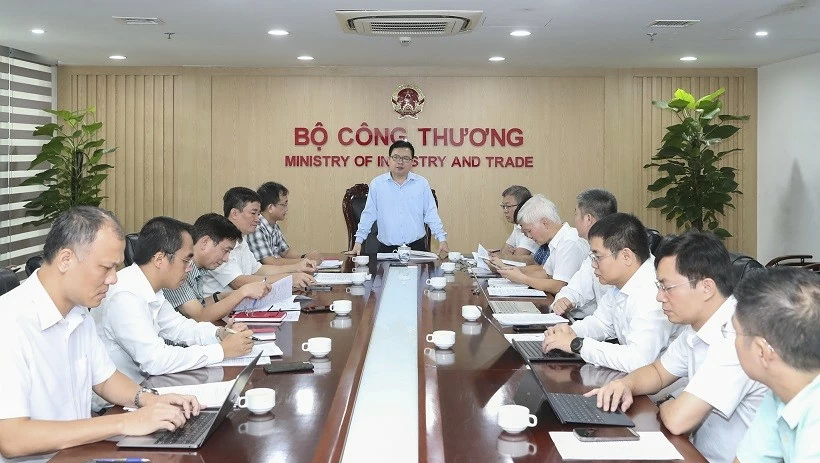 |
| Deputy Minister of Industry and Trade Truong Thanh Hoai works with EVN, EVNNPT, and related units to review the implementation of power transmission projects under the adjusted Power Plan VIII, on July 10. (Photo: Ng. Tuan) |
Vigorous implementation of key power source and transmission projects
Vietnam Electricity (EVN) is actively accelerating the implementation of projects under the adjusted Power Plan VIII approved by the government. This plan emphasizes sustainable development, prioritizes renewable energy, and ensures national energy security. Based on this, EVN has recently focused resources on implementing key transmission projects to synchronize with the progress of power sources, enhance inter-regional and inter-provincial transmission capacity, relieve the load of major power sources, improve electricity import capacity, and ensure power supply for areas with high load growth.
According to EVN's report, from 2026 to 2030, EVN and its units plan to complete 292 power transmission projects, including 78 500kV projects and 214 220kV projects, with a total length of approximately 16,665 km of transmission lines and 91,263 MVA of transformer capacity. The net investment demand for the transmission grid during this period is estimated at about 157,900 billion VND.
EVNNPT regularly petitions local authorities to resolve obstacles to expedite transmission grid projects. The 500kV and 220kV transmission line projects are prioritized for completion to relieve power source loads. In the first half of 2026, many projects achieved good progress thanks to close coordination between EVN and local governments.
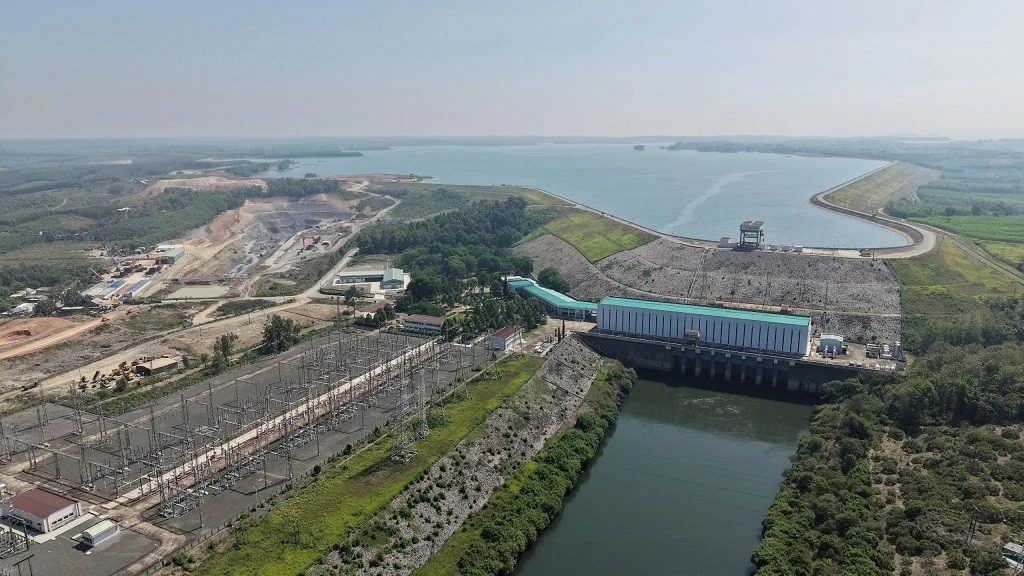 |
| The existing Tri An Hydropower Plant and the area under construction for the Tri An Hydropower Plant expansion. (Photo: Ngoc Linh) |
For instance, the Tri An Hydropower Plant expansion project (Tri An commune, Dong Nai province) has received special attention from EVN leadership. Delegations led by EVN leaders frequently inspect construction progress, encouraging workers and engineers to overcome challenges to ensure project quality and schedule. Currently, units are urgently overcoming difficulties, accelerating progress, and striving for completion by the end of 2027. According to the plan, the Hieu Liem bridge component will be completed and put into use in Q3/2026; Unit 1 of the Tri An Hydropower Plant expansion will generate electricity in Q3/2027; Unit 2 will generate electricity in Q4/2027; and the entire project is expected to be completed in Q4/2027. Once operational, the Tri An Hydropower Plant expansion is expected to add approximately 113 million kWh annually to the national power system, enhancing power supply reliability, improving reservoir operation efficiency, and further promoting the role of the Tri An hydropower complex on the Dong Nai river basin.
Similarly, the Bac Ai Pumped Storage Hydropower Project (Khanh Hoa province) is also in a phase of urgent construction. Dubbed the "giant battery" of the national power system, Bac Ai Pumped Storage Hydropower is not only a pioneering project in Vietnam but also a symbol of resilience in the sunny and windy land of Khanh Hoa. Amid the unpredictable weather of the Bac Ai Tay highlands, the construction site remains active with the installation of critical equipment. In Q2/2026, the Bac Ai Pumped Storage Hydropower Project continued to maintain a multi-pronged construction pace, with many components meeting and exceeding planned targets. Specifically, by the end of June, 8 out of 12 quarterly targets were completed. EVN is committed to completing components as planned under the adjusted Power Plan VIII. The project aims to generate electricity from Unit 1 by the end of 2029 and complete the entire project by 2030. Upon completion, it will be the largest and most modern pumped storage hydropower project in Southeast Asia. The project holds not only technical significance but also strategic importance in Vietnam's international commitment to achieving net-zero emissions by 2050.
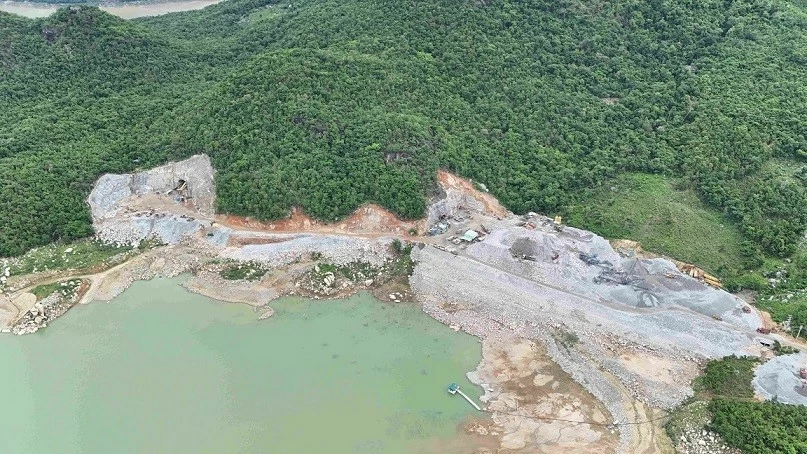 |
| A section of the Bac Ai Pumped Storage Hydropower Project construction site viewed from above. (Photo: Ngoc Linh) |
In addition, EVNNPT is preparing investment steps for ultra-high-voltage direct current (HVDC) transmission projects, serving the long-term development orientation of the power system.
Simultaneously, EVN is also promoting the development of rooftop solar power nationwide. Many households and businesses in Nghe An and other provinces have installed systems, contributing to an increased share of renewable energy. Supportive policies from EVN make it easier for people to access clean technology.
Amid growing investment needs for developing the power transmission system, the National Power Transmission Corporation (EVNNPT) is actively working with development banks and international financial institutions, including the Asian Development Bank (ADB), to arrange ODA funding for key transmission projects. This ensures stable funding and modern technology for the power infrastructure. Many key transmission grid projects have undergone thorough field surveys.
EVN leadership frequently encourages workers on construction sites. The 2026 Workers' Month witnessed many gratitude activities, sharing with employees involved in construction. This creates a strong morale boost for the frontline force in implementing key projects.
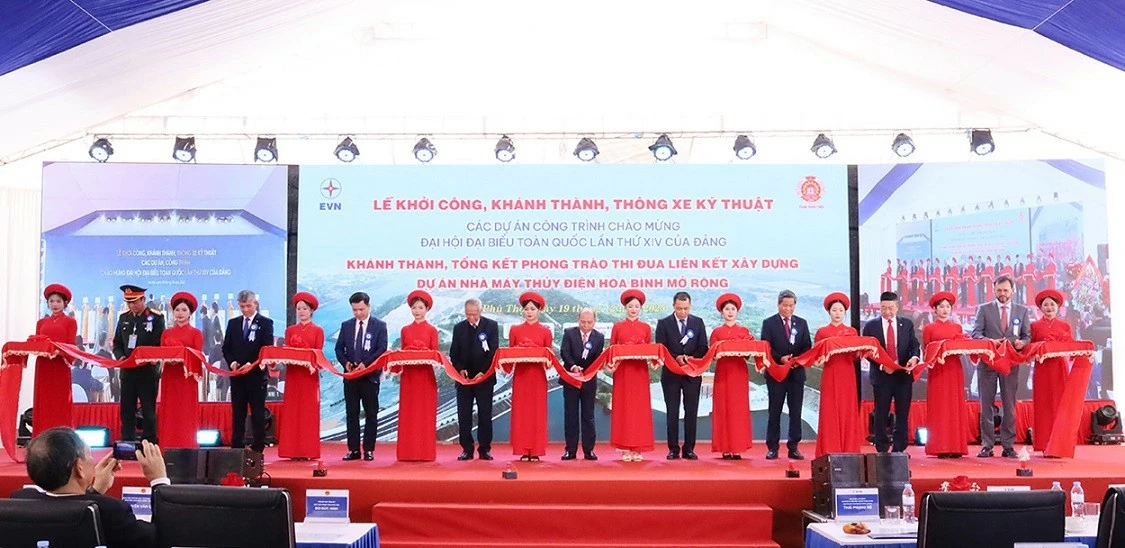 |
| Ribbon-cutting ceremony for the Hoa Binh Hydropower Plant expansion project on December 19, 2025, in Phu Tho. (Source: EVN) |
Practical contributions to sustainable socio-economic development
Accelerating projects under the adjusted Power Plan VIII has brought numerous benefits to Vietnam's economy. Through this, EVN contributes to GDP growth by ensuring a stable power supply for industrial production and services.
As of early 2026, the total power capacity of Vietnam's power system reached 87.6 GW, ranking second in ASEAN and 20th globally. EVN, as a state-owned enterprise, plays a pivotal role in ensuring Vietnam's national energy security, managing nearly 37% of total power capacity, producing over 40% of national electricity output, operating the 500kV - 220kV transmission system, the 110kV grid, and distributing nationwide, acting as the sole electricity buyer in the power market.
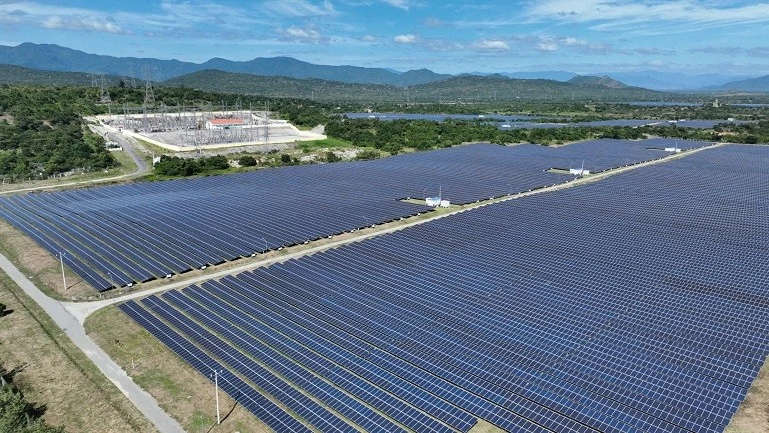 |
| Phuoc Thai 2 Solar Power Plant. (Source: EVN) |
The expansion of renewable energy by EVN helps reduce carbon emissions, moving towards a green economy. Rooftop solar power is widely spreading, bringing economic benefits to residents and businesses. Households save on electricity costs by self-producing clean energy.
A notable solar power project invested by EVN is the Phuoc Thai 2 Solar Power Plant project in Phuoc Huu commune, Khanh Hoa province, connected to the national grid through the 220 kV Phuoc Thai substation and 220 kV transmission line. This is a level I energy industrial project, group B, using high-efficiency photovoltaic technology combined with a modern string inverter system. Once completed, the plant will supply 168.92 million kWh annually to the national grid, contributing to the development of clean energy, reducing greenhouse effects, and contributing to the socio-economic development of the locality.
Additionally, LNG and thermal power projects are closely monitored by EVN to ensure timely operation. This supports balancing power sources and reduces reliance on traditional fuels. EVN collaborates with partners to address challenges related to gas sources.
Moreover, transmission grid projects help connect regions, especially remote areas, thereby supporting balanced economic development.
Overall, EVN's efforts under the adjusted Power Plan VIII have significantly contributed to Vietnam's sustainable economy. Energy security is strengthened, the environment is protected, and economic growth is robustly supported.
In the future, with a high sense of responsibility, EVN will continue to play its role and continuously innovate to meet the country's development needs. The ongoing projects will serve as a solid foundation for Vietnam's energy future. The entire power sector is united for a prosperous and sustainable economy.