



Celebrating 20 years of the Politburo's Resolution 36
WVR - Alongside the nation's socio-economic and diplomatic achievements, over the past 20 years, Resolution No. 36-NQ/TW concerning overseas Vietnamese (OV) by the Politburo has demonstrated the Party and State's significant attention to our compatriots abroad. It has fundamentally transformed the perceptions and sentiments of overseas Vietnamese towards their homeland and nation.
Latest
At the end of 1998, while serving as the Director General of the Consular Department, I was transferred by the Ministry of Foreign Affairs to serve as the Deputy Chairman of the Committee for Overseas Vietnamese (established in 1959, under the Government, and since 1995, became a General Department-level unit of the Ministry of Foreign Affairs).
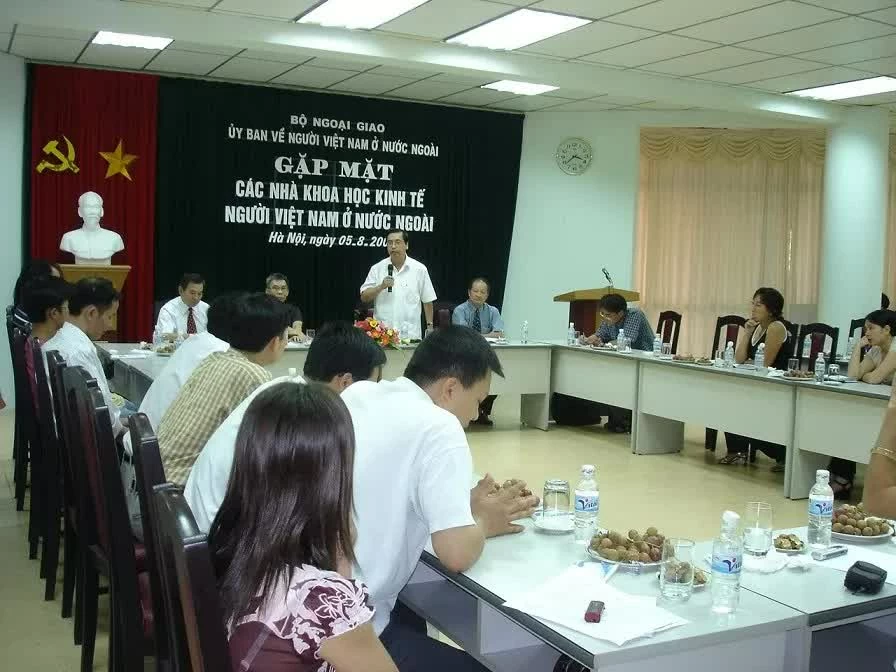 |
| Deputy Minister of Foreign Affairs, Chairman of the Committee for Overseas Vietnamese Nguyen Phu Binh meets with OV economic scientists returning for the PET 2006 International Conference on Economics and Public Management. (Source: State Committee for Overseas Vietnamese) |
Deputy Minister Nguyen Dy Nien, concurrently Chairman of the Committee, explained: The integration of the Committee into the Ministry of Foreign Affairs aims to link the work of mobilizing our overseas compatriots with diplomatic affairs, and my transfer to the Committee was also for this purpose. Before this, only two Department-level officials from the Ministry had been assigned to work at the Committee.
Preparation and drafting of the Resolution
At that time, the country's economy was still struggling, and we were applying a dual pricing policy for services for domestic citizens and foreigners, including overseas Vietnamese returning to live or visit family.
To persuade ministries to apply domestic service pricing for our compatriots, colleagues at the Committee introduced me to Politburo Resolution 08, issued on November 29, 1993, which was comprehensive but marked "Confidential" and thus not widely disseminated.
Discussing with colleagues at the Committee, we realized that central agency officials were unaware of this document, and local officials were likely even less informed. To understand the situation and work with overseas Vietnamese and their relatives in localities, we sought permission from the Ministry to organize a local working trip of over a week, traveling by road from Hanoi to Ho Chi Minh City and back.
Working with provincial People's Committees and visiting economic establishments invested by our compatriots, meeting and understanding the sentiments of overseas Vietnamese and their relatives, we found that most of our compatriots went abroad, including those from southern provinces, primarily for economic reasons.
Therefore, when the country opened up and created new opportunities, our compatriots immediately considered returning to do business. However, in all localities, leaders acknowledged being informed about Politburo Resolution 08 of 1993, but due to confidentiality, it could not be widely disseminated within the political system. The consensus was clear: overseas Vietnamese, regardless of their departure circumstances or reasons, should be regarded as "children of Lac and descendants of Hong", without discrimination, and welcomed back for family visits, investment, and trade with the homeland.
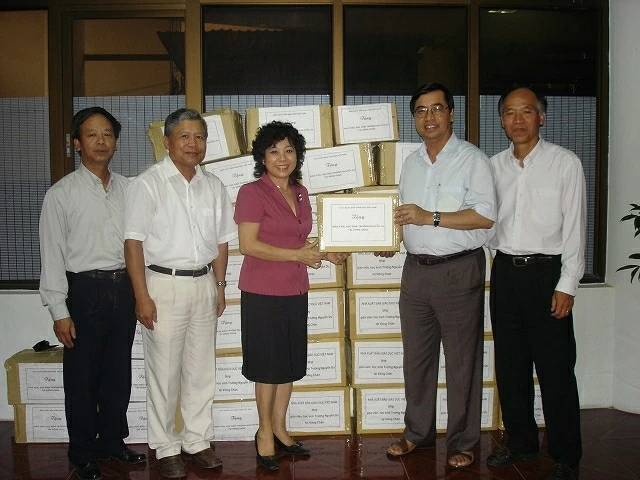 |
| Deputy Minister of Foreign Affairs, Chairman of the Committee for Overseas Vietnamese Nguyen Phu Binh receives books from the representative of the Education Publishing House to send to teachers and students of Nguyen Du School in Laos in July 2006. (Source: State Committee for Overseas Vietnamese) |
According to feedback from our compatriots, there were some issues with entry and exit procedures at border gates, and investment and business licensing procedures varied from place to place, with some being easy and others difficult, leading to unfortunate incidents. Additionally, the general opinion of our compatriots was a desire for the State to allow them to enjoy service pricing similar to domestic citizens.
After visiting localities, we clearly recognized that Politburo Resolution 08, issued on November 29, 1993, was the first official document of our Party concerning overseas Vietnamese, considering them a part of the Vietnamese nation and a resource for national development.
The resolution identified the important role of the Vietnamese community abroad in the cause of renewal and international integration, setting requirements for information and external communication work for the Vietnamese community in other countries.
Although the resolution contained very new content in this field, it was only directional, making it difficult to widely disseminate within political system agencies and among our compatriots both domestically and abroad.
Given this situation, we reported to the Party Committee of the Ministry of Foreign Affairs, requesting the Secretariat to allow the resolution to be publicized and widely disseminated, and based on that, proposed specific measures to implement the above policy.
Additionally, the Committee actively worked with ministries to implement a unified service pricing policy for overseas Vietnamese, similar to domestic citizens, considering this a breakthrough in implementing the policy of regarding overseas Vietnamese as part of the Vietnamese nation.
We were very pleased that after a period of advocacy and presentation to the leaders, the Secretariat requested the Party Committee of the Ministry of Foreign Affairs to prepare the content for a new resolution on overseas Vietnamese work, more comprehensive and suitable for the development of the new situation both domestically and internationally. A resolution that would be openly and widely disseminated, outlining the responsibilities of the entire political system as well as the rights and obligations of our compatriots both domestically and abroad.
Moreover, ministries gradually agreed with our Ministry's proposal to apply a unified pricing policy for overseas Vietnamese similar to domestic citizens, progressing towards a unified pricing policy for both Vietnamese citizens and foreigners, which was implemented a few years later.
To prepare the content of the resolution, we held several working sessions at the expert level with ministries to unify viewpoints and anticipate specific content to be included in the draft resolution.
Initially, Deputy Minister and Chairman of the Committee Nguyen Dy Nien directly gave directions to us. In 1999, after he was appointed Minister of Foreign Affairs, Permanent Deputy Minister Nguyen Dình Bin, concurrently Chairman of the Committee, continued to lead us in this work.
When I was appointed Assistant to the Minister in early 2001, Nguyen Chien Thang, former Ambassador to France, was appointed Deputy Chairman of the Committee to continue overseeing the resolution preparation group. In 2002, I was appointed Deputy Minister and later appointed Chairman of the Committee, replacing Deputy Minister Nguyrn Dinh Bin, who went on a term as Ambassador to France, just as the resolution draft was entering the finalization stage.
Looking back at the Committee's work at that time, I was very impressed with the Department-level and expert staff of the Committee, who dedicated their lives and accumulated extensive experience in community mobilization work. They were very enthusiastic after the Committee was integrated into the Ministry of Foreign Affairs, clearly seeing that this work was receiving special attention from the Party and State, and they wholeheartedly participated in the drafting work. We also received close and direct guidance from Ministry leaders such as Nguyen Dy Nien and Nguyen Dình Bin.
Especially, we were fortunate to have Vu Khoan, a former Ministry leader who dedicated his life to diplomacy, then a Party Central Committee Secretary and Deputy Prime Minister directly overseeing foreign affairs, not only providing general direction for the resolution's construction but also directly revising the content, structure, and wording of the draft resolution.
In anticipation of those directly working with overseas Vietnamese and the vast overseas Vietnamese community, on March 26, 2004, Politburo Resolution No. 36 was issued, marking a very important new development in mobilizing our overseas compatriots.
Breakthrough thinking in Overseas Vietnamese mobilization
Building on the Party's perspective on overseas Vietnamese work in Politburo Resolution 08 of November 29, 1993, Politburo Resolution 36 of March 26, 2004, introduced new developments in thinking and guiding perspectives on this work.
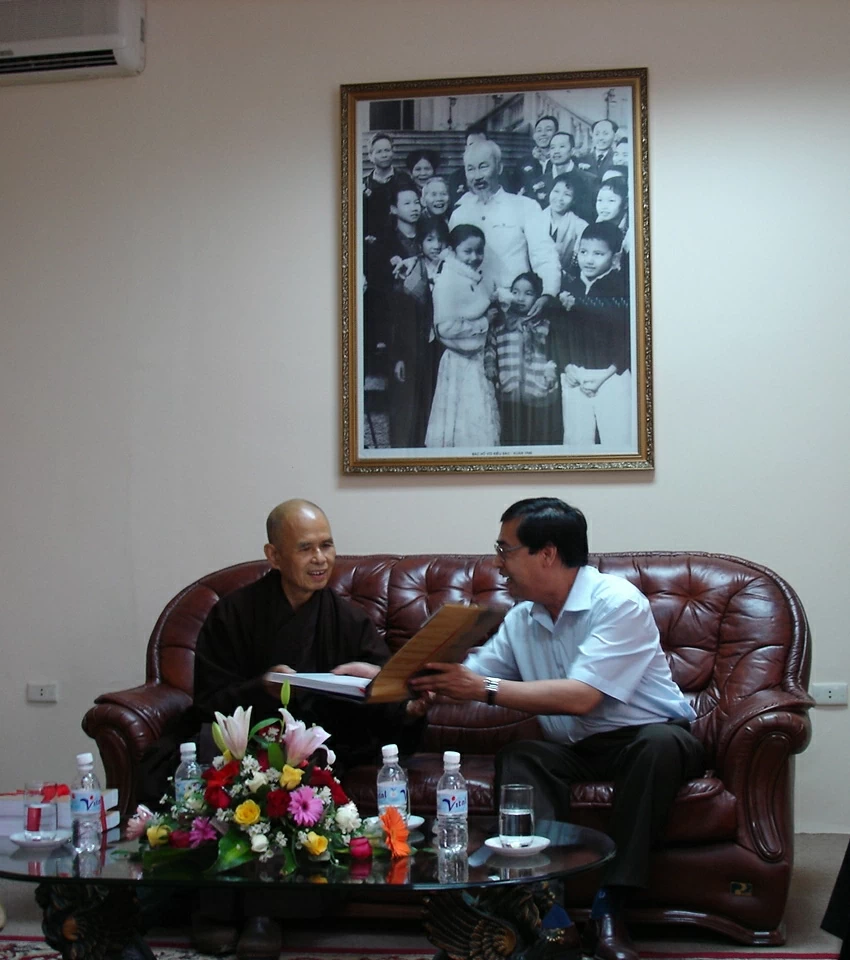 |
| Chairman of the Committee for Overseas Vietnamese Nguyen Phu Binh meets Zen Master Thich Nhat Hanh during his visit to his homeland in April 2007. (Source: State Committee for Overseas Vietnamese) |
This is a public resolution, not only stopping at perspectives and guiding policies for this work but also outlining a comprehensive strategic direction, serving as a basis for formulating the Party and State's policies throughout the period of promoting international integration, guiding the activities of ministries, sectors, and localities concerning our overseas compatriots.
The consistent and overarching theme of the resolution is National Great Unity, considering overseas Vietnamese an inseparable part of the Vietnamese ethnic community, a resource for national development, and an important factor in developing cooperative and friendly relations with other countries.
The resolution clearly states: "Eliminate prejudices, discrimination due to past or class origins, build an open spirit, respect, sympathy, mutual trust, and together look towards the future. All Vietnamese, regardless of ethnicity, religion, origin, social status, reason for going abroad, who wish to contribute to achieving the above goal, are gathered in the great national unity bloc."
Resolution 36 outlined a series of tasks to ensure the interests of our overseas compatriots, such as legal status, including issues of entry and exit, nationality, marriage, inheritance, property, etc.; building a system of policies and laws to attract the contributions of human resources and financial resources of our compatriots to the cause of national development, especially in the fields of science-technology, investment-trade, culture-education-health-sports-tourism; innovating information, communication, Vietnamese language teaching, and national cultural activities for the Vietnamese community in various locations; innovating and diversifying methods of mobilization, gathering forces, with the aim of unity, mutual support in life, and looking towards the homeland, especially focusing on the younger generation.
Resolution 36 affirmed that overseas Vietnamese work is the responsibility of the entire political system and the entire people, clearly stating specific responsibilities and assigning tasks to each agency, mechanism in the political system, ministries, sectors, and localities, specialized agencies, and our diplomatic missions abroad in implementing this strategic task.
The resolution also calls for building a close coordination mechanism between specialized agencies (State Committee for Overseas Vietnamese - Ministry of Foreign Affairs) with state management ministries and agencies, central and local organizations, and associations.
Our overseas compatriots are not only beneficiaries of new policies brought by the resolution but also active participants in implementing the tasks set out in the resolution, from contributing ideas to policy formulation to implementing those policies.
The resolution also calls for improving reward policies for organizations and individuals with outstanding achievements in community building, contributing to national development, as well as for domestic organizations and individuals with outstanding achievements in overseas Vietnamese mobilization work, and calls for satisfactorily resolving past issues left by history according to national ethics.
Key achievements over the past 20 years
Immediately after the resolution was issued, the National Assembly, Government, ministries, sectors, the Fatherland Front, and socio-political organizations all developed action programs with specific measures to implement the tasks outlined in the resolution.
In particular, the close coordination between government ministries proposed to the National Assembly to pass a series of legal documents in all fields related to overseas Vietnamese, from nationality, entry and exit, residence, land, housing, investment, business, etc., towards increasingly connecting our compatriots with their homeland, with rights approaching those of domestic citizens.
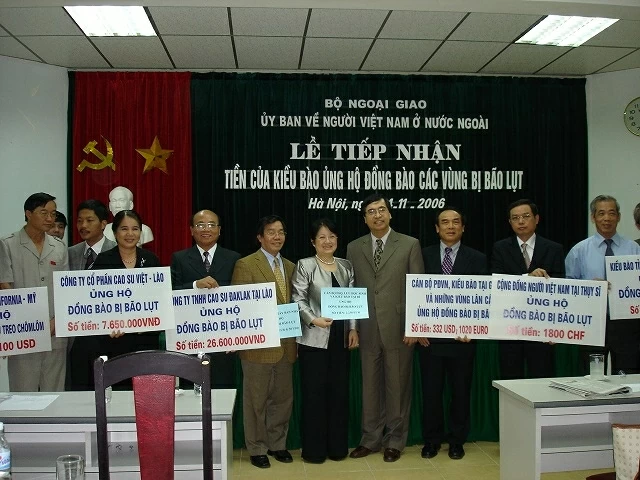 |
| Deputy Minister of Foreign Affairs, Chairman of the Committee for Overseas Vietnamese Nguyen Phu Binh receives donations from overseas compatriots to support compatriots in flood-hit areas in November 2006. (Source: State Committee for Overseas Vietnamese) |
To assist our compatriots legally, the Association for Liaison with Overseas Vietnamese signed an agreement with the Vietnam Bar Federation to establish a Legal Advice and Assistance Center for Overseas Vietnamese to help them understand and apply Vietnamese law in protecting their legitimate interests.
We have welcomed many figures related to the old regime, such as Nguyễn Cao Kỳ, musician Phạm Duy, Zen Master Thích Nhất Hạnh, contributing to promoting the spirit of National Great Unity, looking towards the future; inviting our overseas compatriots to participate in the Hung Kings' Festival in the country.
In response to the above policy, the Association for Liaison with Overseas Vietnamese, in coordination with the Vietnamese Association in some locations, brought the Worship of Hung Kings, recognized by UNESCO as an Intangible Cultural Heritage of Humanity, to the Vietnamese community in many locations worldwide in Asia, Europe, and America.
Over the years, the Ministry of Foreign Affairs has organized Homeland Spring and Lunar New Year activities for our overseas compatriots at the central and local levels nationwide, organized summer camps for Vietnamese youth abroad with various activities, organized annual visits to the Spratly Islands for our overseas compatriots.
Not only encouraging our overseas compatriots to visit the country, organizing for them to contribute ideas to the Party and State's policies, high-level leaders and delegations from government agencies and mass organizations regularly meet with our compatriots during visits to other countries to understand the actual situation, and learn about their thoughts and aspirations.
These activities have helped our overseas compatriots understand the Party and State's attention, as well as domestic compatriots, understand the domestic situation, and increasingly connect with their homeland, building trust in the Party, State, and people at home.
Teaching and learning Vietnamese in the overseas Vietnamese community has always been one of the top tasks of specialized agencies and domestic organizations.
The Ministry of Foreign Affairs, the Ministry of Education, and many domestic agencies and organizations have coordinated to compile textbooks and Vietnamese learning materials to provide to Vietnamese communities in other countries, organized centralized or online classes for students in various locations, organized training for Vietnamese language teachers abroad, encouraged countries to include Vietnamese language programs in primary and secondary schools and universities in some locations with large overseas Vietnamese populations, and strengthened Vietnamese learning through cultural exchange activities in various locations.
Especially, the government's approval of the Day to Honor the Vietnamese Language in the Overseas Vietnamese Community (September 8 annually) has encouraged and spread love for the Vietnamese language and culture, fostering love for the homeland and country.
The Association for Liaison with Overseas Vietnamese has coordinated with the University of Languages and International Studies, Vietnam National University, Hanoi, to compile an online Vietnamese language teaching curriculum with 10 versions through major languages or local languages with large Vietnamese populations, organized online Vietnamese classes in 5 countries, and will expand this learning format to other locations. Additionally, the Association has organized "I Love My Country's Language" contests in some locations to teach Vietnamese through folk songs and Vietnamese songs.
Attracting resources from our overseas compatriots, including remittances and scientific-technological resources, has always been one of the key tasks of domestic agencies and organizations.
In the spirit of "benefiting the country, benefiting the home", bringing practical benefits to our compatriots and also contributing to the country, annually, the amount of remittances sent home has reached 18-19 billion USD/Euro, similar to the annual FDI capital implemented.
To effectively attract this capital, the Association for Liaison with Overseas Vietnamese is promoting the implementation of the "Investment Support Forum for Overseas Vietnamese (INVESFOV) project. However, compared to remittances, the intellectual-scientific-technological resources of our overseas compatriots are very large, as 80% of Vietnamese people are living and working in developed countries, and at least 10% of over 6 million overseas Vietnamese have a university degree or higher.
In recent years, the Ministry of Foreign Affairs (State Committee for Overseas Vietnamese and our representative agencies in other countries) has made great efforts to gather and connect networks of Vietnamese experts-intellectuals in other countries to attract this resource for the development of science-technology and innovation in the country.
Many experts and intellectuals have been invited to participate in advisory organizations, including advisory groups for the government. Vietnamese entrepreneurs in other countries have also made important contributions to finding markets for domestically produced products or the demand for importing essential goods from abroad.
If at the beginning of the renovation period (1986), only 8,000 of our overseas compatriots visited the country, by 2004 (when Resolution 36 was issued), 430,000 people visited, and that number now exceeds 1 million annually. A large number of our compatriots, elderly people returning home, young people seeking jobs and settling in the country. Many successful entrepreneurs in Europe focus on investing in the country, building leading enterprises in economic sectors (Vingroup, Sungroup, Vietjetair, Techcombank, Masan...).
Many successful entrepreneurs in Western countries have chosen their homeland to invest, contributing to making their homeland prosperous, such as Nguyen Hoai Bac, Nguyen Thanh My (Canada), Nguyen Ngoc My (Australia).
Our compatriots are very excited because they are always honored by the Party, State, and domestic organizations on major occasions, representing the community in many locations to participate in the Central Committee of the Vietnam Fatherland Front, the common house of National Great Unity.
The trend of experts, intellectuals, and scientists in other countries gathering into regional and global intellectual networks is developing the country in response to the Party and State's call.
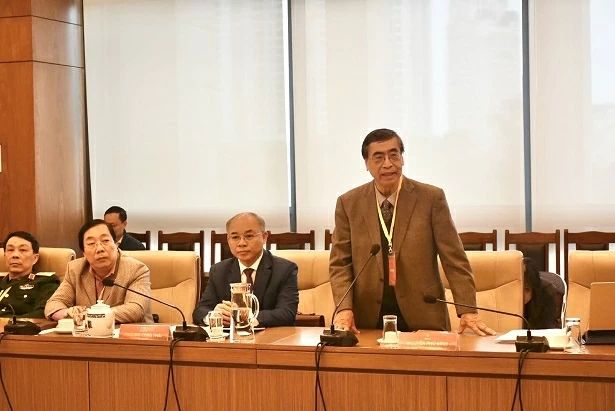 |
| Ambassador Nguyen Phu Binh is currently the Chairman of the Association for Liaison with Overseas Vietnamese. (Photo: Canh Tieu) |
Overseas Vietnamese work enters a new era
After more than 20 years of implementing Politburo Resolution 36, we clearly see that overseas Vietnamese work has truly become one of the strategic tasks of our Party and State, with the overseas Vietnamese community not only being an inseparable part of the Vietnamese ethnic community but also a very important resource contributing to the cause of national construction.
The contents and issues raised in the resolution remain relevant today. Throughout this process, our Party has regularly summarized and supplemented, updating the resolution's contents (Directive 45 in 2015 and Conclusion 12 in 2021), ensuring this work continues to develop.
However, with the significant changes in the country recently, our Party has issued a series of new policies, reflected in four major resolutions (referred to as the "Four Pillars"), all related to the overseas Vietnamese community.
As we urgently prepare for the 14th National Party Congress to lead the country into a new era of development, the issuance of a new Politburo resolution on overseas Vietnamese work, with more comprehensive and elevated content, will certainly elevate this work to new heights, contributing increasingly effectively to the cause of national construction and defense in the new era of development.