





Vietnam leaves significant impressions in key UN mechanisms, offers valuable lessons for more effective multilateralism: UN official
WVR - Vietnam's development story, with its journey of transformation—from war to peace and from underdevelopment to prosperity—and its experience in combining economic growth with social progress and environmental protection, Vietnam can offer valuable lessons for efforts to foster trust and enhance the effectiveness of multilateralism, said Assistant Secretary-General of the United Nations (UN) and Director of the Asia-Pacific Region at UNDP Kanni Wignaraja.
Latest
 |
| Kanni Wignaraja, Assistant Secretary-General of the United Nations (UN), Director of the Asia-Pacific Region at UNDP. (Source: UNDP) |
Consistent vision on development and foreign Affairs
Assessing the significance of the event where General Secretary and State President To Lam led a high-level Vietnamese delegation to attend the UN General Assembly High-Level Week, Kanni Wignaraja stated that Vietnam's presence consistently reflects a development and foreign affairs vision that places peace, stability, security, and the happiness of the people at its core.
Historical experiences have deeply ingrained in Vietnam the understanding that a nation not only needs to feel secure within its borders but also requires a peaceful, stable, and cooperative environment regionally and globally.
“This is also the spirit consistently conveyed in the messages that Vietnamese leaders, ministries, sectors, and representatives at the UN frequently raise at international forums,” emphasized Kanni Wignaraja.
Kanni Wignaraja assessed that Vietnam has left significant marks in key UN mechanisms, from its role as a non-permanent member of the Security Council in two terms, contributions at the UN General Assembly and the UN Human Rights Council; increasingly demonstrating international responsibility by dispatching forces to participate in UN peacekeeping operations, while also supporting nations and communities affected by natural disasters, crises, and difficulties.
According to her, these are not merely technical or diplomatic contributions but reflect an open-minded approach: What is good for other nations and the international community is also good for Vietnam.
She also expressed appreciation for Vietnam's transition from a recipient of development assistance to an increasingly proactive partner capable of contributing more to the world's common goals.
Recalling her time working in Vietnam, Kanni Wignaraja noted that it was still the early stages of the Doi Moi (Renovation) process, yet Vietnam's reform mindset already demonstrated a forward-looking vision. She cited the example of cooperation related to the Enterprise Law—one of the legal frameworks facilitating the development of businesses and the private sector.
According to her, the growing contributions of both the public and private sectors in Vietnam to the current economy and society are founded on institutional reforms, including support from the United Nations Development Programme (UNDP) in building certain legal documents and governance capacities.
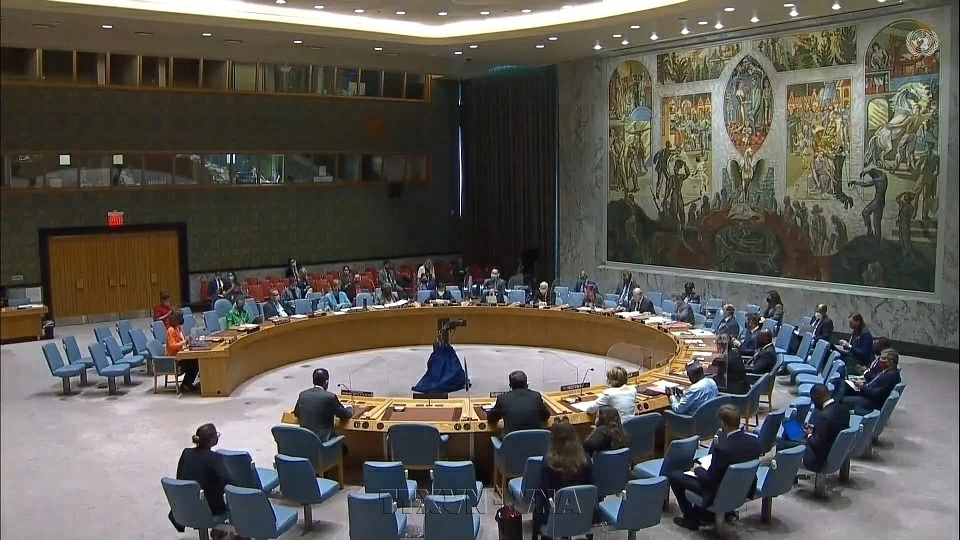 |
| Vietnam participates in discussions at the Security Council on the protection of civilians in conflict, contributing to promoting solutions for international peace and security. In the photo: United Nations Security Council session (New York, 7/2021). (Photo: Huu Thanh) |
Two major lessons
Kanni Wignaraja noted that Vietnam can offer two major lessons to the UN and the international community. The first lesson is to place people, especially the most vulnerable, at the center of all development policies.
The senior UN official stressed that no matter how challenging a country or community's situation is, focusing on the welfare of the people and human security as the core of investment and policy planning will always drive society forward.
From that perspective, a nation can transition from war to peace, from underdevelopment to prosperity, or from climate conflict and injustice to climate equity.
Kanni Wignaraja assessed that Vietnam's experience shows that people-centered development is not just a slogan but must be reflected through specific policies aimed at poverty reduction, expanding access to basic services, strengthening social security systems, enhancing the quality of education and healthcare, and ensuring development opportunities for all population groups.
The second lesson is that a nation does not necessarily have to choose a single goal or a linear development path. In an increasingly complex world, countries need the ability to simultaneously promote multiple goals and maintain a balance between priorities.
She stated that Vietnam has demonstrated this approach by simultaneously strengthening state institutions and public governance capacity, while facilitating the development of the private sector, businesses, and the business community; promoting economic growth while focusing on preserving nature, resources, and biodiversity. According to the UNDP official, this is a valuable lesson as the world faces a series of interwoven crises.
Regarding the need to reform the UN to make it more effective, representative, and responsive to current crises, Kanni Wignaraja suggested that the first question should be what the reform aims to achieve and what results it will bring to the people. Once the desired outcomes are clearly defined, changes in the apparatus, coordination methods, or operational mechanisms can be designed in the right direction.
She recalled the “Delivering as One” model, which Vietnam was one of the pilot countries to implement about 15 years ago. This model aims to increase cohesion, efficiency, and unity in the activities of UN organizations at the national level, avoiding resource dispersion and program overlap.
According to Kanni Wignaraja, the lesson from Vietnam is that reforms need to be flexible, adaptable to the context, needs, and development priorities of each country, rather than being designed according to a centralized model applied to all. The UN needs to establish common principles and “safety corridors,” but must create space for solutions to change in line with the realities of each country.
Referring to Vietnam's roadmap for implementing the Sustainable Development Goals (SDGs) from now until 2030, Kanni Wignaraja particularly emphasized the crucial role of the youth. The Asia-Pacific region currently has about 700 million people aged 16 to 24, a generation better educated and more connected than previous ones.
However, she noted that opportunities for young people are shrinking, while their aspirations, expectations, and ambitions are growing. The gap between the youth's education level, connectivity, expectations, and actual job and development opportunities can lead to disappointment, erode trust, and affect social stability.
Kanni Wignaraja also noted: “Vietnam is entering a phase of population aging. Therefore, development needs to be viewed across the human lifecycle, from children, youth, working-age individuals to the elderly. A major priority is ensuring that each person throughout their entire lifecycle has access to opportunities and can realize their aspirations.
Therefore, increasing investment in healthcare and innovating education to meet the demands of new jobs—instead of maintaining the old educational model from 20 years ago—is another important priority.”
Kanni Wignaraja stated that UNDP and the UN will continue to support Vietnam in strengthening development foundations, while Vietnam brings its experience, resources, voice, and growing responsibility to contribute to the international community. It is a mutually beneficial relationship.


