



University of Economics Ho Chi Minh City – From Sustainable University to Urban Innovation Hub
Universities today cannot stand apart from the major challenges facing contemporary cities and society. Climate change, transformation of growth models, innovation, social inequality, and ecological degradation pose complex problems that far exceed the problem-solving capacity of any single discipline or organisation.
Latest
In this context, the University of Economics Ho Chi Minh City (UEH) has chosen a transformative path: developing the University–City Innovation Hub model, where the university is not merely a space for training and research, but becomes a knowledge infrastructure and co-creation platform for the sustainable development of the city and region.
From a 50-Year Foundation to New Development Requirements
After nearly half a century of establishment and development, UEH has affirmed its position as one of Vietnam's key higher education institutions, internationally integrated, with academic prestige and a global partner network. UEH not only trains high-quality human resources for the country but also contributes increasingly to applied research, policy consulting, and innovation.
In October 2023, the Prime Minister signed a Decision to convert the University of Economics Ho Chi Minh City into a University. This was not merely a legal milestone but also established new requirements for the institution's development model, governance, and social role in the context of globalisation and sustainable development.
With the educational philosophy of "Academic pioneering, serving society, promoting innovation, and orienting toward sustainability," UEH has established a vision to become a multidisciplinary university that acts sustainably, aiming to be among the leading university groups in Asia with global influence by 2045. Rather than pursuing purely quantitative growth in scale or rankings, UEH has chosen a development path based on social impact, where knowledge is validated through concrete contributions to sustainable development.
The world is entering a period of profound transformation, where economic, social, environmental, and technological issues are closely intertwined. These challenges cannot be solved through single-discipline thinking or within the scope of a single organisation. In this context, higher education needs to shift from a role of knowledge transmission to an active agent of development, co-designing and piloting new solutions with government, businesses, and communities.
From this requirement, UEH is gradually transitioning from the "sustainable university" model to a role of coordinating the urban–regional innovation ecosystem, by inheriting internal strengths, accumulating experience, and expanding cooperation rather than making abrupt or superficial changes.
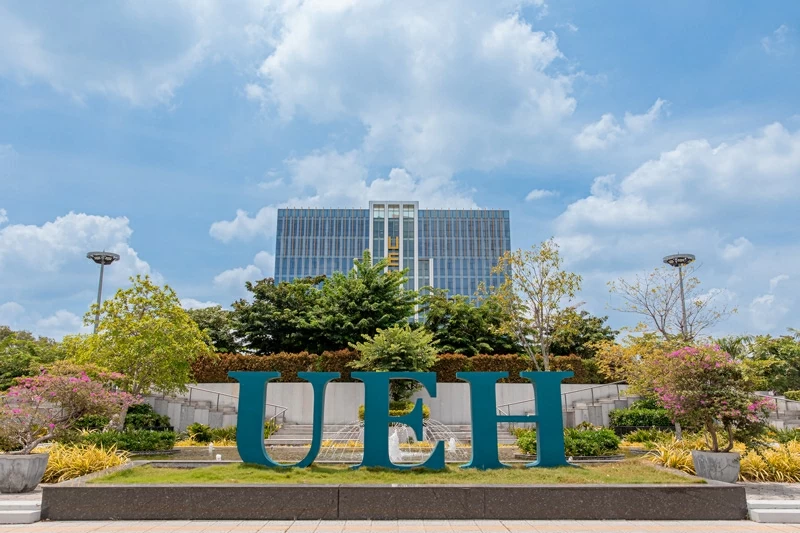 |
The Roadmap of Inheritance: From Internal Strengths to Broader Impact
During the 2021–2025 period, UEH focused on laying the foundation for a multidisciplinary, sustainable university, strengthening autonomous governance, enhancing the quality of training and research, and implementing green initiatives on campus.
During the 2026–2030 period, UEH will expand learning and research spaces beyond the classroom, operating the university as a sustainable learning city where people, technology, and community interact in a real-world environment.
From 2030 onward, UEH will gradually assume the role of the nucleus of the urban–regional innovation ecosystem, integrating knowledge, policy, technology, and environmental requirements within a unified operating model. The University–City Innovation Hub is formed through a development roadmap characterised by inheritance and long-term accumulation.
University–City Innovation Hub: The University as the Foundation of the Urban–Regional Innovation Ecosystem
The University–City Innovation Hub is a next-generation university model in which UEH is positioned as the coordinating nucleus of the urban–regional–global innovation ecosystem. The university not only generates knowledge but also activates development transformation processes through connections among academia, policy, business, community, and the natural environment.
In this model, UEH serves as the nucleus of a creative, digital, green, and humanistic zone, creating bridges between:
- Academia – economics – governance – technology – entrepreneurship – culture – arts – urban development.
- Physical space (green–smart university campus, open library, living laboratories...) and digital space (digital platforms, open data, smart analytical tools).
- Employment-oriented education transitioning to co-creative education and innovative entrepreneurship – where learners become job creators, social innovators, and creative entrepreneurs.
Five Pillars of the University Connected with the City
UEH's University–City Innovation Hub operates based on five strategic pillars: Training – Research – Operations – Governance – Community. Training shifts toward smart, personalised, and lifelong learning, connected to both global and local contexts. Research is moving toward knowledge-to-impact, creating policies, solutions, and science–technology startups. Campus operations become an urban-scale living lab for green solutions and the circular economy. Governance is based on data and digital platforms, moving toward co-governance. Community serves as a space for nurturing culture, arts, and social innovation.
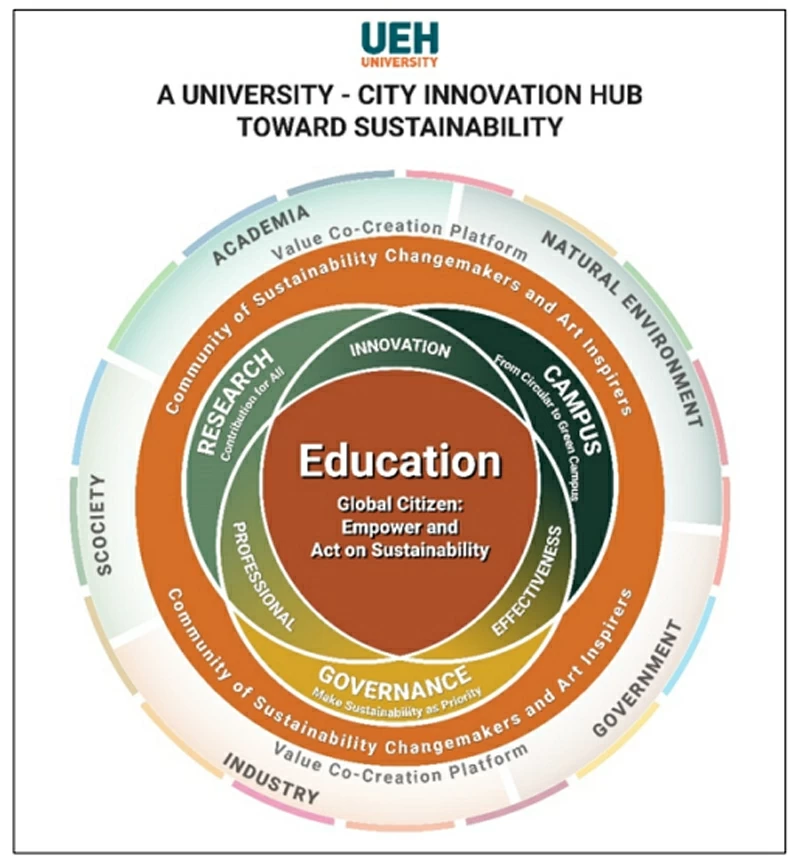 |
| UEH City University Hub Model (Source: UEH) |
Multi-Stakeholder Cooperation and Mechanisms for Driving Innovation
The UEH model is built on the Quintuple Helix principle, emphasising cooperation among the university, government, businesses, community, and the natural environment. UEH maintains the coordinating role, creating conditions for all parties to co-design, pilot, and scale solutions in real-world contexts.
The knowledge–innovation flywheel mechanism creates a continuous development spiral: learning experiences generate initiatives; initiatives are tested in living labs; impact results feed back into policy and local development; this, in turn, attracts additional resources and continues to nurture education, research, and innovation.
The University–City Innovation Hub marks UEH's strategic transition – from a multidisciplinary, sustainable university to an open urban innovation platform, where the university becomes knowledge infrastructure and the "coordinating brain" for development. In its role as the nucleus connecting academia, policy, business, community, and nature, UEH is contributing to shaping a new approach for Vietnamese higher education: universities do not stand outside the flow of development but accompany the city and society in creating a sustainable future.

| Ho Chi Minh City residents enjoy Liverpool culture in the heart of the city Recently, the city of Liverpool, in collaboration with the British Consulate General in Ho Chi Minh City and the British Council, brought the Liverpool cultural ... |
| Van Lang University: A lasting partnership with the EU Over the past 35 years of cooperation between Vietnam and the EU, education has consistently been one of the most enduring pillars, where knowledge transcends ... |
| 14th National Party Congress: Harnessing intelligence, unity, and innovation as the foundation for Ho Chi Minh City's new development phase WVR - The 14th National Congress of the Party takes place at a particularly significant time: the nation marks 40 years of persistent innovation, with ... |