





Should children be taught about AI or by AI?
The UAE has made AI a mandatory subject from kindergarten to grade 12, but what stands out is not just this forward-thinking decision, but also how the nation integrates technology into classrooms without replacing children's critical thinking. Experiences from Singapore, China, and Korea show that the race to incorporate AI into education is not merely a technological competition but a balancing act between innovation, learning capacity, child development, and school responsibility.
Latest
This past September, in a classroom for 7- to 8-year-olds in the UAE, students explored the Stone Age through a lesson that combined traditional methods and technology. They read and wrote about cave paintings and then used virtual reality (VR) glasses to explore historical images and spaces.
Henry Price, the founding principal of Rugby School Dubai, hopes that in the future, students can approach ancient Egyptian history in a similar way: reading materials, creating art, exploring pyramids in a virtual environment, and even using AI to ask questions and simulate dialogues with historical figures.
However, Price emphasizes not the enticing technologies that can be brought into the classroom, but the purpose of using them. According to him, AI does not replace reading, writing, exchanging ideas, or creating; it helps expand learning experiences. The school aims to cultivate students who use technology to ask better questions, rather than passively receiving answers from machines.
This is also the spirit of the UAE's AI education policy. The Gulf nation recently became the first to make AI a mandatory subject in the education curriculum from kindergarten to grade 12. However, introducing AI in schools does not mean giving children free rein with technology. Instead, the UAE is working to develop a controlled approach, appropriate for each developmental stage, in which understanding technology, recognizing its limits, and maintaining independent thinking are emphasized alongside the use of AI.
 |
| Should children be taught about AI or by AI? |
Introducing AI into Classrooms Does Not Automatically Innovate Education
The debate over AI in education is increasingly polarized. Some countries consider equipping young people with AI knowledge early on as essential for adapting to the future. Others worry that technology could impair concentration, independent thinking, mental health, and foundational skills if children are exposed too early or without guidance.
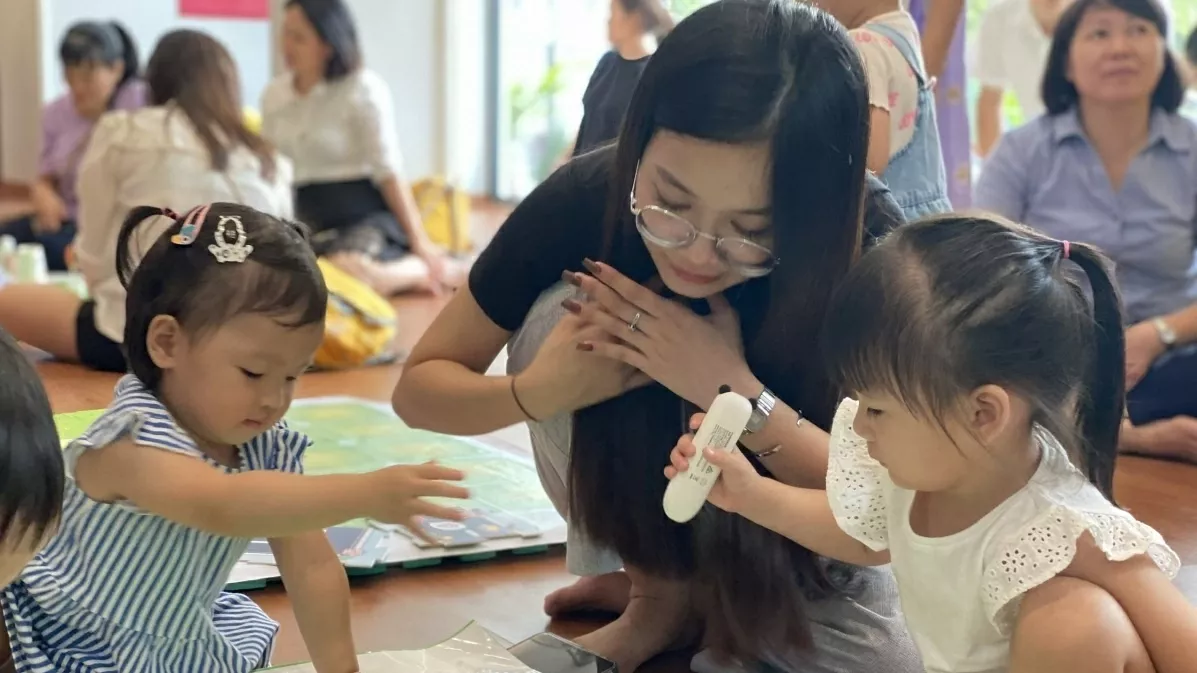
The UAE opts for a proactive approach. At Dubai Schools Al Khawaneej, students in grades 1 to 3 are not required to use generative AI independently. Instead, teachers use storytelling, interactive activities, discussions, and role-playing games to help children understand how technology works.
In one lesson, a teacher might present an example of an incorrect or biased AI response and ask students to identify and analyze the issue. In another activity, the teacher plays the role of a robot, requiring students to give increasingly specific instructions to complete a task. Through this, children learn that machines respond only to the information and guidance provided and become aware of technology's limitations.
Most schools in the UAE are approaching AI as a foundational skill, similar to reading comprehension or numerical reasoning, rather than focusing on intensive technical training.
This approach highlights a notable distinction: AI education does not necessarily begin with children using chatbots or content creation tools, but can start by helping them understand what AI is, how it works, why it sometimes gives incorrect answers, and why humans should not automatically trust what technology produces.
Dubai is developing a broader policy framework on digital technology and AI in education, with a 10-year roadmap to prepare students for the rapid technological changes, including personalized learning approaches.
Saeed Kharbash, CEO of Policy, Research, and Programs at the Knowledge and Human Development Authority (KHDA) in Dubai, emphasizes that technology integration must align with children's development, support meaningful learning processes, and not detract from direct, non-digital experiences essential to their growth and health.
This is particularly important as AI increasingly has the potential to replace tasks considered core to the learning process: writing an essay, solving a math problem, summarizing a document, or searching for information. If technology is used to circumvent every challenge students face, the effectiveness of learning may no longer align with the convenience AI offers.
Singapore: AI by Age, Teachers as Guides
Singapore serves as a noteworthy case by not choosing an extreme approach between encouraging AI use and restricting technology.
According to the Singapore Ministry of Education's direction, AI use in schools is implemented in stages, with varying levels of access and supervision. Younger students are prioritized for activities appropriate to their cognitive abilities, while the direct use of AI is gradually expanded at higher education levels.
In its educational transformation program through technology, Singapore places AI within a digital learning ecosystem rather than viewing it as an independent tool. Platforms are designed to support personalized learning, provide feedback to students, and assist teachers, while maintaining safety, privacy, and educational goals.
In Singapore, students are guided to learn about AI, how to use AI, alongside AI, and beyond AI's limitations. This approach emphasizes that AI is both a subject to understand and a tool to use, but not a means to replace the entire learning process.
One of the principles Singapore focuses on is using AI under teacher guidance, distinguishing between tasks where AI can be used and assignments that require students to demonstrate their abilities independently.
In assessments that require students to independently demonstrate their knowledge, the use of AI may be restricted or prohibited. Conversely, for tasks where technology use is allowed, schools need to clarify the scope, usage, and require students to take responsibility for their learning products.
This direction helps avoid an increasingly apparent risk in education: students may complete assignments faster and produce more polished products, but their actual capabilities may not be enhanced.
Singapore demonstrates that AI can be introduced into schools through a roadmap, with teacher supervision and clear rules, rather than relying solely on students' access to technology.
China: Building AI Capacity from Primary Education
While the UAE focuses on mandatory AI programs and Singapore emphasizes age-based controlled access, China is moving towards building AI capacity in primary education on a large scale.
In December 2024, the Chinese Ministry of Education issued guidelines to enhance AI education at primary and secondary levels. According to these guidelines, AI education is integrated into the curriculum at various levels: younger students become familiar with AI and develop initial awareness; older students explore and use technology; and high school students are encouraged to participate in applications, creative activities, and practical projects.
The guidelines also encourage integrating AI content into information technology, science, practical activities, and extracurricular programs, while promoting problem-based learning projects to help students develop thinking, problem-solving, and creative abilities.
Notably, China not only focuses on students but also on building a team of AI-capable teachers, developing educational resources, and strengthening connections among primary schools, universities, research institutes, and technology companies.
In Beijing, according to information released in 2026, high school students are required to participate in at least 8 hours of AI education each year. Some schools in Shenzhen also conduct regular AI activities, where students not only learn to use large language models to solve problems but are also encouraged to test, evaluate, and verify answers from various sources.
The Chinese model shows that AI education can be built into a comprehensive system, linked with the curriculum, teacher training, technological resources, and innovation capacity development.
However, large-scale implementation does not automatically equate to quality. The challenge remains in how AI content is designed, whether teachers have the capacity to implement it, and whether students truly develop the necessary skills rather than merely becoming familiar with the tools.
Republic of Korea: Lessons from a Rapid Deployment
Contrary to proactive AI education models, the Republic of Korea's experience highlights the risks when technology is deployed widely before necessary conditions are fully prepared.
In 2025, the Republic of Korea implemented AI-integrated digital textbooks to personalize learning, tailor content to each student's abilities, reduce teacher workload, and enhance educational effectiveness. The program was designed to gradually expand within the public school system.
However, the rapid deployment faced numerous reactions. Teachers, students, and parents reported issues related to technical errors, content quality, information accuracy, data privacy, screen time, and workload.
Some teachers argued that the tools did not meet quality standards, while students struggled to maintain focus and use personalized features effectively. The deployment also sparked debates about teacher preparation, infrastructure, and the extent to which learning outcomes were verified.
Following these debates, the Republic of Korea's National Assembly approved adjustments, shifting AI-integrated digital textbooks from being official textbooks to supplementary educational materials, making their use a choice for each school rather than a mandatory widespread requirement.
The Republic of Korea's experience does not mean AI is unsuitable for education. On the contrary, it shows that a technology with great potential can still fail if the deployment speed exceeds the education system's preparedness.
Educational innovation requires not only technology but also experimentation, evaluation, training, teacher and parent consensus, and adjustment mechanisms when outcomes do not meet expectations.
When AI Does Homework Better, Do Students Learn Better?
A major question facing education systems is whether the use of AI truly improves learning capacity or merely helps students complete tasks faster.
Data from the OECD's Program for International Student Assessment (PISA) shows that generative AI has become a familiar tool in learning in many places. 52% of surveyed students reported using AI chatbots to draft text for writing assignments at least once a week, at least twice a week, or daily, according to PISA data analysis published by the OECD in October 2026.
However, the data also shows that the relationship between AI use and learning outcomes is not straightforward. In some cases, students who frequently use AI chatbots for specific learning tasks achieve lower academic results than those who do not, but this does not prove that AI is the direct cause. Students struggling with learning may also be the group using AI more.
The OECD suggests that AI can support learning when used purposefully, at an appropriate level, and with guidance. Conversely, excessive or unguided use may lead students to reduce meaningful engagement in the learning process, transfer cognitive tasks to technology, and limit opportunities to develop thinking skills.
The concern is not whether students use AI, but what they use AI for.
If AI helps explain a difficult concept, provides suggestions to help students solve problems independently, gives feedback on reasoning, or helps identify unclear points in writing, it can become a learning support tool.
But if AI writes the entire essay, solves math problems, or replaces the process of exploring, analyzing, and expressing oneself, convenience may come with the risk of weakening the skills education aims to develop.
AI can help students create a complete piece of writing, but that piece does not necessarily reflect the learner's reading comprehension, reasoning, or creativity.
Therefore, the boundary between using AI for learning and using AI to avoid learning needs to be more clearly defined at each educational level, subject, and task type.
Teachers, Parents, and Policy: Three Indispensable Pillars
Incorporating AI into education cannot rely solely on providing devices, software, or user accounts. The decisive condition remains human factors and how the education system organizes technology use.
The UAE plans to train 22,000 teachers to use AI in teaching, assessment, program analysis, and lesson planning. In some schools, teachers are provided with instructional materials, command banks, regular updates, and professional support.
Teacher training aims not only to help them learn how to use AI but, more importantly, to choose appropriate use cases, evaluate output quality, identify risks, and ensure AI does not replace core educational tasks.
Parents also need clear information about the tools used, their purpose, data collected, students' exposure time to AI, and child protection measures.
UNICEF, in its 2025 guidelines on AI and children, emphasizes principles such as safety, data protection and privacy, non-discrimination, transparency, accountability, ensuring the best interests of children, and preparing children for the AI world.
These principles show that AI education needs to be viewed within a broader framework of children's rights, human development, and the responsibility of technology providers.
Schools cannot be responsible only for learning outcomes; they must also consider how technology is used, how data is processed, and AI's impact on students' physical, mental, social, and cognitive development.
The Goal Is Not a Generation Proficient in Tools, But a Generation Capable of Thinking
The UAE, Singapore, China, and the Republic of Korea are demonstrating different approaches to AI education. No model can be perfectly replicated across all education systems, as each country has different resources, infrastructure, curricula, teacher teams, and educational cultures.
However, these experiences can suggest some common principles.
AI needs to be introduced into education according to a roadmap suitable for age and cognitive abilities. Teachers must be prepared before or alongside the implementation process. Technology should be evaluated based on actual learning outcomes, not the prevalence or number of tools used. Foundational skills such as reading, writing, arithmetic, reasoning, communication, and creativity need to continue being protected. Meanwhile, data safety, privacy, transparency, and accountability must become essential requirements.
More importantly, AI education should not only aim to create students proficient in using technology. In a world where AI increasingly performs tasks requiring human knowledge and skills, the ability to ask questions, verify information, think independently, be creative, and make responsible decisions will become even more crucial.
AI can help children learn faster, access more knowledge, and explore new learning methods. But if technology is used to replace the thinking process, convenience may become the price paid for cognitive abilities.
The challenge of education in the AI era, therefore, is not how quickly technology is brought into classrooms, but how technology serves human development. The goal is not a generation that can do everything with AI, but a generation knowledgeable enough to use AI, capable enough not to rely on AI, and brave enough to know when to think independently.

| European Overseas Vietnamese build classroom for disadvantaged children in Thai Nguyen WVR - On May 24, in Nghia Ta Commune, Thai Nguyen Province, the State Committee for Overseas Vietnamese, under Ministry of Foreign Affairs (MOFA) in ... |

| Lang Tre in Dong Nai welcomes Japanese friends, spreading love to orphaned children WVR - Exciting football matches, lively badminton games, and the first time making a matcha latte... brought a day full of laughter to 105 orphaned ... |

| Launch of the 'Tieng Viet trong tim con' contest for Vietnamese children in Europe WVR - In response to Vietnam Culture Day on November 24, the Vietnam Cultural Center in France (CCV), in collaboration with the Association of Vietnamese ... |