





Prime Minister chairs Steering Committee meeting, underscores housing development as a key pillar of social welfare policy and driver of growth
WVR - On the morning of November 11, Prime Minister Pham Minh Chinh, Head of the Central Steering Committee on Housing Policy and Real Estate Market (Steering Committee), chaired the third meeting of the Steering Committee, which was held online with 34 provinces and cities nationwide.
Latest
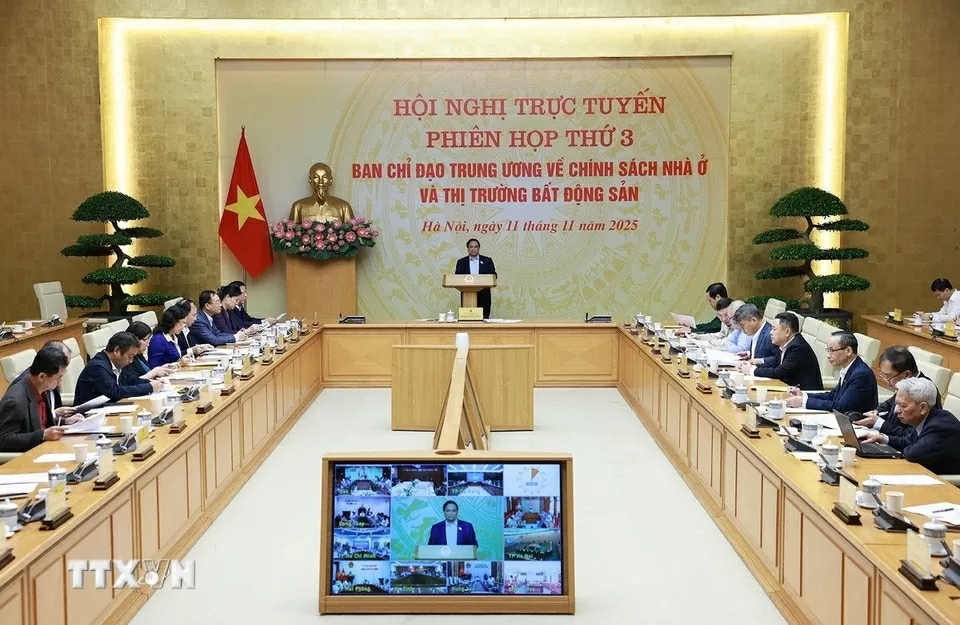 |
| Prime Minister Pham Minh Chinh chairs the meeting of the Central Steering Committee on Housing Policy and Real Estate Market. (Source: VNA) |
The meeting was attended by leaders from ministries, central agencies, associations, businesses in the real estate sector, and leaders from provinces and cities nationwide.
In his opening remarks, Prime Minister Pham Minh Chinh emphasized that the Party and State's stance is to ensure social progress and equity, continuously improving people's lives and guaranteeing citizens' right to housing.
Among these, housing development is a crucial pillar of social welfare policy and economic-social development, with the principle of not sacrificing social progress, equity, and welfare for mere economic growth.
Highlighting that housing policy should be seen as a citizen's right, the Prime Minister made it clear that we are in a phase of acceleration and breakthrough to achieve the economic-social targets for 2025 and the entire term. The real estate market is a vital channel for capital mobilization and allocation, significantly impacting other economic sectors, fostering growth, and contributing to rapid and sustainable national development.
In recent times, the Party, State, National Assembly, and Government have been gradually addressing institutional, legal, capital, and land fund challenges, reducing administrative procedures for projects, and improving the supply of social housing, especially for low-income individuals, workers, and laborers.
The Prime Minister underlined that investment in social housing is considered as a driving force for the country's economic-social development. It is a key task for the 2025-2030 period, serving as a dual lever to address housing needs, ensure social welfare, and promote growth and job creation.
Since the beginning of the term, the Government and Prime Minister have issued 22 Resolutions, 16 Directives, and numerous communications related to the real estate market and social housing, achieving positive results.
Implementing the plan to develop 1 million social housing units by 2030, the country has initiated 696 social housing projects with a scale of 637,000 units, completing 128,600 units. Since the beginning of the year, over 123,000 units have been under construction, with 62,000 completed. Efforts are needed to reach the target of 100,000 units by year-end.
 |
| Leaders of ministries, sectors, and delegates attend the meeting. (Photo: Tran Hai) |
However, the real estate market still faces many difficulties and inadequacies; housing prices, especially in major cities like Hanoi, Ho Chi Minh City, and Da Nang, remain significantly higher than citizens' incomes.
The progress of some social housing projects is still slow, despite the National Assembly's Resolution 201 and the Government's Decree 192 to address challenges.
The allocation of 20% land funds for social housing development in commercial housing projects has not been strictly implemented; some localities have not genuinely prioritized the approval process for purchasing, renting, or leasing social housing, causing public dissatisfaction.
Therefore, relevant ministries and sectors, especially localities, must draw lessons, ensure transparency, and facilitate equal access to social housing, preventing negative occurrences. "The Ministry of Public Security must direct the police force to monitor, intervene, and strictly handle any detected violations of the law," the Prime Minister instructed.
At this meeting, the Prime Minister requested the Ministry of Construction to provide a concise and clear report, based on which ministries, sectors, and localities should review and evaluate the implementation of assigned tasks, highlighting achievements and delays, clarifying responsibilities, especially of leaders, regarding unfinished tasks, difficulties, and obstacles, and proposing solutions.
Regarding the progress of social housing projects, the Prime Minister demanded the Ministry of Construction to report clearly on the investment and construction procedures, reasons for delays, and localities' involvement.
The Prime Minister also mentioned the need to establish a unified national process for investment and construction, from planning, site clearance, and procedural steps, to reduce the preparation time for social housing construction to 3-6 months instead of two years.
On the allocation of clean land funds, the Prime Minister noted that localities have been proactive, but there are not many large enterprises actively proposing to use clean land funds for social housing projects.
He urged enterprises not to always prioritize profit, as we have a responsibility to society, the people, and the poor, emphasizing "national solidarity and community spirit." The Prime Minister directed to identify the root causes, pinpoint obstacles, determine where the Government needs to intervene, and what policies are needed to mobilize and encourage enterprise participation.
Prime Minister Pham Minh Chinh expressed particular concern and called for vigilance, prevention, and elimination of non-transparency, negativity, hoarding, price inflation, speculation, and profiteering in the approval, sale, and rental of social housing.
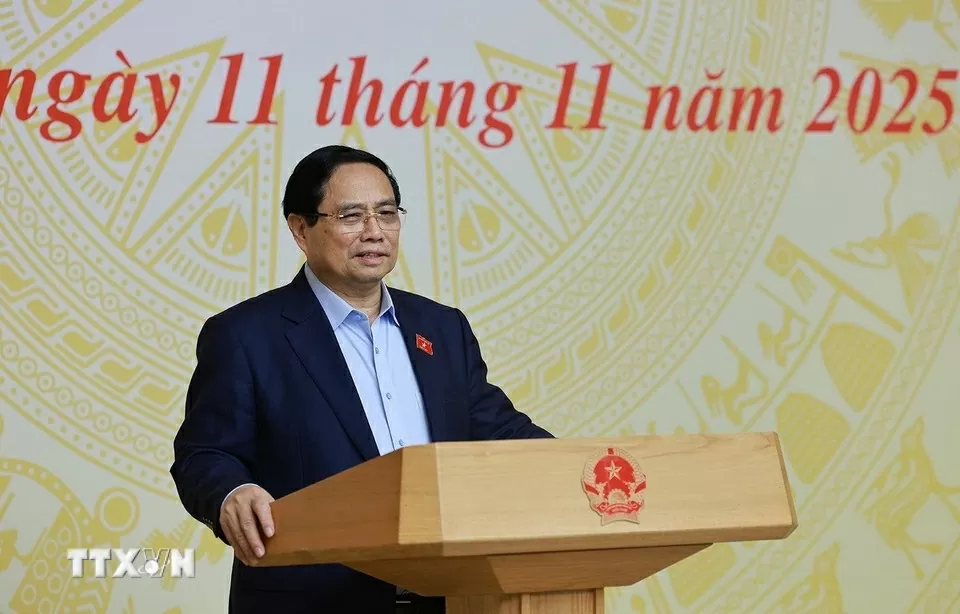 |
| Prime Minister Pham Minh Chinh speaks at the meeting. (Source: VNA) |
The Prime Minister assigned the Ministry of Construction to draft a Directive from the Prime Minister on this issue, urging delegates to provide specific feedback on the draft Directive with a practical approach, "for every policy, there must be ten measures" to ensure effective implementation.
The Prime Minister called on delegates to uphold responsibility, proactivity, creativity, and decisiveness in action, ensuring "six clarities: clear people, clear tasks, clear responsibilities, clear authority, clear timelines, clear results"; speak frankly, truthfully, and accurately about the issues that need resolution. Matters within the Government's authority should be addressed by the Government, those within ministries' authority should be resolved by ministries, and those within localities' authority should be handled by localities...
Alongside this, the development of a healthy and sustainable real estate market contributes to macroeconomic stability and social welfare.
The Prime Minister emphasized that a healthy society requires all activities to be healthy. For housing and real estate policies to be healthy, sustainable, and effectively developed, all related parties must contribute responsibly, with the spirit of a facilitating state, pioneering enterprises, public-private partnership, a prosperous nation, and happy citizens.
According to the Ministry of Construction, the Government and Prime Minister have been attentive and decisive in implementing comprehensive solutions to address difficulties, promptly promoting investment projects, and increasing the supply of housing and real estate across segments, especially social housing.
The real estate market is fundamentally stable, with improved supply, restored investor confidence, increased liquidity, and many social housing projects licensed, commenced, and completed, contributing to meeting citizens' housing needs.
Nationwide, 3,297 projects of commercial housing, social housing, and land plots are being implemented, with a scale of 5.9 million units and a total investment of 7.42 million billion VND; 218 tourism and resort projects, with a scale of 10,800 units and a total investment of 1.86 million billion VND; 223 commercial, service, and office projects, with a total investment of 544.3 billion VND; 447 industrial zones have been established with a total industrial land area of approximately 93,000 hectares.
In recent years, prices for apartments, townhouses, villas, and residential land have increased significantly; the increase in housing and land prices has far exceeded the average income growth, making it more challenging for citizens to access housing and land.
The prices of other real estate types, such as tourism, resort, commercial, office, and industrial real estate, have also increased annually, but at a much lower rate than housing and land prices.
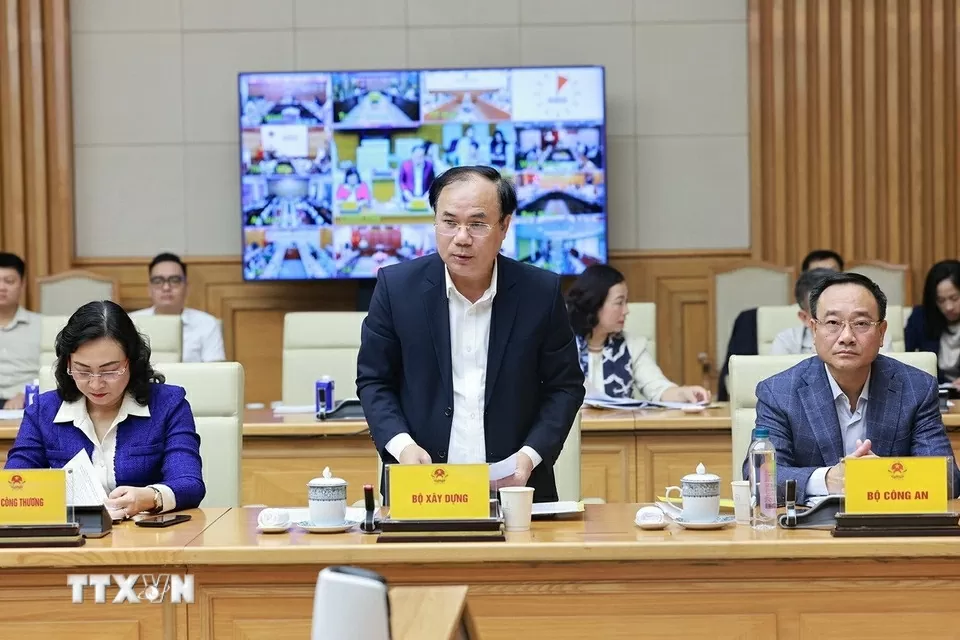 |
| Deputy Minister of Construction Nguyen Van Sinh speaks. (Source: VNA) |
According to reports from 22 out of 34 localities, the real estate inventory in projects during the third quarter is approximately 26,717 units/plots. The inventory of condominium and individual housing types is increasing, at 137% compared to the second quarter of 2025; the land plot type is decreasing at 68.8% compared to the second quarter of 2025.
Regarding social housing development, according to the Ministry of Construction, implementing the 1 million social housing units plan, the country currently has 696 social housing projects underway with a scale of 637,048 units.
Among these, 191 projects have been completed, with a scale of 128,648 units; 195 projects have commenced construction, with a scale of 123,057 units; 310 projects have received investment approval, with a scale of 385,343 units. Thus, the number of completed, commenced, and approved projects by 2025 reaches 60% of the target set in the plan.
To achieve the 2025 goal of building 100,275 social housing units, localities nationwide have commenced 82 new projects with a scale of 89,888 units; 61,893 units have been completed, reaching 62%.
It is anticipated that by the end of 2025, an additional 29,692 units will be completed, bringing the total number of completed social housing units in the year to 91,585/100,275 units, achieving 91%. Among these, 17 provinces and cities are likely to meet or exceed the assigned targets; 13 localities are unlikely to meet the targets.
Ministries and sectors such as the Ministry of Defense, Ministry of Public Security, and Vietnam General Confederation of Labor are also actively participating in developing social housing to meet the housing needs of officers, soldiers, workers, and laborers.
Specifically, the Ministry of Public Security has commenced 8 housing projects for the people's armed forces with a scale of 4,554 units; the Ministry of Defense plans to commence 8 housing projects for the armed forces with a total scale of 6,547 units; the Vietnam General Confederation of Labor has commenced 3 projects, totaling 1,700 units.
Nationwide, approximately 1,427 locations with a scale of 9,830.26 hectares of land have been planned for social housing. Most localities have allocated sufficient land funds for social housing development.
Many localities have prioritized and allocated social housing land in convenient locations, near urban centers and industrial zones, ensuring technical and social infrastructure, such as Dong Nai, Ho Chi Minh City, Tay Ninh, Ha Tinh, and Hue City.