




Lessons from Vietnam: Bringing Khan Academy into the classroom
Following their visit to Tien Thang B Primary and Lower Secondary School in Hanoi and conversations with the Khan Academy Vietnam (KAV) team, Michael and Martha Ho took away experiences and lessons as they explored an education journey taking shape in Cambodia.
Latest
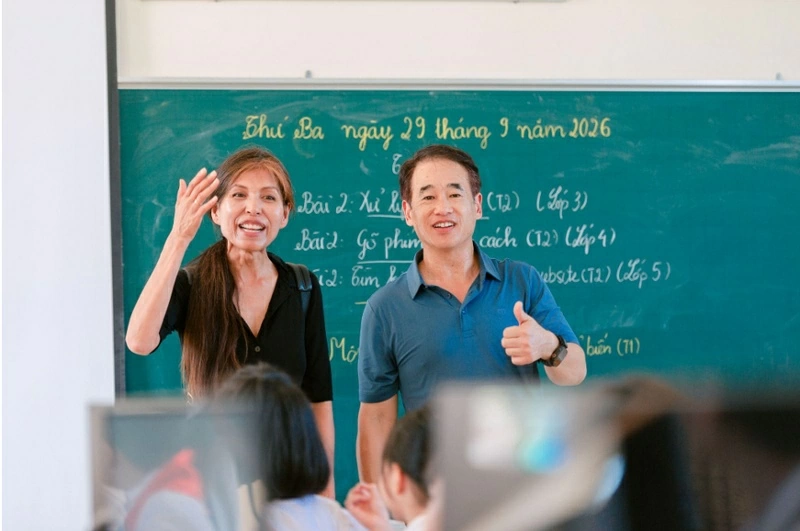
A regular school day at Tien Thang B Primary and Lower Secondary School in Hanoi welcomed two special visitors. Michael and Martha Ho did not come to give a speech or introduce a new program. Instead, they spent time observing students as they learned, talking with teachers, and asking very practical questions: How is Khan Academy being used in the classroom? How have teachers adapted to it? And what helps an online learning platform truly become part of teaching and learning?
As two Americans who share a strong belief in the power of education, Michael and Martha are learning from their experience implementing Khan Academy in Vietnam as they embark on a new educational journey taking shape in Cambodia. Their visit to Tien Thang B and their conversations with the Khan Academy Vietnam team were, therefore, more than a school visit. They offered an opportunity to see what is happening inside a real school, listen to the people directly involved, and learn lessons that may be relevant in a different context.
A School where everyone is learning and growing
What delighted Michael and Martha most during their visit was seeing students learning firsthand and witnessing their enthusiasm and eagerness to learn.
During a conversation with the students, Michael asked what subjects they enjoyed most. Their answer was simple: Math and English. For Michael, their answers, along with the students’ enthusiasm during class, were among the moments that left the strongest impression on him.
At Tien Thang, however, learning is not only a journey for students.
 |
| Lessons from Vietnam: Bringing Khan Academy into the classroom |
Speaking with Michael and Martha, Mr. Nguyen Quoc Viet, Principal of Tien Thang B Primary and Lower Secondary School, shared that strengthening students’ English skills also requires teachers to continuously learn and develop themselves. English teachers at the school not only teach their own classes but also support their colleagues in learning English, share knowledge, and collaborate to create vocabulary notebooks to encourage daily English practice.
The school is also developing plans to introduce bilingual classes starting this school year, including subjects such as Math–English. The goal is to create an environment where students can not only learn a foreign language as a subject, but also have opportunities to use it in real learning activities.
The conversation with the principal also helped Michael better understand the challenges facing the school and how Tien Thang is preparing for changes in teaching and learning. He was particularly impressed by the way the school sees digital platforms, English proficiency, and the Math curriculum as elements that can work together to support students’ development.
But what moved Michael most were the students' faces. Seeing them learn firsthand and hearing the KAV team speak about their passion and commitment to education gave him a deeper appreciation for the people behind an education program.
For Michael and Martha, the visit therefore offered more than a glimpse of a platform in use at a school. It showed them an educational environment where students, teachers, and the school itself are all learning and changing together.
From Vietnam, lessons that can travel further
What Michael and Martha saw at Tien Thang was also part of a larger question they came to Vietnam to explore: What happens after an education initiative is introduced into a new context?
Khan Academy was developed in the United States, but its journey in Vietnam has shown that an educational platform cannot simply be introduced into schools as a technological tool. To be effective, it needs to be grounded in the realities of the school, work alongside teachers, and respond to students’ specific needs.
These were among the experiences the Khan Academy Vietnam team shared with Michael and Martha during their discussions. Drawing on its experience in Vietnam, KAV has gained a deeper understanding of the questions to consider when starting an educational journey in a new country: What does the education system need? What kind of support do teachers need? What challenges are students facing? And where can technology help address those needs?
For Michael and Martha, this is the value of coming to Vietnam and learning from on-the-ground experience. Rather than simply studying a product or an existing model, they had the opportunity to see how an education platform is integrated into a school, listen to the people directly involved, and observe the impact from the students’ perspective.
These experiences are not a model to be copied exactly. Every country has its own education system, language, and needs. But questions about how to begin, how to work alongside teachers, and how to ensure technology truly serves learning can offer valuable lessons in many different contexts.
Vietnam itself has learned from education innovations developed elsewhere. Today, the experience accumulated from implementing Khan Academy in Vietnam can, in turn, serve as a learning resource for other educational communities.
The Next Journey Taking Shape
Michael and Martha came to Vietnam before continuing their journey to Cambodia, where they plan to learn more about the needs of the education system and explore possibilities for bringing Khan Academy to students in Khmer.
Their visit to Tien Thang and conversations with KAV were therefore not an endpoint, but part of a broader process of learning and preparing for a new journey.
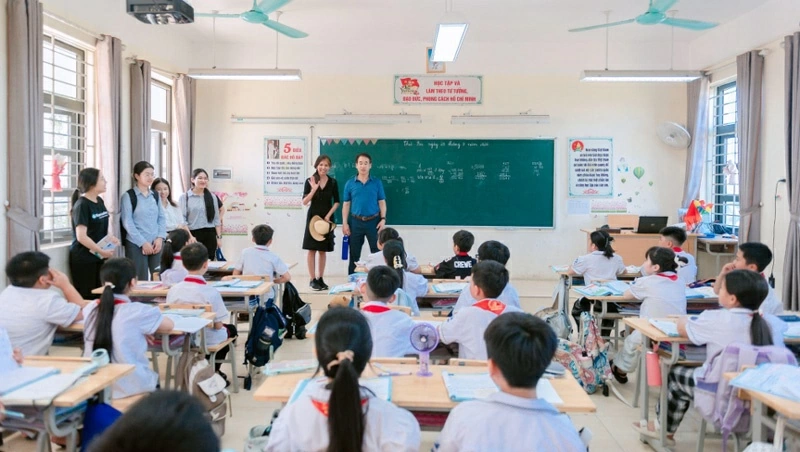 |
| Khan Academy implementation insights paving the way for a new journey. |
From a classroom in Hanoi, questions about teachers, students, technology, and how an education platform can truly become part of a school opened up broader conversations about education in another country.
Reflecting on the visit, Michael shared that what impressed him was not only what the school was doing, but also the people he met. Talking with the principal and hearing firsthand about the school’s challenges, seeing the students in their classroom, and listening to the KAV team speak about their work gave him a stronger sense of a community genuinely dedicated to education.
These experiences led Michael and Martha to see Vietnam as a place with much to learn from before continuing their journey in Cambodia. For them, what they witnessed here showed that when technology meets people who truly believe in education, ideas can begin to take shape as meaningful changes in the classroom.
The education journey taking shape in Cambodia is still ahead. But from Vietnam, lessons are already being shared not to replicate a model, but to explore together what may work best for students, teachers, and schools in another place.
Perhaps this is one of the ways an education idea can travel further: beginning in a classroom, nurtured by people who believe in education, and carried forward by those willing to learn from one another.
Michael described Vietnam as a “good place, good soil” for investing resources to help the Cambodian people. The visit to Tien Thang offered a glimpse of why: a community of students eager to learn, teachers willing to grow, and people committed to making education more accessible and meaningful.
| Havina Group: Expanding the boundaries of the classroom Modern education must answer the questions of what learners need to know, where they will study, with whom they will work, and how they will ... |
| Bringing the Mid-Autumn Festival flavour to every child in Japan WVR - On September 27, in Kobe City, the Vietnamese Association in Kobe, in collaboration with various agencies, units, and community organizations, organized the 2026 ... |


