


Havina Group: Expanding the boundaries of the classroom
Modern education must answer the questions of what learners need to know, where they will study, with whom they will work, and how they will enter the world. From this approach, Havina Group is choosing a path: building connections between schools, businesses, and international education to extend the value of learning beyond the classroom.
Latest
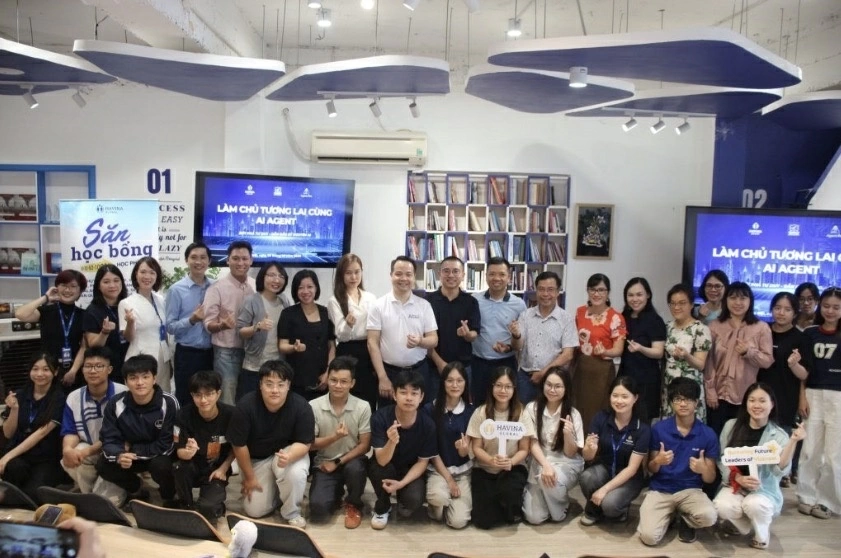 |
| On May 29, 2026, the University of Languages and International Studies - Vietnam National University, Hanoi (ULIS) collaborated with Havina Group to organise the seminar “Mastering the Future with AI Agent”, which was attended by students, lecturers, experts, and business representatives. |
On May 29, 2026, the University of Languages and International Studies - Vietnam National University, Hanoi (ULIS) collaborated with Havina Group to organise the seminar “Mastering the Future with AI Agent”, which was attended by students, lecturers, experts, and business representatives. Here, students not only learned about rapidly developing technology but were also faced with a question closely related to their professional lives: as AI changes the way humans work, which skills will become more important?
Mr. Nguyen Van Dung, the founding Chairman and CEO of Havina Group, also participated in discussions with experts.
This was not only a discussion about AI but also an opportunity for students to get closer to businesses. Two seemingly different activities meet at one point: preparing learners for a journey that does not end at the classroom door.
At the beginning of 2026, Havina Group signed an MoU with GLA Human Resource Solutions Co., Ltd. and Respect Vietnam Co., Ltd. to implement the S2M (School to Market) program. The program aims to help students access businesses through internships, real-world projects, and career experiences, including fields such as electronics, microchips, and semiconductors.
If AI raises questions about future skills, S2M starts with a closer issue: the gap between the knowledge students learn and the needs of businesses.
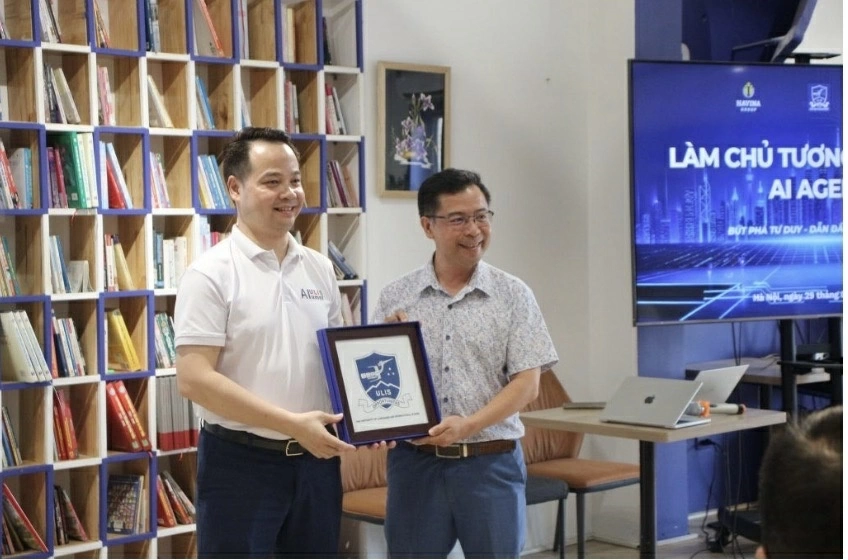 |
| Mr. Nguyen Van Dung, the founding Chairman and CEO of Havina Group (left), also participated in discussions with experts at the “Mastering the Future with AI Agent” program. |
When learning steps out of the classroom
For many years, education has often been envisioned as a clear journey: study, graduate, and then work. However, the rapid changes in technology and the labour market are blurring those boundaries.
A profession can change in just a few years. New jobs emerge with new technologies. Skills once considered advantageous can quickly become common requirements. Therefore, young people need not only a foundation in knowledge but also the ability to adapt, continue learning, and familiarise themselves with the professional environment early on.
Resolution 71-NQ/TW of the Politburo on breakthroughs in education and training development, issued on August 22, 2025, emphasises the need for “learning to go hand in hand with practice”, “theory linked with reality”, and “schools connected with society”; it also encourages expanding cooperation and links between educational institutions and organisations and businesses both domestically and internationally. The resolution also calls for promoting the application of digital technology and artificial intelligence in education and strengthening the connection between schools and businesses to meet workforce demands.
Havina's S2M is positioned right at the intersection between schools and the market.
On January 10, 2026, when signing the cooperation agreement to implement S2M, Havina and its partners set a goal of establishing a long-term connection mechanism among schools, businesses, and students. Internships, real-world projects, and business experiences are integrated into career preparation rather than waiting until students complete their studies.
The “School to Market” concept is therefore not too distant; it shortens the path from the classroom to the workplace, allowing students to understand earlier what businesses need and what they are suited for.
This story is also tied to the relationship between Havina and ULIS, where Mr. Nguyen Van Dung is an alumnus of the English Faculty at ULIS. According to the school, he participated in activities aimed at developing soft skills and helping students find jobs. This relationship has been maintained over the years, including career orientation programs, scholarships, and recruitment.
In October 2024, Havina Group and ULIS jointly organised a programme to award scholarships, conduct career orientation seminars, and hold recruitment interviews. Mr. Dung personally introduced career opportunities within the Havina ecosystem and discussed career orientation, scholarships, and personal development with students.
At that time, the school was not just a place for training but also a business; businesses did not only appear at the end of the journey to recruit people. Both sides met earlier, while students were still studying and had time to adjust their skills, choices, and career expectations.
This is also how an education story begins to transition into a career story.
From a language class to a wider world
If connecting with businesses helps learners look more closely at their career futures, international education opens up a broader space.
Havina Group was established in Singapore in 2011 and later expanded its operations to Vietnam. From language training, the organisation has expanded into career orientation, international education consulting, scholarships, internships, and job placement.
Havina Global currently has a network of partnerships with over 1,000 universities worldwide, providing services related to major selection, scholarships, study abroad, and career orientation.
In this approach, studying abroad is not a separate destination.
Before departure, a student needs to know what they want to study, which environment suits them, and what they will do afterwards. Language skills, major selection, school choice, scholarships, adaptability, internships, and career opportunities can all be part of the same journey.
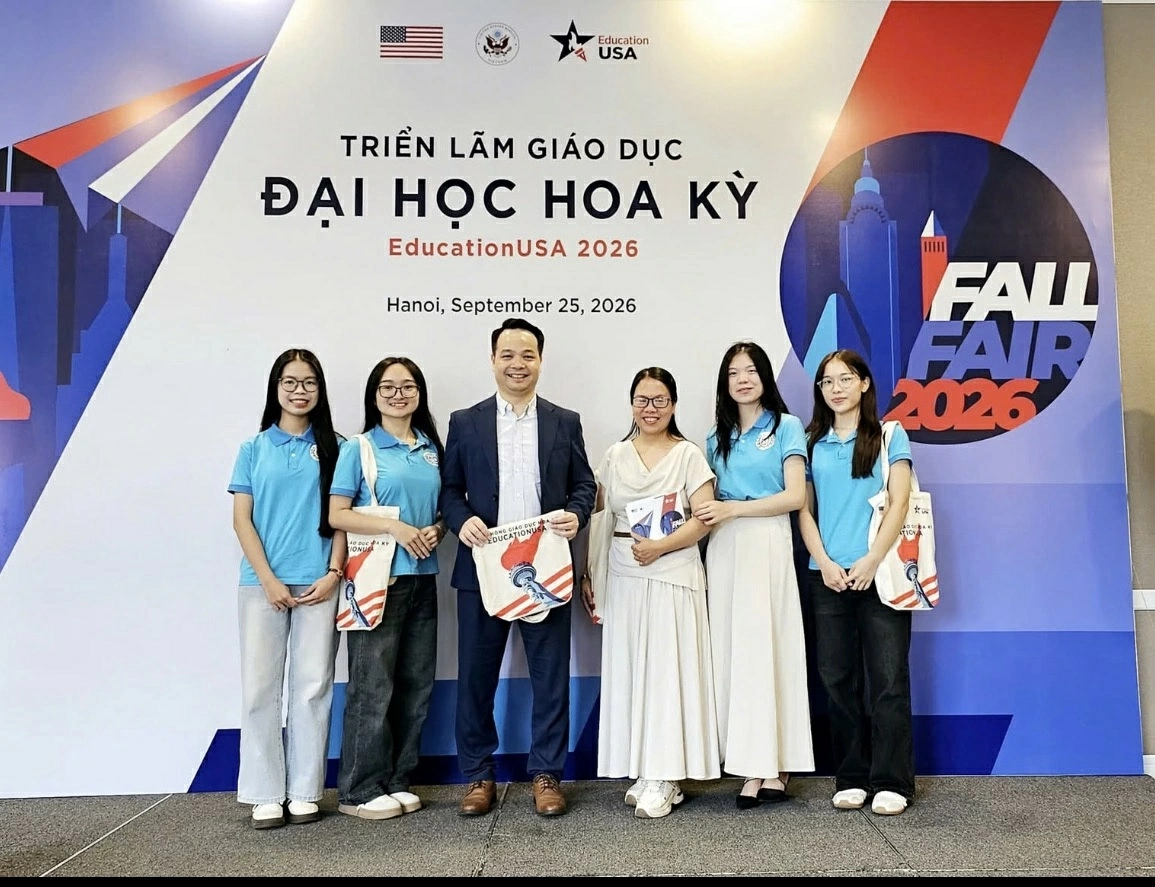 |
| On September 25, Havina participated in the U.S. Higher Education Fair - EducationUSA 2026 in Hanoi, where students and parents had the opportunity to meet representatives from 60 universities and colleges in the U.S. |
In September 2026, Havina Global representatives participated in international recruitment events, working with representatives from schools and educational organisations from various countries to update information on admissions, majors, and educational trends for the 2027 recruitment season. On September 25, Havina participated in the U.S. Higher Education Fair - EducationUSA 2026 in Hanoi, where students and parents had the opportunity to meet representatives from 60 universities and colleges in the U.S.
These activities place Havina in a broader position than a mere study abroad consultancy. Learners gain access to additional information, opportunities, and international education options, while the learning story is situated in relation to their subsequent career path.
This approach also meets the requirement for international integration in Vietnamese education. Resolution 71 emphasises developing education in a harmonious way between national and global dimensions, absorbing the quintessence of humanity and international standards, and training Vietnamese citizens capable of integration.
But perhaps more noteworthy than the numbers or programs is the underlying question: how can what young people learn today become a toolkit for the world they will enter tomorrow?
The founder and the journey back to the classroom
There is an interesting circle in the journey of Havina Group's Chairman Nguyen Van Dung: from the ULIS classroom, he entered the field of education; then, many years later, he returned to those classrooms, this time on the other side of the lectern.
He built Havina Group and continued to connect his activities with education, career orientation, and employment. When returning to ULIS, he was no longer a learner but someone sharing with students about careers, technology, and the opportunities ahead.
In Havina's Career Orientation Semester program, Mr. Dung is introduced as a business management expert, alongside experts from various fields. The program aims to help students understand themselves, explore careers, engage with the business environment, and develop the skills necessary for their future paths.
At the AI Agent program at ULIS in May 2026, Mr. Dung again appeared with technology experts to discuss with students.
These returns to the classroom create a natural flow in his journey: from a learner entering education, then from education back to learners, but in a different role – the role of a connector.
Perhaps from this, one can better understand how Havina builds its activities.
Language training, career orientation, studying abroad, internships, employment, or technology programs do not necessarily have to be separate segments. Learners can be part of the same journey. A student learning a language can start thinking about a career. A student looking for an internship can better understand what they want to do. Someone preparing to study abroad may simultaneously have to choose both a career and a future work environment.
Behind these choices is an increasingly clear requirement: adaptability.
After more than a decade of development, Havina now presents itself as an ecosystem of education and careers, with activities ranging from language training and career orientation to international education, internships, and employment, along with a network of over 30 training centres and offices domestically and internationally.
But perhaps more noteworthy than the scale is the position Havina chooses.
Not standing in for schools, not standing in for businesses, and not just stopping at sending learners abroad. Havina seeks to stand in the middle.
There, a university can meet a business; students can meet employers; students can access international universities; learners can hear directly from those working in the fields they are interested in.
AI, S2M, or international education, viewed from different angles, all return to one question: how should young people be prepared to enter their own world?
This question becomes clearer as AI enters education and technology continues to change how people learn and work. In this context, connections between schools, businesses, and external educational resources become even more significant.
More than 15 years after its establishment in Singapore, Havina has evolved from language training into a broader ecosystem of education, career orientation, and career connections. This story is closely tied to the journey of founder Nguyen Van Dung – an alumnus returning to the classroom, but in the role of an educator and connector.
A language class may start with just a lesson. But behind that lesson could be a major, a scholarship, an internship, a job, or a journey into the world. For Havina, perhaps the value of education lies in those very connections – where what young people learn today begins to meet what they will do tomorrow.
| Stavian Group launches the CSR project 'Nurturing hope – Building the future', donates STEM classroom and medical equipment in Bac Ninh province On August 20, Stavian Group, in collaboration with the Vietnam Academy of Science and Technology (VAST) and local authorities, donated a STEM classroom and essential ... |

| Stavian Group honored in the Top 155 of VNTAX 200 and Top 69 of PRIVATE 100 in 2026 7 September 2026, Stavian Group was honored to be ranked among the Top 155 largest taxpayers in Vietnam (VNTAX 200) and the Top 69 largest ... |
Tags: