




Heritage becomes a bridge connecting Quang Ninh to the world
WVR - Possessing outstanding heritage values and unique cultural spaces, Quang Ninh is expanding its approach to bringing the local image to the world.
Latest
 |
| Chua Dong located on the peak of Yen Tu Mountain, Quang Ninh. (Photo: Khac Huong) |
On July 12, 2025, at the 47th Session of the World Heritage Committee in Paris (France), UNESCO officially inscribed the Yen Tu - Vinh Nghiem - Con Son, Kiep Bac Complex as a World Cultural Heritage, with the consensus of 21 member countries.
This milestone was achieved through meticulous preparation, with Quang Ninh taking the lead in compiling the dossier, coordinating with central ministries and two localities, Bac Ninh and Hai Phong, to clarify the complex's outstanding global values.
During the process of completing and defending the dossier, central and local ministries persistently worked and exchanged with representatives of member countries of the World Heritage Committee, experts, and international organizations.
The values of Yen Tu were introduced not only through scientific documents but also through the story of the birth and development of the Truc Lam Yen Tu Zen sect, the worldly philosophy of King Tran Nhan Tong, the spread of Truc Lam Buddhism, and the historical, architectural, and landscape values crystallized in the heritage space.
Thus, the journey to inscribe Yen Tu also became a hallmark of cultural diplomacy, bringing values formed and preserved in Vietnam into a broader dialogue with the international heritage community.
Heritage gradually becomes a resource for development
With two UNESCO-recognized world heritages and a rich cultural heritage system including many historical-cultural relics, scenic spots, and intangible cultural values, Quang Ninh is setting the requirement of preservation in relation to value promotion. Heritage is not only seen as values to be preserved but is gradually becoming a resource for economic, cultural, and tourism development.
In this orientation, heritage diplomacy is identified as a method to expand international cooperation, bringing the image of Ha Long Bay and Yen Tu closer to international friends, while also receiving knowledge, experience, and resources for conservation and value promotion.
The city maintains exchanges with UNESCO, the World Heritage Center, the International Union for Conservation of Nature (IUCN), the International Council on Monuments and Sites (ICOMOS), the Japan International Cooperation Agency (JICA), the Most Beautiful Bays in the World Club, and many international organizations, networks, and experts; while implementing scientific research, environmental protection, biodiversity, carrying capacity assessment, and tourism management activities.
Mr. Vu Kien Cuong, Head of the Management Board of Ha Long Bay - Yen Tu World Heritage in Quang Ninh, stated that in the new development phase, cultural diplomacy, including heritage diplomacy, will be an important resource to enhance the position and promote sustainable development of the locality.
According to him, the Management Board will continue to deepen relations with UNESCO, the World Heritage Center, IUCN, ICOMOS, and international networks; while proactively expanding cooperation with countries with extensive experience in heritage conservation, marine heritage management, and heritage economy development such as Japan, Republic of Korea, and other regional countries.
A noteworthy point in this orientation is that Quang Ninh not only aims to receive international experience but also gradually strengthens knowledge diplomacy and heritage diplomacy.
According to Mr. Vu Kien Cuong: “The locality will proactively propose initiatives, build research programs, exchange experts, train, and share experiences to have a voice and contribute more positively in the international heritage network.”
Along with that, the resources and network of UNESCO are expected to be exploited more effectively to develop high-quality cultural, tourism, education, and creative products; while preserving outstanding global values and creating livelihoods and improving community life.
From this perspective, heritage becomes a bridge bringing the image of Quang Ninh closer to international friends, while opening up new connections in knowledge, experience, and cooperation.
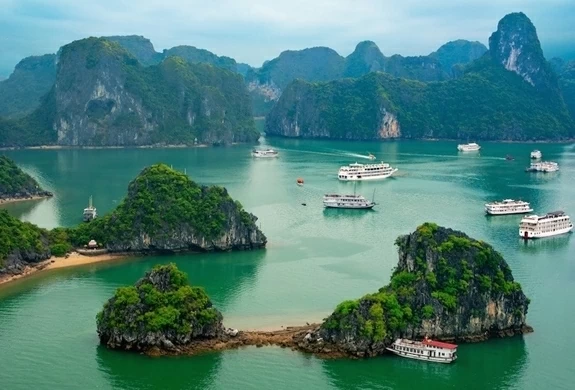 |
| Ha Long Bay. (Source: Touropia) |
Building Quang Ninh's brand through distinctive values
In the context of deeper integration, Quang Ninh's external activities are implemented synchronously on all three pillars: Party diplomacy, State diplomacy, and people-to-people diplomacy, closely following the foreign policy and orientation of the Party, State, and the Ministry of Foreign Affairs.
In this flow, cultural diplomacy is increasingly identified as a method to promote the image and enhance the appeal of the locality on the international stage.
Quang Ninh has issued and implemented Resolution No. 17-NQ/TU dated October 30, 2023, on building and promoting the cultural values and human strength of Quang Ninh; Plan No. 188/KH-UBND dated August 4, 2022, implementing the Cultural Diplomacy Strategy to 2030, and Plan No. 11/KH-UBND dated January 10, 2025, implementing Directive No. 30/CT-TTg.
From cultural and tourism events to investment, trade promotion activities, culture is increasingly integrated more substantively into external activities. Ha Long Carnival, International Yoga Day, Mong Cai - Dong Hung Investment, Trade, and Tourism Fair, promotional activities associated with the Clipper Race, or international tourism seminars have become channels introducing the land, people, culture, and development potential of Quang Ninh.
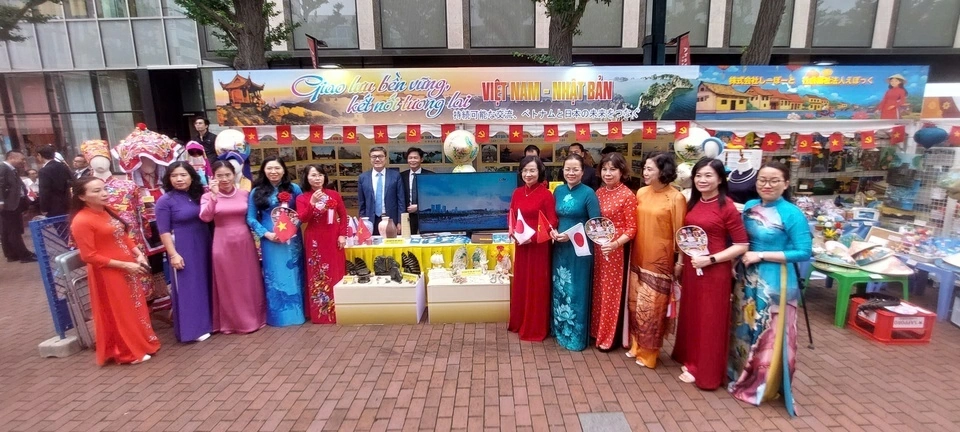 |
| The image of Quang Ninh introduced at the Vietnam Festival in Sapporo (Japan). (Source: Quangninh.gov) |
Conversely, the locality actively brings international partners to Quang Ninh through famtrip, presstrip programs, activities for KOLs, and foreign journalist delegations. The image of Quang Ninh is also introduced at the Vietnam Festival in Sapporo (Japan), research programs, cultural industry promotion in the Republic of Korea, and the Vietnam Film Promotion Program at the Busan International Film Festival.
External information is also expanded in terms of subjects and communication methods. The city strengthens coordination with domestic and international press agencies; cooperates with over 30 central news agencies and newspapers; publishes bilingual Vietnamese - Chinese, Vietnamese - English publications; and coordinates with Vietnamese Representative Missions to introduce potential, strengths, and investment attraction policies.
As a result, the socio-economic development achievements, external activities, culture, tourism, and investment environment of Quang Ninh are more widely conveyed to the international community.
In the future, with the requirement to build Quang Ninh into an international tourism center, a marine economic center, and an international trade gateway of the Northern region, external work is oriented to be more closely linked with development strategy.
The focus is on building Quang Ninh's brand through the distinctive values of Ha Long Bay, Yen Tu, and the unique heritage and culture system; promoting on digital platforms, through international events, and the network of Vietnamese Representative Missions.
The recognition of Ha Long Bay - Cat Ba Archipelago and Yen Tu as World Heritage by UNESCO provides a foundation for Quang Ninh to develop heritage economy, cultural industry, cultural tourism, and high-quality spiritual tourism. Alongside cultural diplomacy, the locality continues to expand relations with potential partners in Japan, Republic of Korea, China, Singapore, the EU, the United States, Australia, and the Middle East; strengthening connections with corporations, financial centers, research organizations, innovation centers, and international business associations.
Green economy, high technology, logistics, seaports, digital transformation, renewable energy, education - training, and tourism are identified as key areas of cooperation.